Email Campaigns and SEO: How to Make Each One Boost the Other
SearchBlueprint · · 9 min read · scored 94/100

Email campaigns and SEO work together when you use one channel's data to strengthen the other. Email subject lines reveal which keywords readers respond to. SEO-driven blog content gives your email list something worth forwarding, sharing, and linking to. Neither channel replaces the other, and neither works as well alone as it does alongside its counterpart.
Most marketing teams still run email and SEO as separate projects with separate calendars. That's a missed opportunity. The same keyword research that shapes a blog post can shape a subject line. The same content that ranks on Google can be resent to a list that already trusts you. This article covers how the two channels actually connect, what to build first, and how to measure whether it's paying off.
How Email Campaigns Impact SEO Performance
Search engines don't read your inbox. Google can't see who opened a campaign or which link someone clicked inside it. So the connection between email marketing and SEO is indirect. It runs through the traffic, content, and reputation your list builds for your website, not through the emails themselves.
Traffic and Engagement Signals
When an email sends someone to your site, that visit becomes something search engines can observe. They can see how long the person stays, how many pages they view, and whether they bounce straight back out. None of this is a confirmed direct ranking factor by itself. But visitors who explore several pages and come back later send a pattern of their own. That pattern correlates with rankings that hold up over time.
Backlinks and Shares Your Best Emails Earn
Backlinks are still one of the clearest trust signals a page can earn. Google Search Central explains that its crawlers primarily discover new pages by following links from pages already in the index. That means content that gets shared, quoted, or linked to after an email send is handing Google exactly what it needs. It finds and re-crawls that page sooner. An email to an engaged, relevant list is one of the reliable ways to put a new article in front of readers. Those are the readers likely to link to it.
List Growth from Pages That Already Rank
The traffic works the other way too. A landing page that ranks well is a steady source of new subscribers, provided there's a clear signup form on it. Organic visitors who found you through a search are often better subscribers than ones from a cold list. They arrived already looking for what you offer. Treating search visibility and list growth as one funnel, rather than two separate campaigns, is one of the ideas covered in why cross-channel SEO strengthens brand visibility, and how to prove it.

Building One Content Strategy for Email Campaigns and SEO

The fastest way to combine email campaigns and SEO isn't a new tool. It's using the research you already have twice instead of once.
Share One Keyword List Across Both Channels
If you already run keyword research for SEO, you already know which topics, questions, and phrases your audience searches for. Those same terms belong in subject lines, preview text, and email body copy. Use them the way a reader would say them out loud, not stuffed in. Google's own leaked-and-later-confirmed ranking discussions pushed SEO commentators to focus less on exact keyword density and more on topical relevance and brand recognition. The SEO strategist Rand Fishkin summed up the shift bluntly, writing that he was "a bit worried that E-E-A-T is 80% propaganda, 20% substance." That's because plenty of powerful brands rank well with little demonstrated expertise behind the page. The practical takeaway for a smaller business is the opposite of discouraging. Consistent, recognizable, useful content sent to a real audience builds the kind of brand signal that a one-off blog post can't.
Turn Best-Performing Content Both Ways
Your analytics already tell you which blog posts rank and which emails get opened and clicked. Feed that data back into each channel:
- Repurpose a high-ranking blog post into a short email that links back to the full piece.
- Turn a high-open-rate email into a blog post. Add more detail, more internal links, and more room to rank for long-tail variations of the same topic.
- Update an older post with the questions your list has actually asked in replies, then resend a link to it as "updated" content.
This is also where basic on-page discipline pays off twice. A landing page built with the fundamentals covered in how to improve website SEO for higher organic traffic in 8 steps is easier to rank. It's also easier to convert once an email sends someone to it.
| Email Tactic | What You Send | Primary SEO Benefit | Where to Start |
|---|---|---|---|
| Newsletter roundup | A short digest linking to 2-3 recent posts | Fresh referral traffic and repeat visits to ranking pages | Schedule it around your regular publishing cadence |
| Content upgrade email | A gated resource tied to a specific blog post | Longer dwell time and more return visits to that URL | Attach it to your highest-traffic existing post |
| Re-engagement campaign | A message to subscribers who haven't opened in months | Recovers otherwise-wasted list reach into fresh clicks | Segment by last-open date before resending |
| Post-launch announcement | News about a new page, tool, or feature | Early traffic and shares that speed up indexing | Send the day the page goes live, not weeks later |
Metrics That Prove Email Campaigns and SEO Are Working Together
If you can't separate email-driven visits from organic ones, you can't tell whether the two channels are actually reinforcing each other. That separation starts with tagging. Every link you put in an email should carry a UTM parameter, built with a tool like a free UTM builder. That way, Google Analytics can report email traffic on its own line instead of lumping it into "direct."
Once tagging is in place, a handful of numbers tell you whether the strategy is working:
| Metric | What It Measures | Where to Find It | What a Healthy Trend Looks Like |
|---|---|---|---|
| Email-attributed sessions to blog/landing pages | How much of your site traffic email is actually driving | Analytics, filtered by UTM source | Steady or growing share of total sessions |
| Backlinks or shares after a send | Whether email recipients amplify your content elsewhere | Backlink or social-listening tools, checked in the days after a send | New referring domains appearing within a week of sends |
| Branded search volume | Whether your list is searching your brand name directly | Search Console, or keyword tools tracking your brand terms | Small upticks around and after major campaigns |
| List growth from organic pages | Whether ranking pages are converting visitors into subscribers | Form or signup analytics segmented by traffic source | Organic-sourced signups growing alongside overall organic traffic |
None of these need to move dramatically in a week. What matters is the direction. If email-driven sessions, referral links, and branded search are all trending up together, the two channels are compounding. They aren't competing for the same budget and attention.

Common Mistakes That Undercut Email Campaigns and SEO
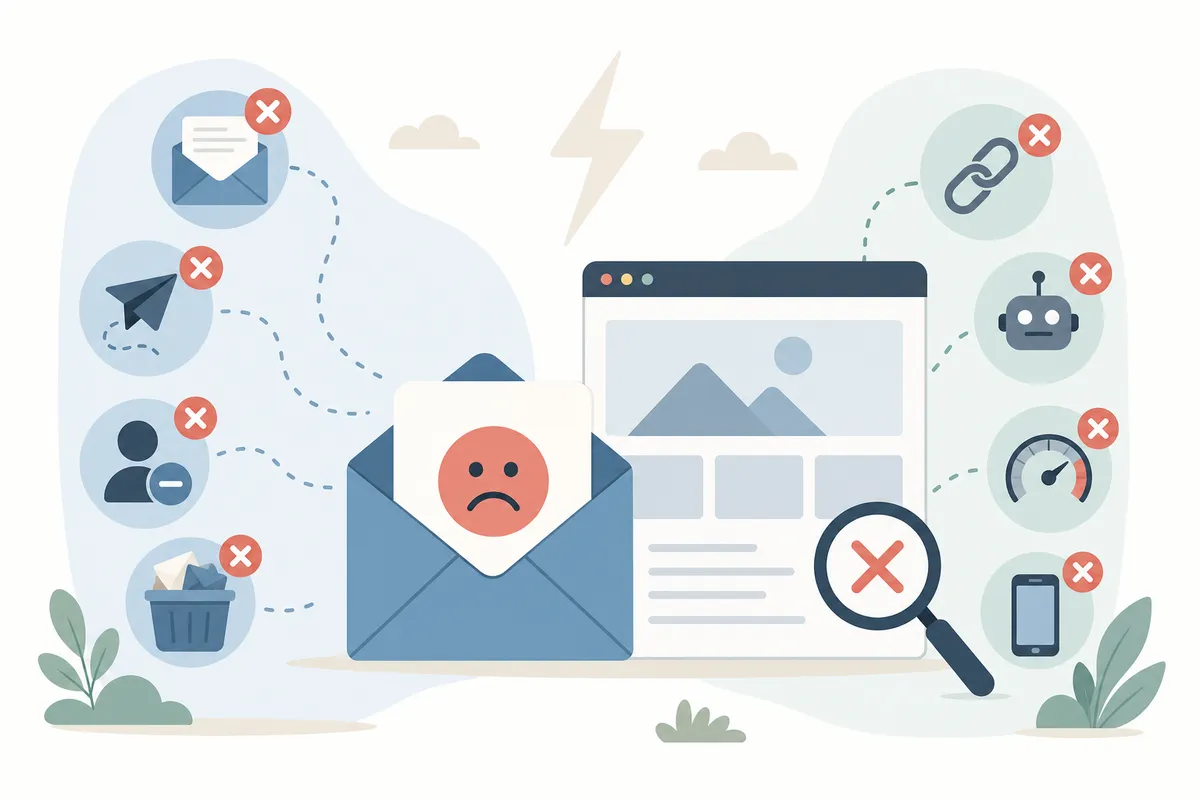
Most of the ways email and SEO efforts cancel each other out are avoidable. Most of them are basic execution mistakes rather than strategic ones.
- Sending to a cold, unsegmented list. A generic blast to everyone gets ignored. Low engagement on repeated sends can hurt your sender reputation, which then hurts the deliverability of every future email.
- Never tagging links. Without UTM parameters, email traffic shows up as "direct" in analytics. You lose the ability to prove the channel is working at all.
- Publishing content that only ever goes out once. A blog post that's emailed once and never mentioned again wastes the compounding value both channels are supposed to create together.
- Ignoring basic on-page hygiene. Broken links, missing meta descriptions, and thin content undercut the SEO value of a page. They also undercut the experience of anyone who clicks through from an email. Many of these are covered in 16 common SEO mistakes to avoid, and how to fix each one.
- Treating personalization as optional. Research cited by email platform Twilio found that 66% of consumers say impersonalized content discourages them from buying. Separate data from BrightEdge found personalized email can produce transaction rates several times higher than generic sends. A list treated as one undifferentiated group underperforms both as an email channel and as a source of engaged, SEO-friendly traffic.
Google is estimated to handle more than 90% of global search traffic. Worldwide email volume is estimated at roughly 333 billion messages a day in 2022, projected by Statista to approach 392.5 billion daily by 2026. Both channels are too large and too competitive to run on guesswork. Customer trust compounds the case for getting the basics right. Research cited across the email marketing industry puts the share of consumers who read reviews before buying at 93%. That means the trust signals your content earns, reviews, shares, mentions, matter to both a search engine and a subscriber deciding whether to click.
FAQs
Does email marketing directly improve my SEO rankings?
Not directly. Search engines can't see your email opens or clicks. What they can see is the traffic, engagement, and backlinks that a well-run email campaign generates for your website. Those are real signals that support rankings over time.
What's the best way to start combining email campaigns and SEO?
Start with keyword research you've already done for SEO and reuse it in your next few subject lines and email topics. Then tag every link in your emails so you can measure the traffic separately from organic search in your analytics.
Should I turn blog posts into emails, or emails into blog posts?
Both, depending on which performs better first. A high-ranking blog post makes a strong email digest. A high-open email on a topic with no dedicated page is a sign you should write one. It proves there's demand for that content.
How do I know if my email campaigns are actually helping my SEO?
Track email-attributed sessions to your key pages. Watch for new backlinks or shares in the days after a send, and monitor branded search volume around major campaigns. If all three trend up together over a few months, the channels are reinforcing each other.
Does the size of my email list matter for SEO?
Less than engagement does. A smaller, genuinely interested list that opens, clicks, and shares your content is more valuable for SEO than a large, disengaged one. That's because search engines and readers both respond to real engagement, not raw subscriber counts.
Turn Your Next Send Into an SEO Asset
Your next newsletter can do more than fill inboxes. Written around the same keyword research you already use for SEO, it becomes another asset feeding your rankings. It's not a one-time email that disappears after a day. Start by pulling the three topics your subscribers click most and checking whether your site already ranks for them. The fastest way to see where email campaigns and SEO already overlap on your own site is simple. Talk to the team behind a free sample SEO report.
Resources / References
Sources
About the author
SearchBlueprint researched, wrote and scored this article with the content pipeline our customers run on their own sites. The score in the byline is what our content engine gave this page before it published. Nothing here is reviewed by hand, which is the point: it is the product's output, published where anyone can check it.