Free Domain Authority Checker: What Your Score Really Means
SearchBlueprint · · 9 min read · scored 95/100
A free domain authority checker tells you how strong a website's backlink profile looks to SEO tools like Moz, Ahrefs and Semrush, on a scale of roughly 1 to 100. The score is not a Google ranking factor, but it is the fastest way to compare your site against competitors and to vet link prospects before you pitch them.
What a domain authority score actually measures
Domain authority is a concept the SEO industry invented to put a number on a site's overall strength. Moz introduced the idea, and the name of its metric stuck as shorthand for the whole category. Every version of the score leans on the same core question: how many other websites link to this domain, and how trusted are those sites?
Semrush adds a useful modern note: sites with higher authority scores tend to rank higher in Google and get referenced more often by AI search tools such as ChatGPT, Perplexity and Google AI Overviews. That makes the score a decent proxy for visibility, even though no search engine reads it directly.
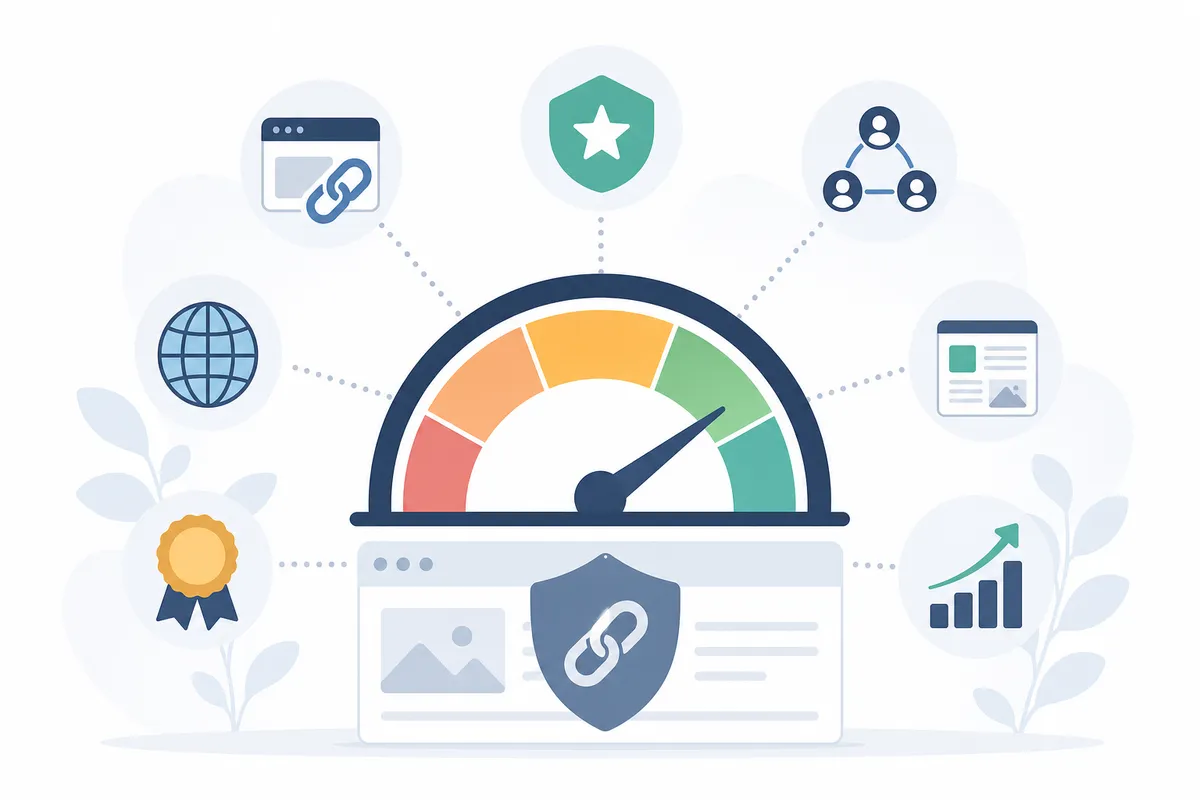
Three tools, three formulas
The three big scores look interchangeable. They are not. Each row below stands on its own, so use it to read any score you meet in the wild.
| Metric | Tool | Scale | Built from | What sets it apart |
|---|---|---|---|---|
| Domain Authority (DA) | Moz | 1 to 100 | Link Explorer backlink data plus a machine-learning model that predicts how likely a site is to rank | The original metric; Moz introduced domain authority to the SEO industry |
| Domain Rating (DR) | Ahrefs | 0 to 100 | The quantity and quality of unique referring domains, weighted by how many other sites those domains link out to | Backlinks only; Ahrefs says DR ignores traffic, link spam and domain age |
| Authority Score (AS) | Semrush | 1 to 100 | Eight weighted signals across link power, organic traffic and spam checks | Counts real search traffic and flags manipulated link patterns; Semrush updates it every two weeks |
Because the formulas differ, the same site gets different numbers in each tool. That is normal. Pick one tool for a project and stay with it, so every comparison is apples to apples.
Why Google says it does not rank you
Google representatives have consistently denied that domain authority is a ranking factor, and you will not find the term anywhere in Google's own Search Central documentation. Ahrefs notes that Google's John Mueller has described a sitewide score that maps to similar things, which is probably why the metric still feels predictive.
It often is. When Ahrefs studied the correlation between Domain Rating and keyword rankings across 218,713 domains, the two correlated well. Ahrefs is careful to call that a correlation study, not proof of causation, and you should read every authority score the same way: a thermometer, not a thermostat.
Where to check domain authority for free
You do not need a paid subscription to get a credible score. Five well-known tools return one at no cost, and each free tier has a different shape.

| Tool | Score shown | Free limit | What you get with the score |
|---|---|---|---|
| Moz Domain Analysis | DA | One domain at a time | The original Domain Authority figure, straight from the source |
| Ahrefs Website Authority Checker | DR | One domain at a time, plus DR as you browse via the free SEO Toolbar and account | A free DR API for pulling scores in bulk |
| Semrush Website Authority Checker | AS | One domain per check | Total backlinks, referring domains, estimated monthly traffic, 12-month growth, top pages by backlinks and competitor scores |
| DAPAChecker.org | DA and PA, plus DR and UR | 5 URLs per submission, up to 30 a day for registered users | Spam score, domain age and an Excel export |
| SmallSEOTools DA Checker | DA and PA | 5 URLs at once, no sign-up | Referring domains, inbound and outbound links, IP address and region |
The paid tiers only matter once you need volume. DAPAChecker.org lists a Starter plan at $7 per month and a Growth plan at $15 per month, or $49 and $139 per year, with premium submissions of up to 1,000 URLs at once. SmallSEOTools' paid plans allow up to 20 domains per check, with customized plans reaching 200. Ahrefs' entry-level Starter plan is listed at $29 per month. If you are checking one site and a handful of rivals a few times a month, the free versions cover you completely.
What counts as a good domain authority score
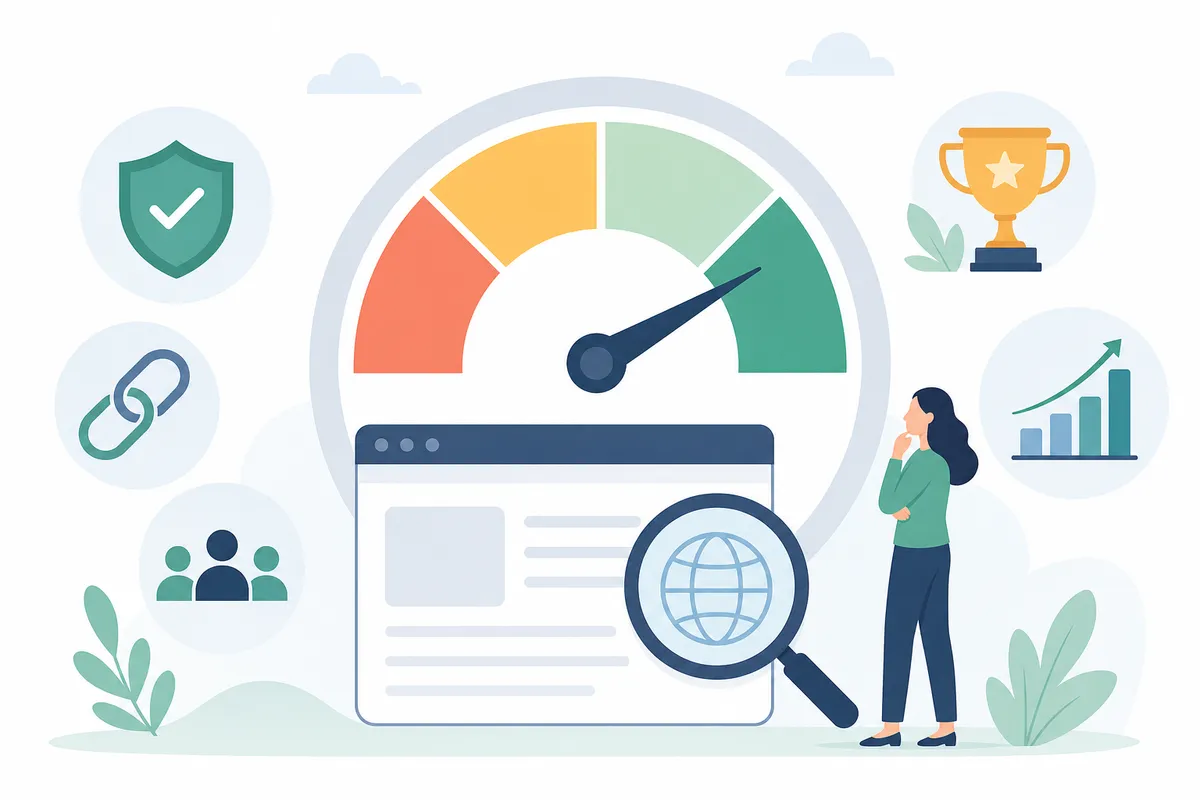
There is no universal pass mark. Semrush puts it plainly: a score of 30 might be strong in a small niche and weak in a competitive one. SmallSEOTools' guide calls 50 to 60 good and anything above 60 outstanding, but treat that as a rough national average, not a target for your market.
The number is relative by design
These scores are logarithmic and comparative. Even the giants sit close together: Ahrefs' own tool page notes moz.com at DR 91 against ahrefs.com at DR 88. Both Ahrefs and Semrush land on the same rule of thumb, and it is the only one worth keeping: your score is good if it is higher than, or comparable to, similar sites in your niche.
Benchmark against the sites that outrank you
Pull the five domains sitting above you for your most important keyword and run them through the same checker. While you are at it, compare their reach with a website traffic checker that estimates organic visits, because a rival with a similar authority score but triple your traffic is winning on content, not links. That pairing tells you whether your gap is a link problem or a page problem.
How to use a free domain authority checker well
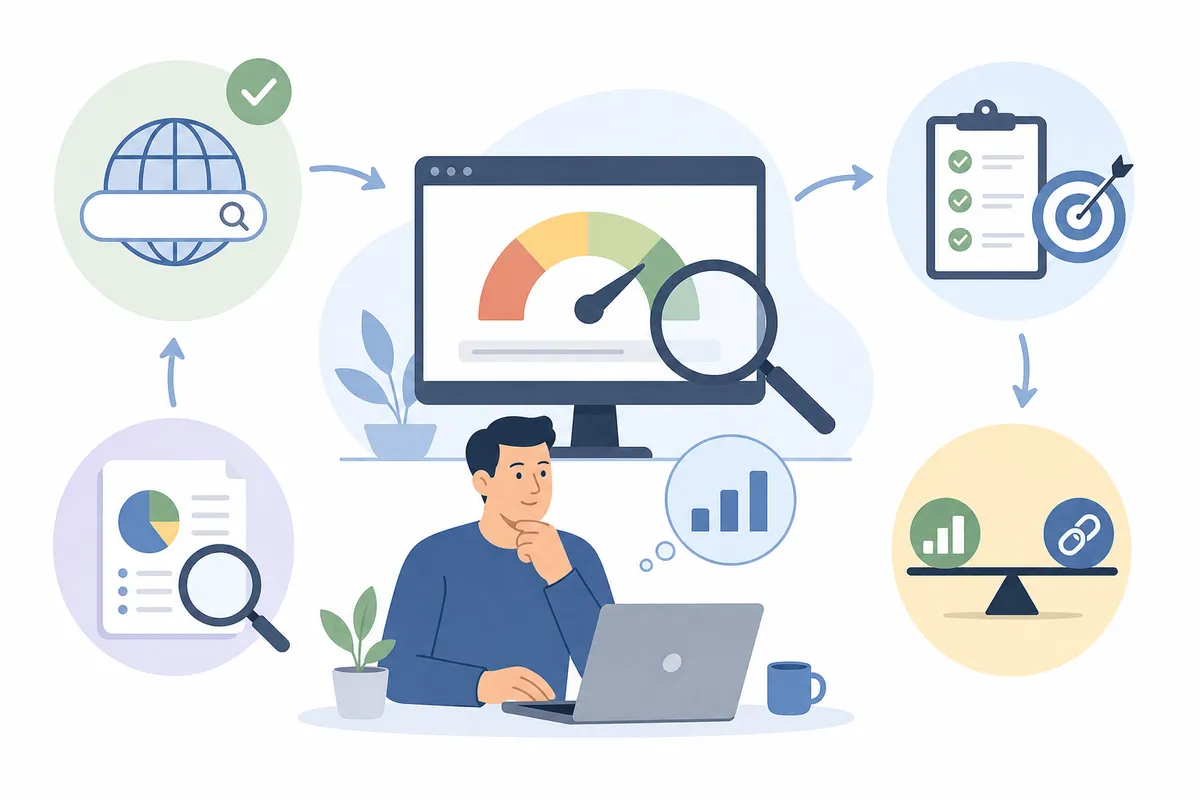
The score becomes useful the moment you stop treating it as a grade and start treating it as a filter. Four jobs come up again and again.
Track competitors, not just yourself
A score gap between you and a competitor is a rough measure of link popularity. Watch it alongside actual positions, because rankings are the outcome you are paid for. A free rank checker that shows where any domain stands for a keyword closes that loop: authority explains part of why a rival outranks you, and the SERP shows by how much.
Vet link prospects before outreach
Semrush suggests a practical benchmark for outreach: links from sites scoring higher than your own tend to help your profile most. Ahrefs adds a checklist beyond the score, and it is worth running in full. Do they have quality backlinks of their own? Do they publish real content? Do they get organic traffic? Are they topically relevant to you? Will the site still exist in a year? A quick look at a domain's age, creation and expiry dates helps with that last question, since a site registered eight weeks ago with a suspiciously high score deserves skepticism.
Screen incoming offers
Guest post pitches and paid placement offers arrive with inflated claims. Check the pitching site's score before replying, and look for the manipulation patterns Semrush screens for: no keyword rankings at all, an unusually high share of dofollow referring domains (over 90 percent), or many referring domains sharing one IP address. A big backlink profile with no traffic behind it is a red flag, not an asset.
Watch the trend, not the tick
Scores move slowly. Semrush recalculates Authority Scores for all domains every two weeks, so daily checking tells you nothing. Check your own domain every few weeks. A slowly rising number says your link and content work is landing. A flat or falling one says the current approach needs a rethink.
How to raise domain authority without gaming it
Every credible source agrees on the mechanism. Ahrefs states that earning backlinks from more unique websites, meaning new referring domains, is the only way to improve its Domain Rating. Repeat links from the same site barely move it. In Ahrefs' analysis of roughly 920 million pages, referring domains were also the strongest correlating backlink factor for rankings, which is why this one input dominates every formula.
Three habits do the work:
- Earn new referring domains on purpose. Digital PR, original research, unlinked brand mentions and broken link building all target the same outcome: a site that has never linked to you, linking to you.
- Publish pages worth citing, and make them technically clean. Pages that rank attract links over time. Before promoting one, run it through a free meta checker that grades your titles and headings, because a page with a broken title tag rarely earns the click that earns the link.
- Keep the profile clean. Paid links, link exchanges and private blog networks create exactly the patterns Semrush's spam signals catch, and Authority Score is built to discount them.
One honest caveat, straight from Ahrefs: improving your site's authority should never be the primary goal. Build links to the specific pages you want to rank. The domain score follows as a side effect, and chasing the number directly is how sites end up buying links that get discounted anyway.
FAQs
Is domain authority a Google ranking factor?
No. Google representatives have consistently said they do not use domain authority, and the term appears nowhere in Google's documentation. Ahrefs' study of 218,713 domains found authority scores correlate well with rankings, so the metric is a useful predictor, just not a lever Google reads.
Why does my site score differently in Moz, Ahrefs and Semrush?
Each tool has its own crawler, its own link index and its own formula. Moz uses a machine-learning model trained to predict rankings, Ahrefs counts only backlink quantity and quality, and Semrush blends links with traffic and spam checks. Compare scores within one tool only.
What is a good domain authority score for a new website?
New sites start near the bottom of the scale because they have few referring domains, and that is expected. A good score is one that is comparable to, or higher than, the sites ranking for your target keywords, so benchmark against your niche rather than a fixed number like 50.
How many URLs can you check at once for free?
Typically five. DAPAChecker.org allows 5 URLs per submission with a 30-a-day limit for registered users, and SmallSEOTools accepts 5 at once with no sign-up. Bulk checking of hundreds or a thousand URLs sits behind paid plans listed from $7 a month.
How often do domain authority scores update?
Semrush states it refreshes Authority Scores for all domains every two weeks; other tools update on their own index cycles. Since new links take time to be crawled and counted, checking monthly is enough to see a real trend.
Check your score, then map the gap
A free domain authority checker gives you the headline number in seconds; it cannot tell you which pages, links or fixes will move it. Run your site and your top three rivals through one today, write the scores down, and re-check in a month. If you want the gaps behind the number mapped page by page, talk to the team and start with a sample SEO report built from a real site audit to see exactly what that looks like.
Resources / References
Related reading: Free Moz Domain Authority Checker: What Your Score Really Means.
Sources
About the author
SearchBlueprint researched, wrote and scored this article with the content pipeline our customers run on their own sites. The score in the byline is what our content engine gave this page before it published. Nothing here is reviewed by hand, which is the point: it is the product's output, published where anyone can check it.