Google Algorithms Explained: How Rankings Really Work
SearchBlueprint · · 12 min read · scored 90/100

Google algorithms explained simply: they are the automated systems that crawl, index, and rank pages. Then they decide which results actually answer a search. Google blends hundreds of signals, from content relevance to backlinks to page speed. It adjusts these systems continuously, rather than on any fixed schedule.
Google Algorithms Explained: Crawling, Indexing, and Ranking
There is no single Google algorithm. What people call "the algorithm" is really a layered set of systems that work in sequence: crawling, indexing, and serving results. Google's own Search Central documentation lays that out. Google does not accept payment to crawl a site more often or rank it higher; every stage runs programmatically.
Crawling comes first. Automated programs called crawlers, chiefly Googlebot, follow links from known pages to new ones. They also read a submitted XML sitemap to find URLs worth visiting. Google renders each page with a recent version of Chrome. That lets it see content that JavaScript adds after the page first loads.
Indexing comes next. Google analyzes the text, images, and video on a crawled page. It groups near-duplicate pages together and picks one canonical version to represent the group. Signals collected here include language, country relevance, and general usability. They get stored in the Google index, a database spread across thousands of machines. Not every crawled page gets indexed; thin or duplicate content is often skipped entirely.
Serving is the stage most people actually mean by "ranking." When someone runs a search, Google's systems scan the index. They return the pages judged most relevant and highest quality for that specific query. Results are adjusted for the searcher's location, device, and language.

The Ranking Factors Google's Algorithms Actually Weigh
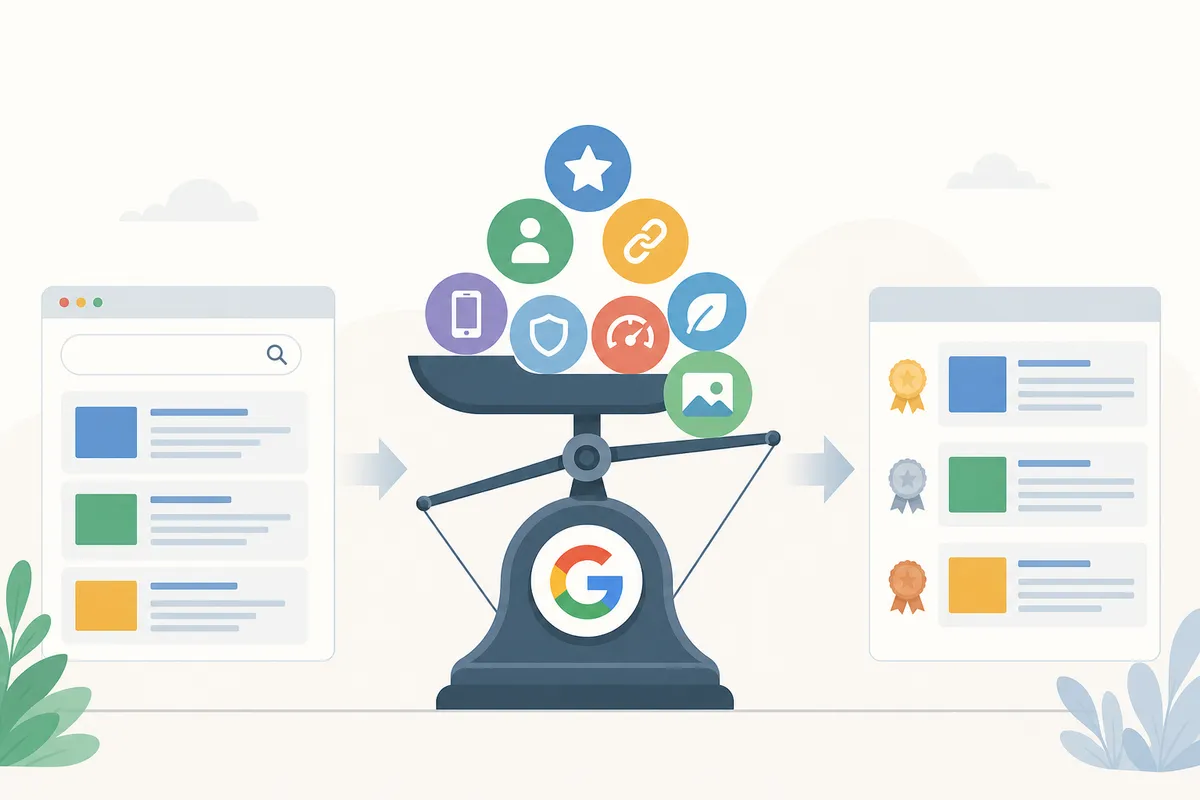
Google has never published a complete list of ranking factors. TechTarget's reporting on the algorithm puts the number at more than 200 specific signals, grouped under a handful of broader categories. Five of those categories cover most of what actually moves a page up the rankings: relevance, quality, experience, authority, and context.
Content Relevance and Search Intent
Relevance starts with matching what a searcher actually wants, not just the words they typed. Google's language systems correct spelling, understand synonyms, and try to detect intent, whether informational, commercial, transactional, or navigational. A search for "best running shoes" pulls up comparison and review content. A search for a specific shoe model and size pulls up a product listing. Getting this wrong is why some pages rank and others don't, even when both cover the same keyword. Google's crawlers also weigh where a term sits: in the title tag, the H1, and the body copy. None of those placements override an actual intent mismatch, though.
Content Quality and E-E-A-T
Google's Search Quality Evaluator Guidelines describe Experience, Expertise, Authoritativeness, and Trustworthiness, known as E-E-A-T. Human reviewers use this framework to judge whether content deserves to rank. It is not a single scored metric inside the algorithm. Still, it maps closely to signals the ranking systems do weigh. Those include clear sourcing, accurate claims, and content written by someone who plainly understands the subject. Thin, spun, or duplicated content tends to lose here first. Google's Helpful Content system was folded into the core ranking systems in 2023. It specifically targets pages written to attract search traffic rather than to genuinely help the reader. The March 2024 core update was aimed in part at reducing exactly that kind of unhelpful, unoriginal content.
Page Experience and Core Web Vitals
Google measures how a page actually performs for a visitor through Core Web Vitals: loading speed, interactivity, and visual stability. Details are on web.dev. Industry guidance for site owners commonly puts the practical bar at a load time of 2.5 seconds or less. Mobile-friendly design, no intrusive pop-ups, and HTTPS round out the baseline expectations. None of these alone will out-rank a page with better content. But a slow, broken mobile experience can quietly cap how high a genuinely good page climbs.
Backlinks and Trust Signals
Backlinks remain one of the clearest trust signals Google's systems read. A link from a relevant, reputable site tells the algorithm that someone outside your own domain vouches for the page. That is a large part of why links still move rankings. This is especially true on competitive commercial terms, where dozens of sites cover the same subject. Quality outweighs volume. A handful of links from established sites in your niche typically carries more weight than a large batch from unrelated, low-authority domains. Manipulative link schemes, meanwhile, remain squarely inside Google's spam policies.
Topical Authority and Semantic Relevance
Google also rewards sites that go deep on a subject rather than covering it in one thin page. A domain with genuine breadth on a topic tends to outrank a single isolated article. It answers the adjacent questions a reader would ask next. That is the core idea behind how topics beat individual keywords in modern search. Building that kind of coverage usually means publishing a cluster of related pages that link to each other. That beats chasing one exact-match keyword.
Context: Location, Device, and Personalization
Finally, Google adjusts results based on where a search happens and what device it happens on. Sometimes it also weighs a signed-in user's own search history. A search for a local service in Singapore returns different results than the same search in Sydney. A mobile query for an urgent need often surfaces map results that a desktop search would not. None of this changes what content deserves to rank in principle. It changes which version of "best" applies to that specific searcher, at that specific moment.
| Category | What It Measures | Example Signal | Why It Matters |
|---|---|---|---|
| Relevance | Match between the query and the page | Keyword and topic alignment in title, headings, and body | Wrong-intent pages rarely rank regardless of quality |
| Quality (E-E-A-T) | Expertise, accuracy, and trustworthiness | Clear sourcing, author expertise, original insight | Weeds out thin or duplicated content |
| Page experience | How the page performs for a visitor | Core Web Vitals, mobile usability, HTTPS | Caps how high a slow or broken page can climb |
| Backlinks | External trust and popularity | Links from relevant, reputable sites | One of the oldest and strongest trust signals |
| Topical authority | Depth of coverage across a subject | Interlinked content clusters, not one isolated page | Signals genuine expertise rather than a one-off post |
A History of Major Google Algorithm Updates
Google has shipped thousands of changes to its ranking systems since 2003, most too small to notice. A handful reshaped the results page enough that the SEO industry gave them names. Tracking that history explains why certain tactics from a decade ago no longer work.
The Foundational Updates (2003-2015)
Florida, launched September 18, 2003, was one of the earliest widely felt updates, targeting pages stuffed with thin content. Panda followed on February 24, 2011, demoting low-quality and duplicate content sitewide rather than page by page. Penguin arrived April 24, 2012, going after manipulative link building and keyword stuffing specifically. The Page Layout Algorithm launched January 19, 2012. It targeted pages so covered in ads that visitors had to scroll past them to reach content. Google's own figures put the affected share of sites at roughly 1%. Hummingbird, launched August 22, 2013, rebuilt how Google parsed natural-language queries to better match intent rather than exact wording. Mobilegeddon arrived on April 21, 2015, and began prioritizing mobile-friendly pages in mobile search results. It was an early sign of how much mobile performance would come to matter for ranking.
The Machine-Learning Era (2015-2022)
RankBrain, introduced in 2015, was Google's first major machine-learning system inside ranking. It was built to interpret queries it had never seen before by comparing them to similar ones. Fred, in March 2017, targeted sites overloaded with ads and thin, revenue-first content. Google shifted to mobile-first indexing on March 26, 2018, so its crawlers now primarily judge the mobile version of a page. BERT, also 2018, improved how Google's systems understood the context of words in longer, conversational queries. MUM followed in 2022, extending that language understanding to more complex, multi-part questions.
Core Updates and Continuous Change (2023-2026)
Since 2023, Google has run broad core updates several times a year. It has also run separate spam updates and Helpful Content updates, now folded into the core ranking systems. The November 2023 Reviews Update, which began November 8 and completed December 7, focused specifically on review content. The March 2024 core update ran from March 5 to April 19, a 45-day rollout. Google described its goal as reducing unhelpful, unoriginal content in search results by roughly 40%. More recent rollouts show the same rhythm. The August 2025 spam update took 26 days to complete. The December 2025 core update finished in 18 days, and the March 2026 core update rolled out over about two weeks. A February 2026 update broke from the usual pattern by targeting the Discover feed specifically rather than general search results. None of these updates target one single tactic forever; each one recalibrates the same relevance, quality, and experience signals covered above.
| Update | Launched | What It Targeted | Still Relevant Because |
|---|---|---|---|
| Panda | February 24, 2011 | Thin and duplicate content | Content depth is still a core quality signal |
| Penguin | April 24, 2012 | Spammy, manipulative link building | Backlink quality still outweighs backlink volume |
| Hummingbird | August 22, 2013 | Literal keyword matching over intent | Search intent still decides what ranks |
| Mobilegeddon | April 21, 2015 | Non-mobile-friendly pages | Mobile-first indexing now judges most sites by default |
| Helpful Content / Core Updates | Ongoing since 2022 | Content written for search engines, not readers | Directly shapes today's E-E-A-T expectations |

How Often Google Updates Its Search Algorithm
Google changes its ranking systems constantly. Industry reporting on the topic puts it plainly: Google makes minor tweaks several times a day. The vast majority go unnoticed and unannounced. Tracked update histories show the same pattern at the larger end. A handful of named updates a year used to be typical. Now it is a steady sequence of core updates, spam updates, and topic-specific updates, like the 2026 Discover core update. These arrive every few months rather than a couple of times annually.
Google does not confirm every change. SEO professionals typically notice an update first through sudden ranking or traffic shifts. They then compare notes before Google's own channels confirm or deny a rollout. Core updates are the ones worth watching closely. They touch how Google reads quality and relevance sitewide, rather than fixing one narrow issue. A site with genuinely strong content usually recovers within one or two subsequent updates. A site built around thin or manipulative content, though, tends to keep sliding.

Ranking Factors That Are Actually SEO Myths
Not everything repeated in SEO forums is confirmed. Industry analysis of the algorithm draws a clear line between factors Google has confirmed and ones that remain debated without solid evidence. Domain age, for instance, does not help on its own; an old domain with weak content still ranks poorly. Bounce rate is disputed too. Google has publicly downplayed it as a ranking signal. But a set of internal documents that leaked in May 2024 suggested it may factor in more than Google has stated. The actual weight remains unclear. Keyword density, the old practice of hitting a target percentage of keyword mentions, is not a ranking factor either. It comes back to what role keywords still play: topical relevance, not repetition.
| Factor | Status | What the Evidence Shows |
|---|---|---|
| Search intent match | Confirmed | Directly shapes which results Google surfaces for a query |
| Backlink quality | Confirmed | Links from relevant, authoritative sites carry real weight |
| Domain age | Disputed / not confirmed | An older domain with weak content still ranks poorly |
| Bounce rate | Disputed | Google downplays it; leaked 2024 documents suggest some effect, weight unclear |
| Keyword density | Not a ranking factor | Topical relevance matters; hitting a percentage does not |
How to Align Your Site With Google's Algorithms
Chasing each individual update is a losing game, since the systems recalibrate constantly and Google rarely explains exactly what changed. A step-by-step plan that actually works focuses on the same handful of fundamentals every update tends to reinforce.
Build for Search Intent, Not Just Keywords
Start by checking what is already ranking for a term before writing anything. If the top results are comparison guides, a product page targeting the same term is fighting the wrong intent. That holds no matter how well it is built. Building an intent-driven SEO strategy means mapping each page to one clear intent, informational, commercial, or transactional. It also means matching the format searchers already expect for that query.
Earn Real Backlinks and Topical Authority
Publish content genuinely worth linking to: original data, first-hand experience, or a clearer explanation than what already ranks. Then reach out to sites that would plausibly cite it. Pair that with a real content cluster: a handful of interlinked pages covering a subject from different angles. That builds authority faster than one long article trying to cover everything at once.
Fix the Technical and Mobile Basics
Google evaluates the mobile version of a page by default. Understanding why Google ranks by mobile SEO first is not optional for most sites. Confirm pages load in roughly 2.5 seconds or less and pass Core Web Vitals. They should also render cleanly, without pop-ups blocking content on a phone screen. None of this replaces strong content, but a broken mobile experience puts a ceiling on how far good content can climb.
Treat AI-Assisted Content Carefully
AI tools can speed up drafting. But Google's Helpful Content systems specifically watch for content produced primarily to attract search traffic rather than to help a reader. Understanding what Google actually rewards from AI-assisted content matters here. The tool used to write a draft is less important than whether a knowledgeable person reviewed it. That person added real insight and stands behind the claims made. Unreviewed, mass-produced AI content is exactly the pattern the Helpful Content system and the March 2024 core update were built to catch.
FAQs
What is the Google algorithm in simple terms?
It is not one program but a layered set of systems. Those systems crawl the web, index what they find, and rank pages for each search query. The ranking itself uses hundreds of signals covering relevance, quality, and page experience.
How many Google algorithms are there?
Google has never published an exact count. Named systems like Panda, Penguin, RankBrain, and BERT each handled a different part of ranking. They now work together inside the broader core ranking systems, rather than as separate standalone algorithms.
How often does Google update its search algorithm?
Minor adjustments happen multiple times a day, most unannounced. Larger core updates, the ones that noticeably move rankings, typically roll out several times a year. They can take anywhere from about two to six weeks to fully complete.
Can you optimize for a specific Google algorithm update?
Not reliably. Google rarely details exactly what an update changed. By the time SEOs reverse-engineer a pattern, the next update has usually shifted things again. Building consistently around search intent, content quality, and page experience holds up better than reacting to any single update.
What's the difference between a core update and a spam update?
A core update recalibrates how Google judges relevance and quality across the board, and can affect well-built sites alongside weak ones. A spam update specifically targets manipulative tactics, like link schemes or scaled low-quality content. It mainly affects sites already violating Google's spam policies.
See How Your Own Site Measures Up
Google algorithms are now explained, from crawling through the latest core update. The next useful step is checking where your own site actually stands against these same signals. Look at a sample SEO report to see exactly what a full audit surfaces. Then talk to the team about applying it to your own domain.
Resources / References
Sources
About the author
SearchBlueprint researched, wrote and scored this article with the content pipeline our customers run on their own sites. The score in the byline is what our content engine gave this page before it published. Nothing here is reviewed by hand, which is the point: it is the product's output, published where anyone can check it.