Lead Generation SEO: How to Turn Rankings Into Leads
SearchBlueprint · · 14 min read · scored 89/100

Lead generation SEO means ranking pages for the searches your future customers run when they're close to buying. Then it converts that traffic into qualified inquiries your sales team can work, not just visits. It differs from traffic-focused SEO in which keywords you chase, what each page asks visitors to do, and how you measure success.
What Is Lead Generation SEO?

Lead generation SEO is search engine optimization aimed at one outcome. It gets a visitor to hand over their contact details or start a sales conversation. Regular SEO often stops at rankings and traffic. Lead generation SEO keeps going until someone fills out a form, books a call, or requests a quote.
The practice sits on three pillars. First, you target keywords that signal someone is close to a buying decision, not just researching a topic out of curiosity. Second, you build pages structured around what that specific searcher needs next, proof, pricing, or a clear next step. Third, you track the outcome all the way to a qualified lead, not just a session in your analytics tool.
This matters because traffic and leads are not the same thing. A blog post that ranks for a broad, informational term can pull in thousands of visitors and produce almost no inquiries. Most of those readers were never going to buy. A service page ranking for a narrower, intent-heavy phrase might get a fraction of the traffic and outproduce it on leads. If you're new to how search demand actually breaks down by intent, a complete keyword research guide is a useful starting point. Read it before you build a lead-gen program on top of it.
Where lead generation SEO gets interesting is the handoff between marketing and sales. A visitor who converts through a lead-gen page isn't done being nurtured. They're handed to a rep, a booking calendar, or a sales sequence. That means the SEO program has to be judged by what happens after the click. It's not just about where the page sits in the results.
How Lead Generation SEO Turns Search Traffic Into Leads
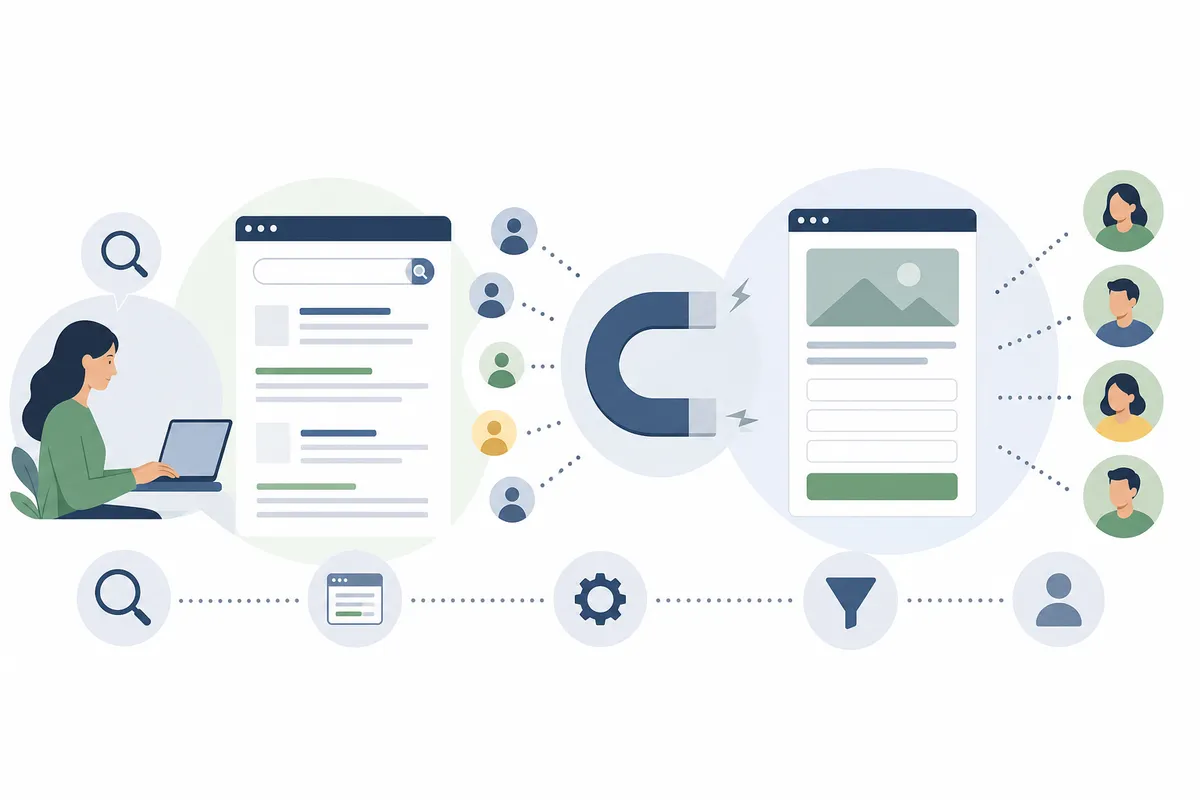
The Path From Search to Inquiry
A visitor doesn't go from "typed a search" to "signed a contract" in one step. They move through stages, research, comparison, evaluation, decision, and each stage calls for a different kind of page. Someone searching a broad, educational phrase wants an explanation. Someone searching "[service] pricing" or "[service] vs [competitor]" wants a comparison and a number. Treat both searches the same way and you'll lose the educational visitor to a hard sell. Or you'll lose the ready buyer to a page that makes them dig for an answer.
Content built around these stages needs a home for every keyword you target. Keyword discovery that surfaces terms worth ranking for matters as much as writing the page itself. See how to find keywords worth ranking for for the process. Skip that step and you end up with content that ranks for terms nobody with buying intent actually searches.
Why AI-Powered Search Results Now Matter Here Too
Search results aren't only ten blue links anymore. Google's AI Overviews and tools like ChatGPT and Perplexity now answer many questions directly. They pull from pages that state facts clearly and can be quoted out of context. For lead generation SEO, that changes what "ranking" is worth. A page that gets cited in an AI answer but never gets clicked produces awareness, not an inquiry.
The practical response is to write pages that answer the core question plainly near the top, so you're eligible to be cited. Then give the reader a specific reason to click through and act. Don't leave everything they need in the summary. A page that only restates general advice won't get cited. A page that hides its useful answer behind a sales pitch won't either.
Traditional SEO vs. Lead Generation SEO

The two share a technical foundation, crawlability, page speed, structured data, but diverge sharply on what they're optimizing toward. This table lays out the practical differences.
| Dimension | Traffic-Focused SEO | Lead Generation SEO | What Changes in Practice |
|---|---|---|---|
| Primary metric | Sessions, rankings, impressions | Qualified inquiries, SQLs, pipeline | Reports track form fills and calls, not just position |
| Keyword choice | Highest search volume available | Buying-intent terms, even at lower volume | A page for 90 searches/month can outproduce one for 900 |
| Content focus | Broad educational coverage | Answer the question, then bridge to a decision | Every page ends with a clear next step |
| Conversion design | Often an afterthought | A/B-tested forms, CTAs, and page flow | Form length and field count get tested like headlines |
| Success measurement | Traffic dashboards | Query-to-inquiry-to-pipeline tracking | Requires connecting SEO data to your CRM |
That last row is where most lead-gen SEO programs fall short. Without a closed loop from the search query to the CRM record, you're optimizing for traffic that may never convert. That's the single most common way these programs quietly waste budget.
How Long Does Lead Generation SEO Take to Produce Leads?

SEO is not a channel that pays off in days. Ranking lift for lead generation SEO efforts typically shows up in 3-5 months. A measurable rise in qualified-inquiry volume tends to follow around 4-8 months in. Meaningful pipeline impact, deals your sales team can point to, usually takes 6-14 months to become clear.
| Milestone | Typical Timeframe | What You'll See | Depends Most On |
|---|---|---|---|
| Ranking lift | 3-5 months | Target pages climbing for buying-intent terms | Existing domain authority, competitive density |
| Qualified-inquiry lift | 4-8 months | Form fills and calls tied to organic traffic | Conversion-path quality on ranking pages |
| Pipeline impact | 6-14 months | Deals your CRM attributes to organic search | Sales-cycle length for your product or service |
| Technical quick wins | Immediate to 4 weeks | Crawl errors fixed, page speed improved | How much technical debt existed beforehand |
That timeline runs longer for products with a multi-month evaluation cycle, like enterprise B2B software. It runs shorter for service businesses with a fast sales cycle. If your business needs leads sooner than that, running paid search alongside SEO is common. PPC delivers volume immediately at a cost per lead. SEO compounds toward a lower cost per lead over a 12-24 month horizon as rankings mature. Most companies run both rather than picking one.
Content Types That Turn Search Traffic Into Leads
Not every page on a lead-gen site does the same job. A healthy structure has a hub page giving the comprehensive overview, and spoke pages going deep on one service. It also has supporting content that answers questions before someone is ready to talk to sales.
| Page Type | Funnel Stage | Job It Does | Example |
|---|---|---|---|
| Pillar / hub page | Research | Covers the topic broadly, links to every related page | "Lead generation SEO" overview linking to service and comparison pages |
| Service or solution page | Evaluation | Goes deep on one offering, states process and pricing framing | A dedicated page for one service line, not a shared catalog page |
| Comparison page ("X vs Y") | Decision | Helps a buyer choose between two named options | "In-house SEO vs. an agency" or "SEO vs. PPC for lead volume" |
| Local or location page | Decision | Adds named neighborhoods, service areas, local proof | A page per city or region a service business actually serves |
| FAQ or problem post | Research to evaluation | Answers what buyers ask before contacting sales | "How long does SEO take to produce leads" style content |
Skip a stage and you leave a gap a competitor's page will fill instead. A site with only a hub page and no comparison content, for instance, sends decision-stage buyers straight into a competitor's "vs" page.
Building a Lead Generation SEO Strategy
A lead-gen SEO program has five moving parts: the keywords you choose and the pages you build for them. It also depends on the technical foundation those pages sit on and the authority that helps them rank. The last part is the conversion path that turns a visit into an inquiry. Skipping any one of them caps what the others can produce.
Start With Keywords That Signal Buying Intent
Not every keyword related to your business is worth a page. The keywords worth building around are the ones a person searches shortly before they're ready to act. Think "[service] cost," "[service] near me," or "best [service] for [use case]." Picking the right subset matters more than picking the most searched terms. See how to pick keywords you can actually win for a framework that weighs difficulty against relevance rather than volume alone. A free keyword suggestion tool is a fast way to see the long-tail variations a head term actually breaks into. Check it before you commit content resources to any of them.
Long-Tail Phrases Convert Better Than Head Terms
Broad head terms bring volume and competition in equal measure. Long-tail phrases, three, four, five words, often naming a specific use case or location, bring far less volume individually. But a searcher typing one has usually already narrowed down what they want. That's why long-tail keywords drive more leads and growth than head terms for most service and B2B businesses. That holds even though each individual page attracts fewer visitors. Building content around dozens of specific long-tail phrases works better than chasing one enormous head term. That's also how long-tail keywords turn into more traffic and sales in aggregate. The traffic adds up even though no single page carries it alone.
Judge Difficulty Before You Commit Resources
A keyword with strong buying intent isn't worth much if you have no realistic path to rank for it. That path has to fit the timeframe your business needs leads in. Before committing a content budget, weigh how hard a term is to rank for against how much a top-three position is worth. Keyword difficulty explained walks through how to make that call without guessing.
Close the Gaps Your Competitors Are Missing
Your competitors are already ranking for some of the buying-intent terms in your space. A look at exactly which ones they've missed is often the fastest way to find winnable opportunities. Running a keyword gap analysis against your competitors surfaces terms with real search demand. Nobody in your space has built a strong page for these terms yet. That's usually a shorter path to ranking than competing head-on for a term three established competitors already own.
Map Every Keyword to Its Own Page
A common failure mode is writing one page that tries to rank for a dozen related keywords at once. That usually means it ranks well for none of them. Each keyword, or tight cluster of closely related keywords, needs its own page built specifically to answer it. Mapping every keyword to its own page keeps your site from cannibalizing itself. That's where two of your own pages compete against each other for the same search, instead of one page owning it clearly.
Fix On-Page and Technical Foundations First
None of the content strategy above works if the pages themselves have basic on-page problems. That means missing title tags, thin content, or no internal links pointing to them. Before investing in new content, run through a full on-page SEO checklist on your existing lead-gen pages. Fixing an underperforming page is often faster than building a new one.
Page speed and mobile usability belong in this pass too. Google's own performance guidance defines the Core Web Vitals thresholds sites are measured against (web.dev, https://web.dev/). A page that loads slowly or renders poorly on a phone loses visitors before they ever see your offer. Since most search traffic arrives on mobile, a page that isn't usable at a phone width is quietly capping its lead volume. That's true regardless of how well it ranks.
Earn Links That Build Topical Authority
Rankings for competitive buying-intent terms usually require more than on-page work. They need external sites linking back to you as a signal of credibility. Google's own search guidance says links remain one of the signals its ranking systems weigh, alongside content quality and page experience (Google Search Essentials, https://developers.google.com/search/docs/essentials). Nine backlink tactics that earn real links covers approaches that hold up over time. These aren't shortcuts search engines are actively working to discount.
Optimize the Conversion Path, Not Just the Ranking
A page in position one that nobody converts on is a wasted ranking. Conversion-rate work is often the highest-leverage lever in the whole program. Doubling a page's conversion rate doubles qualified leads from the exact same traffic you already have, no additional ranking required. That means testing form length and field count, trying a shorter form against a longer one. It also means moving the call-to-action higher on the page. And it means adding real proof, a client count, a named result, a short testimonial, near the point of decision. Pages built for urgent, ready-to-buy searches should put the contact route above the fold. Pages built for earlier-stage research can afford a longer read before the ask.
Measuring Lead Generation SEO Success
Rankings and traffic are leading indicators, not the scoreboard. The real measure of a lead generation SEO program is how many of those visitors become qualified leads. It's also how many of those leads become revenue.
| Metric | What It Tells You | Where to Find It | Good Signal |
|---|---|---|---|
| Rankings for buying-intent terms | Whether you're visible at the moment someone is ready to act | Rank tracking, Google Search Console | Steady position gains on terms tied to your service pages, not just your blog |
| Organic-to-inquiry conversion rate | Whether the page itself does its job once someone lands | Analytics goal or form-completion tracking | Consistently above your site average, not a one-off spike |
| Query-to-SQL pipeline | Whether the leads you're generating are ones sales can actually work | CRM tagged with landing page and organic query | A rising share of organic leads marked sales-qualified |
| Cost per qualified lead vs. paid channels | Whether SEO is becoming cheaper per lead over time | Blended cost tracking across SEO and paid spend | Cost per lead trending down as rankings mature |
The connection most programs skip is the last two rows. They tie an organic query all the way through to a closed-loop record in the CRM. Without it, you can report rising traffic and rising leads while the leads themselves are low quality. Nothing in the reporting distinguishes a serious inquiry from someone who bounced off a contact form out of curiosity. Tagging inquiries by landing page, and by query where Google Search Console data allows, turns a traffic report into a pipeline report.
A simple lead-scoring model helps here too. Assign points for meaningful actions, requesting a demo, visiting a pricing page, opening a follow-up email. That gives your team a rough read on which organic leads are worth prioritizing first. It beats working every inquiry in the order it arrived.
Common Mistakes That Quietly Kill Lead Generation SEO
- Chasing volume over intent. A keyword with ten times the search volume but no buying signal will out-traffic your lead-gen page and out-produce nothing.
- One page trying to rank for everything. Diluted pages rank for fewer terms than a set of focused pages targeting each keyword individually.
- No conversion path testing. Traffic grows while the form conversion rate stays flat, quietly capping lead volume at whatever the untested page already converts.
- Content with no clear reader. A page written for "everyone interested in this topic" answers no one's specific question well enough to be quotable or convincing.
- Measuring rankings instead of pipeline. A program can look successful on a rank tracker and still be producing leads sales can't close. That happens if nobody checked which queries actually turned into revenue.
- Ignoring page experience. Google's spam and quality guidance is clear that content has to genuinely serve the reader, not just satisfy an algorithm (Google Search Essentials, https://developers.google.com/search/docs/essentials). Pages written to game rankings rather than answer the searcher tend to convert poorly even when they do rank.
Should You Run Lead Generation SEO Yourself, or Bring in Help?
A small version of this, one or two service pages and a handful of long-tail blog posts, is realistic to run yourself. Add basic on-page fixes if you have the time and some SEO familiarity. Keyword research tools and on-page checklists get you most of the way there for a narrow scope.
Where it gets harder to DIY is the parts that compound. That means technical SEO at scale, and building enough topical authority to compete for contested terms. It also means the CRM integration that closes the measurement loop, and keeping conversion-path testing running continuously, not as a one-time project. Those pieces are where most in-house efforts stall. It's not because the tactics are secret. They take sustained, specialized time that a team already running the business rarely has spare. If your program has stalled at rankings without producing inquiries, the traffic-to-pipeline gap is usually the first thing worth diagnosing.
FAQs
What is lead generation SEO exactly?
Lead generation SEO is search optimization built to produce qualified inquiries, not just traffic. It targets buying-intent keywords and structures pages around what a ready-to-act visitor needs. It measures success by form fills, calls, and pipeline rather than rankings alone.
How is lead generation SEO different from SEO for traffic or brand awareness?
Traffic-focused SEO optimizes for sessions and impressions across broad, often informational keywords. Lead generation SEO narrows the keyword targets to buying-intent terms and builds conversion-optimized pages around them. It tracks results through to the CRM rather than stopping at analytics dashboards.
How many leads can I expect, and how fast?
It varies by industry, competition, and existing domain authority, so there's no universal number. As a general pattern, ranking lift shows up in 3-5 months. A rise in qualified inquiries follows around 4-8 months in. Measurable pipeline impact typically takes 6-14 months.
Do I need PPC too, or can SEO alone generate enough leads?
Many businesses run both. PPC delivers leads immediately at a per-lead cost. SEO compounds toward a lower cost per lead over 12-24 months once rankings mature. Running paid search during SEO's ramp-up period is common rather than a sign that SEO isn't working.
What's the highest-leverage first step?
Pick a small set of buying-intent keywords you can realistically win, and build one page for each. Then fix the conversion path on your best-performing existing pages before adding new content. Improving what already ranks is usually faster than starting from zero.
Put Your Own Keywords to the Test
Most lead generation SEO programs don't fail from lack of effort. They fail from targeting the wrong keywords or losing visitors on a conversion path nobody tested. Before committing a budget to a new lead-gen page, talk to the team and see what a sample SEO report would surface. It'll cover your own site's keyword targets and conversion gaps.
Sources
About the author
SearchBlueprint researched, wrote and scored this article with the content pipeline our customers run on their own sites. The score in the byline is what our content engine gave this page before it published. Nothing here is reviewed by hand, which is the point: it is the product's output, published where anyone can check it.