Long-Tail Keywords and Short-Tail Keywords: Which Should You Use?
By Toy Wen Da, Co-Founder · Updated · 11 min read · scored 96/100
Long-tail and short-tail keywords differ mainly in search volume and competition. A short-tail term like "running shoes" brings high traffic and brutal competition, while a long-tail phrase like "running shoes for flat feet" brings fewer searches with clearer intent. Put short-tail terms on your homepage and build most of your content around the long tail.

What is a short-tail keyword?
A short-tail keyword, also called a head term, is a broad search of one to three words, such as "running shoes," "standing desk" or "crm." These terms draw a lot of monthly searches and heavy competition from established brands and marketplaces.
The bigger problem is mixed intent. Someone typing "cold brew" might want a recipe, a product or a comparison, and a single page that tries to serve all three ends up doing none of them well.
Short-tail terms still matter beyond raw traffic. Ranking for your core head term, even on page two, puts your brand in front of people who are still comparing options, and SEO builds brand awareness and drives growth long before you rank number one from exactly that kind of visibility.
They work best on pages built to serve several intents at once: your homepage, a category page, or a pillar guide that links out to narrower content.
What is a long-tail keyword?
A long-tail keyword is a specific search with low individual volume. "Crm for insurance agents," "running shoes for flat feet" and "best budget digital camera under $500" are typical examples. Most are longer than the head term they branch from, but length is a side effect of being specific.
Volume is what defines the tail. A short, obscure product name can be long-tail, and a longer phrase can still be a popular head term if enough people search it each month, so check the volume in a keyword tool before you label anything.
The tail also keeps growing. Google said in a 2019 blog post announcing its BERT update that 15% of the searches it sees every day are new, and Google's John Mueller said in 2025 that the share was still around 15% even with AI search in the mix. New, specific searches are a permanent and growing part of how people search.
How many words is a long-tail keyword?
There is no fixed cutoff. Most long-tail keywords run three words or more because extra words narrow the audience, but a two-word niche product name can qualify if its volume is low enough, and a seven-word phrase can be a head term in a tiny niche. Judge a keyword by its monthly searches and competition.
Short-tail vs. long-tail keywords: side-by-side comparison
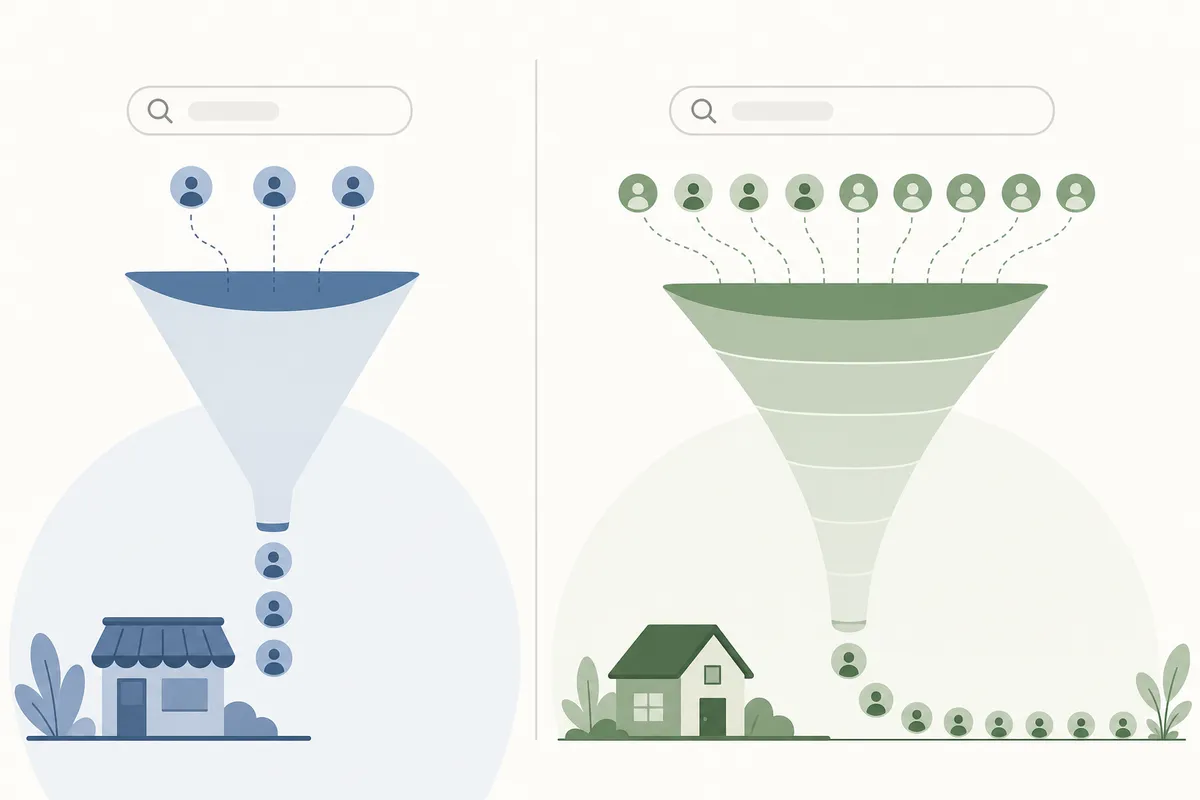
The table below sets the two types against the factors that shape an SEO plan.
| Factor | Short-Tail Keywords | Long-Tail Keywords | What It Means for You |
|---|---|---|---|
| Typical length | 1-3 words | 3+ words, but volume decides | Volume tells you more than word count |
| Example | "crm" | "crm for insurance agents" | The longer version tells you exactly who is searching |
| Monthly search volume | High | Low, often under 1,000 | One short-tail win can match dozens of long-tail wins on raw traffic |
| Competition | High, dominated by established domains | Lower, open to newer sites | Long-tail pages are where a new site can rank first |
| Searcher intent | Mixed, several needs behind one query | Narrow and specific | Long-tail pages tend to convert better because the need is already clear |
| Best page type | Homepage, category page, pillar guide | Blog post, FAQ, product page | Match the page type to the keyword type |
| Typical time to rank | Often a year or more with strong links | Weeks to a few months on a healthy site | Long-tail content usually earns a new site its first real wins |
Real examples of short-tail and long-tail keywords
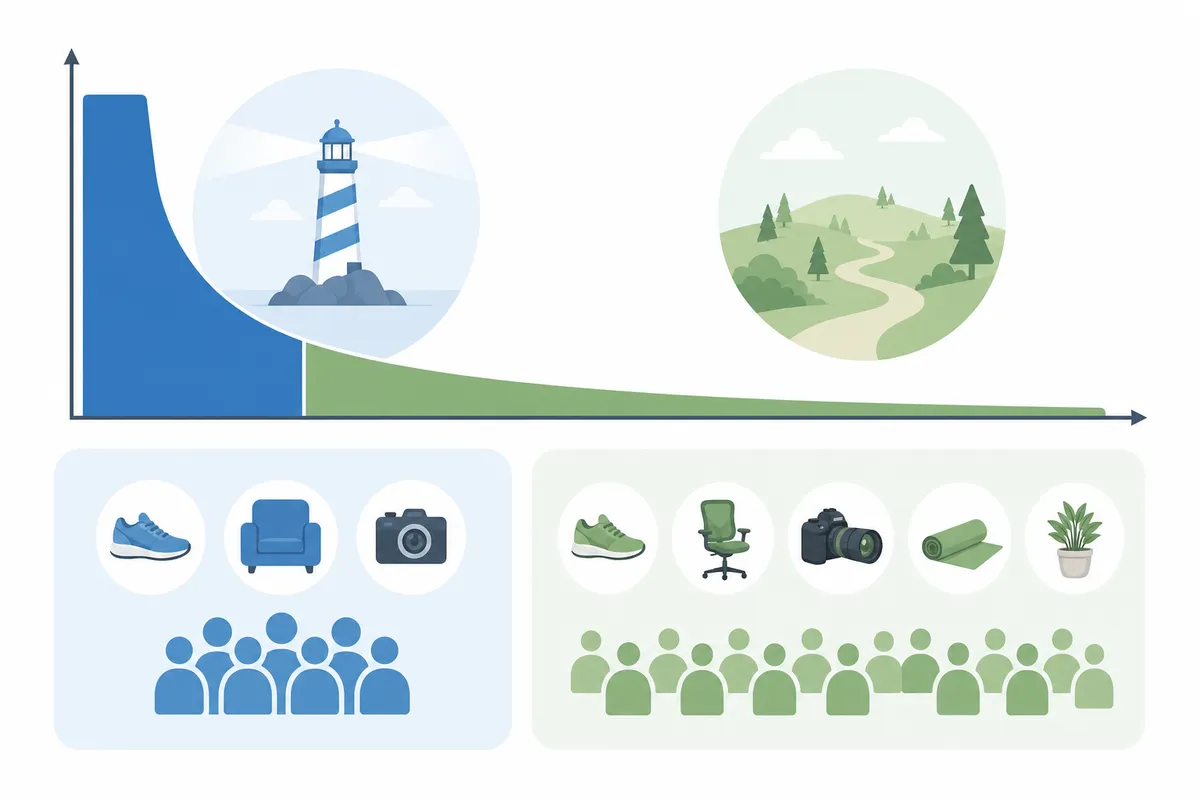
Pairs from several industries make the pattern easy to see.
| Niche | Short-Tail Keyword | Long-Tail Example | What the Searcher Wants |
|---|---|---|---|
| CRM software | "crm" | "crm for insurance agents" | A tool built for their specific industry, not a generic one |
| Running gear | "running shoes" | "running shoes for flat feet" | A product that solves a specific foot or gait problem |
| Home services | "plumber" | "emergency plumber cost per hour" | A price before they even call |
| Photography | "digital camera" | "best budget digital camera under $500" | A recommendation inside a firm budget |
| Travel | "Europe vacation" | "family-friendly travel destinations in Europe" | A trip that actually works with kids |
| SEO software | "seo software" | "seo software for shopify stores" | A tool that already understands their platform |
Each long-tail example adds a modifier: an audience ("for insurance agents"), a problem ("for flat feet"), a budget ("under $500") or an audience filter ("family-friendly"). Those modifiers are how long-tail keywords get built, whether you find them by accident or on purpose.
Why most SEO wins happen in the long tail
Three data points all say to build from the tail up.
The first is sheer share. Ahrefs puts almost 93% of its U.S. keyword database under 10 monthly searches, so the head of the curve is tiny and the tail is nearly everything else.
The second comes from Outrank's platform data, pulled from 189,369 keywords targeted across its customer base in a 90-day window. The median keyword drew 170 monthly searches, 96.7% sat under 1,000, and the median keyword difficulty was just 14 out of 100, with over 63% of targets scoring under 20. Numbers like these are why long-tail keywords tend to rank faster and convert better than a site's head terms, especially for a newer domain.
The third is that specific queries get clicked more often than vague ones, up to a point.
Click-through rate by query length
Outrank analyzed 1.2 million Search Console queries across 111 sites and sorted them by word count.
| Query Length | Click-Through Rate | What's Happening |
|---|---|---|
| 1-2 words | 5.25% | Broad short-tail terms, lots of competing results on the page |
| 5-6 words | 8.39% (the highest band in the study) | Specific enough to match intent, still phrased the way a person talks |
| 10+ words | Falls to 3-4% | Many of these are AI tools fanning one question into dozens of searches |
The last row matters more than it looks. The same study found that 95-98% of these machine-generated, ultra-long queries never get a single click, compared with 74% for normal human searches. Chasing every 12-word phrase in your Search Console report wastes a content calendar, so aim for the human-sounding long tail of roughly three to eight words with one clear need behind it.
Which should you target: short-tail or long-tail keywords?

Your answer depends on your site's current authority and the page you're planning.
- New site or low domain authority: go long-tail first. You can rank for specific, low-competition queries within weeks instead of waiting a year or more for a head term to move, and free keyword and SEO tools will show difficulty and volume before you commit a page to any term.
- Growing site: build pillar-and-cluster sets, with one pillar page on the short-tail term and a group of long-tail articles linking in to support it.
- Online store: category pages take the short-tail and mid-tail terms, and buying guides and blog posts take the long tail.
- Local business: service pages target "service plus city," while FAQ posts answer long-tail questions like "emergency plumber cost per hour."
- Established brand: defend your head terms, and use branded keyword research to find, track and defend your brand so competitors can't quietly rank on your own name.
How short-tail and long-tail keywords work together
The two types are layers of one plan. A pillar page targets the head term, long-tail articles answer the specific questions underneath it, and internal links connect the two in both directions.
A CRM company might build a pillar page around "crm" that covers every major use case at a high level. Supporting articles then go deep on single audiences: "crm for insurance agents," "crm for contractors" and "crm for real estate teams." Each article links back to the pillar, and the pillar links out to every supporting piece.
This structure is also why long-tail keywords drive more leads and growth than head terms over time, even though each long-tail article draws only a little traffic by itself. Fifty specific articles that each convert well can add up to more than a single head term that took two years to rank.
How to write SEO-friendly content with long-tail keywords
Writing for the long tail differs from writing a broad guide, and a few rules keep it from reading as forced.
- Answer the exact question in the heading. If the keyword is a question, make the heading that question and answer it in the first sentence underneath.
- Keep each answer self-contained, so a paragraph pulled out of context by a reader or an AI search tool still makes sense.
- Use the keyword naturally. Work the phrase and close variants in at a natural rate and never bend a sentence to fit the exact phrase in again.
- Group close variants on one page. "Cold brew ratio" and "cold brew ratio in cups" belong together, while a different question like "why is my cold brew sour" earns its own section or article.
- Read how to use long-tail keywords for more traffic and sales if you're building a whole content plan rather than a single page.
For a model of the finished result, 12 SEO writing examples that rank, and why they work breaks down real pages doing exactly this.
Are long-tail keywords better than short-tail keywords?
Neither is better across the board, because they do different jobs and a site that chases only one leaves something on the table.
Short-tail terms bring volume and brand visibility along with mixed intent and brutal competition. Long-tail terms bring clearer intent and faster rankings, but each draws only a trickle of traffic. A site built only on long-tail content can collect hundreds of small wins and still miss the visibility a head term brings, while a site built only on short-tail terms can spend years fighting for rankings it may never reach.
The strongest approach pairs them: a handful of short-tail pillar pages for visibility and a much larger body of long-tail content for the rankings, traffic and conversions you can win this quarter.
How to find long-tail keywords for your business
Four methods cover most of what you need, and they work well together.
| Method | Cost | Shows Real Search Volume? | Best For |
|---|---|---|---|
| Google Autocomplete | Free | No | Quick brainstorming, real phrasing people actually type |
| Keyword research tool | Paid, often with a free trial | Yes | Filtering by volume, difficulty, and word count at scale |
| Google Search Console | Free, if you already have a site | Yes, your own impressions and clicks | Finding long-tail queries you already rank for on page two |
| Competitor keyword gap analysis | Paid tool required | Yes | Finding long-tail terms a rival already ranks for |
If you're weighing which paid tool to buy, this breakdown of Long Tail Pro vs Semrush on price and depth is worth reading before you subscribe. For a quick gut check on a handful of terms, a free tool to check search volume will get you most of the way without a login.
Does a long-tail keyword strategy help you show up in AI search?
Yes, and increasingly so. AI Overviews, chat-based assistants and answer engines respond to specific, conversational questions rather than two-word fragments, so a page built around one clear long-tail question and one self-contained answer gives them a clean passage to pull from.
These tools also use query fan-out, which expands a single prompt into many related sub-questions before composing an answer. A site that covers many long-tail variations around a topic has more of those sub-questions already answered. For a fuller picture of what this shift changes day to day, AI SEO in 2026: what it actually does, and where it falls short is worth a read before you rebuild a content plan around it.
Common mistakes when choosing between short-tail and long-tail keywords
A few habits undo otherwise solid keyword research.
- Chasing head terms too early: a brand-new site competing for "crm" against decade-old domains has chosen the slowest path to its first rankings.
- Writing one thin page per keyword variant: close variants of the same question belong on one page, grouped by intent, instead of spread across five near-duplicate posts.
- Ignoring page speed on long-tail content: a fast-ranking page that loads slowly still loses visitors, and comparing page speed tools on price and depth is worth doing before you scale up publishing.
- Forgetting the internal links back to the pillar: long-tail articles that don't link back dilute the topical signal the pillar page needs.
- Treating every 10-word Search Console query as a content opportunity: most are AI tools fanning out a single question, and the data above shows they rarely earn a click.
FAQs
What is the difference between long-tail and short-tail keywords?
Short-tail keywords are broad, one- to three-word searches with high volume and mixed intent. Long-tail keywords are specific, lower-volume searches, usually three or more words, with one clear need behind them. Volume and competition define the split.
How many words make a keyword long-tail?
There's no fixed number. Most long-tail keywords run three words or more because extra words narrow the search down, but a short, specific phrase with low monthly volume can still count as long-tail, and a longer phrase with high volume can still be a head term.
Are long-tail keywords better than short-tail keywords?
Neither type is universally better. Long-tail keywords rank faster and convert at a higher rate because intent is clearer, and short-tail keywords bring far more total traffic and brand visibility once you can compete for them. Most sites need both.
How many long-tail keywords should a new site target?
There's no single number, but new or low-authority sites generally do better building a large base of long-tail articles before competing for head terms. Outrank's own data shows targeted keywords with a median difficulty of just 14 out of 100, which is well within reach for a newer domain.
Can one page rank for both a short-tail and a long-tail keyword?
Sometimes. A page can pick up long-tail traffic naturally as a side effect of ranking for its main term, but building it around one primary keyword, short-tail or long-tail, gives it the clearest shot at ranking well for that term.
Match each page to the right keyword before you publish
Pick one keyword, short-tail or long-tail, before you write the next page on your site. Pages built around a single clear term rank faster and convert better than pages trying to serve every search at once, and balancing the two types page by page keeps a content plan rankable. If you want a second opinion on where your own site's quickest long-tail wins are sitting, talk to the team and we'll walk through a sample report together.
Resources / References
Sources
About the author
SearchBlueprint researched, wrote and scored this article with the content pipeline our customers run on their own sites. The score in the byline is what our content engine gave this page before it published. Nothing here is reviewed by hand, which is the point: it is the product's output, published where anyone can check it.