Long-tail keywords: why they rank faster and convert better
SearchBlueprint · · 10 min read · scored 100/100
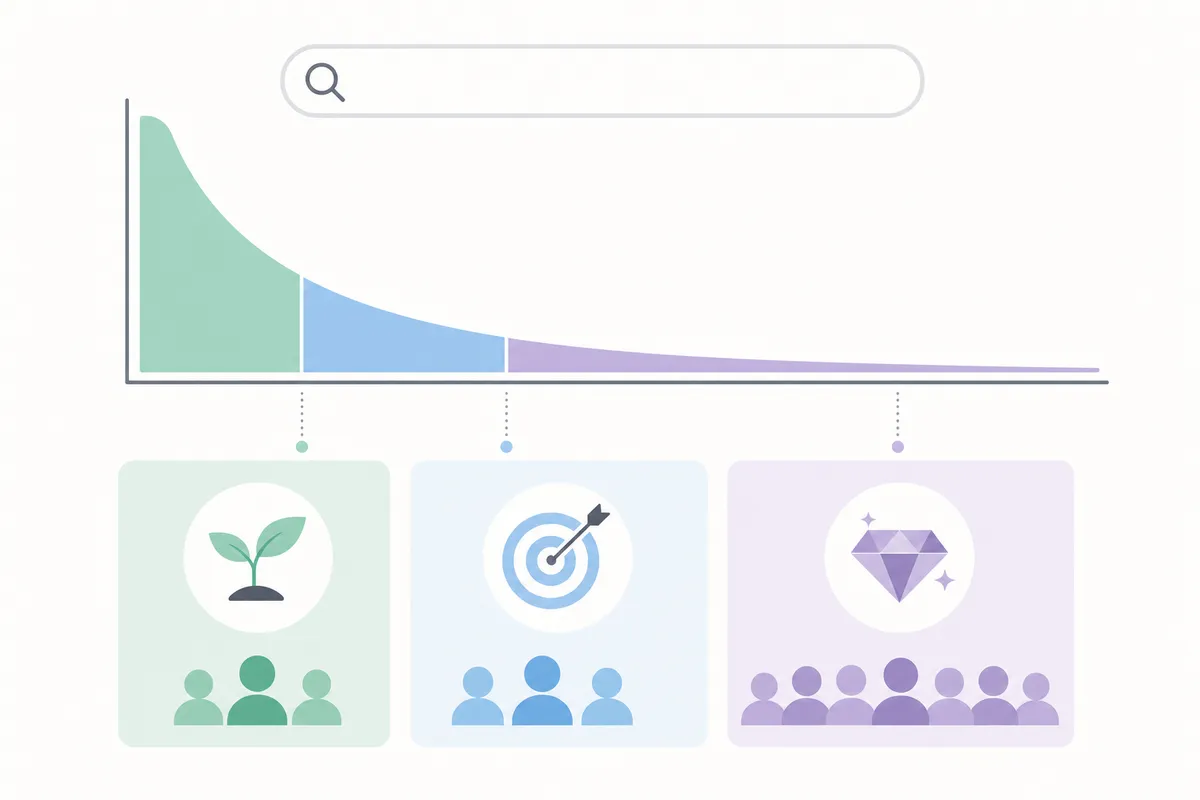
Long-tail keywords are searches with few monthly searches each, usually specific phrases or full questions such as "boiler service cost for a two-bed flat". They rank faster because fewer strong pages compete for them, and they convert better because the searcher has already said exactly what they want.
That is the whole case in two sentences. The rest of this guide covers how to tell a real long-tail keyword from a merely long one, where to find them for free, how to group them so you build one strong page instead of ten thin ones, and why they matter more now that AI answers break questions into smaller ones.
What makes a keyword long-tail
The name comes from the shape of a chart. Sort every search by volume and you get a short "head" of very popular searches, then a curve that flattens into a very long tail of searches made a handful of times each.
Ahrefs, writing about its own keyword database, gives the clearest example. "Meditation" is a head term at about 211,000 searches a month. "Can meditation make you smarter" is a long-tail term at about 50. Both belong to the same topic, and what separates them is how many people search each one.
That distinction matters in practice. "Best electric car" is three words long and is still a heavily contested search. "Ioniq 5 winter range" is four words and asks something far narrower. Judge a phrase by its volume and competition, never by its length.
| Type | Search volume | Competition | Searcher | Example |
|---|---|---|---|---|
| Head term | High | Heavy, often big brands | Browsing a broad subject | "boilers" |
| Mid-tail | Moderate | Mixed | Narrowing down | "combi boiler brands" |
| Long-tail | Low per phrase | Light | Knows what they want | "combi boiler for a two-bathroom house" |
There is no official cut-off between mid-tail and long-tail. A phrase with 300 searches a month is long-tail in a big consumer market and a head term in a narrow B2B one. Compare each phrase with the others in its own topic.
Why long-tail keywords rank faster
Less competition for each search
Ahrefs reports that keywords with fewer than 10 searches a month make up almost 93% of its US keyword database, while just under 18,000 keywords top 100,000 searches a month. Big sites build pages for the 18,000 because the volume pays for the effort. Far fewer pages are written for a specific question, so a well-made answer from a small site can reach page one sooner.
Shorter pages can win
The broader the search, the more ground a page has to cover. Ahrefs compared the top result for "how to buy bitcoin", at about 3,400 words, with the top result for "how to cash out large amounts of bitcoin", at about 1,000. A specific question can be answered completely in less space, which makes it cheaper to write the best page for it.
They add up
One long-tail phrase rarely brings much traffic. Ten related ones answered by the same page can. Ahrefs notes that a page ranking for a popular search usually ranks for many of its supporting long-tail variants too. That is why the method in this guide starts from groups of phrases.
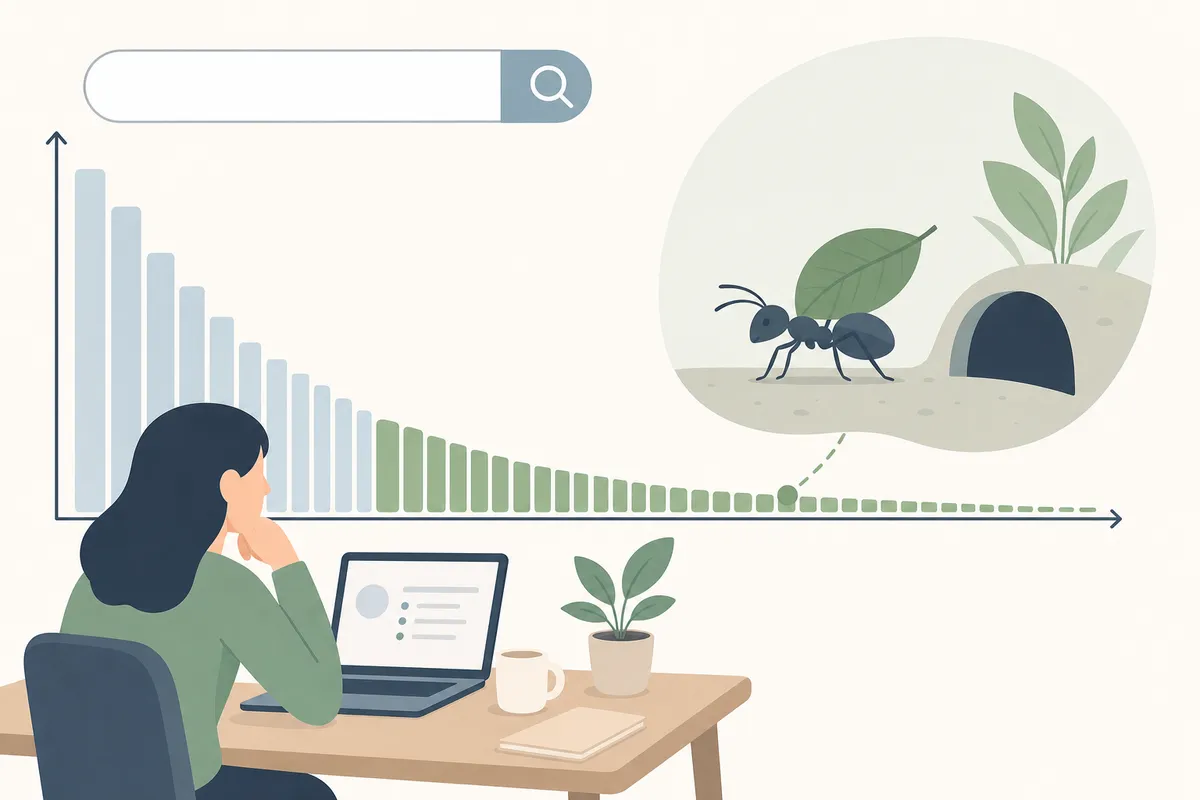
Why long-tail keywords convert better
A specific search is a sign of a later stage in a decision. Someone searching "boilers" might only be curious about how they work, while someone searching "combi boiler for a two-bathroom house" is choosing one and is far more likely to ask for a quote.
The same pattern shows up across industries:
- "accountant" against "accountant for Etsy sellers who also work full time"
- "CRM" against "CRM that syncs with Xero for a five-person agency"
- "physio" against "physio for runner's knee open Saturday"
Each long version names a situation. When your page names the same situation, the visitor recognises themselves in it, and that recognition is what turns a visit into an enquiry. Measure it rather than assume it: compare form fills or sales per visit from your long-tail pages against your broad ones.
Supporting and topical long-tail keywords
Ahrefs splits long-tail searches into two kinds, and the split decides whether a phrase needs its own page.
| Kind | What it is | Example | What to do |
|---|---|---|---|
| Supporting | A rarer wording of a popular search; the same pages rank for both | "how do you get rid of red wine stains" next to "how to remove red wine stains" | Answer it inside the existing page for the popular search |
| Topical | A specific need with no bigger search above it | "red wine stain on a wool rug that has dried" | Give it a page, or a clear section of one, if nothing broader covers it |
The test is to search both phrases. If page one is nearly identical for the two, the long one is supporting, and a separate page would only compete with your own. If the results differ, it is topical and has room for its own answer.
Long-tail keywords and AI answers
Question-shaped searches have always lived in the long tail. They matter more now because of how AI answers are built. Google's guide to AI features and your website says AI Overviews and AI Mode may use a "query fan-out" technique. Behind one question, the system may run several related searches across subtopics before it writes the response. A broad question becomes several narrow ones behind the scenes, and each narrow one is a long-tail search.
Google is also clear that there is nothing extra to do for these features. A page has to be indexed and eligible to show with a snippet, the same as any result. So the practical work is ordinary long-tail work done well:
- Put a real question in a heading, in the words people use.
- Answer it in the first one or two sentences under that heading.
- Keep the answer complete enough to make sense when quoted on its own.

How to find long-tail keywords for free
No single source shows the whole tail, so use the four below together. Begin with the ones that come from real searchers.
Your own Search Console
Open the Performance report, set the last three months and sort queries by impressions. Long-tail searches Google already shows you for are the easiest wins, because Google has already connected them to your site. Filter queries containing words like "how", "best", "for" or "near" to bring the specific ones to the top. Our lesson on Search Console essentials explains the report.
Google's own suggestions
Type a seed phrase into Google and read the autocomplete suggestions, then open a few "People also ask" questions and the related searches at the bottom of the page, all of which come from what real people type. The free People also ask finder collects the questions for any search.

Your customers' words
Enquiry emails, sales call notes, reviews and support tickets hold the exact phrases customers use. Some of those phrases appear in no tool at all, because too few people search them. Forums and community threads in your industry do the same job for questions you have not been asked yet.
A keyword tool for the numbers
Once you have a list, check it. Our free keyword suggestions tool returns up to 50 related searches for one seed, each with monthly volume and a difficulty score, and the keyword checker measures a list you already have. Google's Keyword Planner gives search estimates too, inside a Google Ads account.
| Source | Cost | Shows volume | Best for |
|---|---|---|---|
| Search Console queries | Free | Impressions for your own site | Searches you nearly rank for already |
| Autocomplete, People also ask | Free | No | Real phrasing and follow-up questions |
| Customer emails and reviews | Free | No | The words buyers use, including rare ones |
| Keyword tools | Free tiers and paid | Estimates | Phrase comparison and difficulty |
How to use long-tail keywords on your site
Finding phrases is the easy half, and most of the results come from what you do with them next.
Group by intent, then assign one page per group
Put phrases that want the same answer into one group. "Boiler service cost", "how much is a boiler service" and "average price of a boiler check" are one group and one page. "Boiler service vs boiler repair" wants a comparison and is another. The free keyword clustering tool groups a list for you as a starting point; read the groups before you trust them.
Choose the page type page one shows
For each group, search the main phrase and look at the format that wins. A long-tail search that returns product pages needs a product page; one that returns guides needs a guide. Specific searches often need a section of an existing page rather than a new URL.
Write the phrase where it counts
Use the main phrase of the group in the title, the main heading and the opening lines, and the other phrasings in subheadings and questions. Google's Search Essentials ask for the searcher's words in those prominent places and nowhere does it ask for repetition. Its spam policies treat stuffing a page with keywords as a violation.
Link the pages together
A long-tail page is often the detail behind a broader one. Link from the broad page to each specific page with descriptive anchor text, and back. Google uses links to find pages and to understand what they are about.
A worked example: one physio clinic
Here is how the method plays out for a made-up clinic in Bristol, so the steps are concrete. The searches are the kind you would find in the sources above; check real volumes for your own market before you act on any of them.
Search Console shows the clinic appearing, low on page two, for "physio for runner's knee", "runner's knee treatment Bristol" and "how long does runner's knee take to heal". Autocomplete adds "runner's knee exercises to avoid". Reception's notes add a phrase patients keep using on the phone: "knee pain going downstairs after running".
Grouped by intent, that becomes two jobs. The first four phrases with a local or treatment angle belong on one service page, "Runner's knee treatment in Bristol", with a section answering how long recovery usually takes and which exercises to pause. The patient's own phrase gets a short guide that explains the symptom in their words and links to the service page.
Two pages, five searches covered, and no page competing with another. The clinic then watches impressions for both in Search Console and counts bookings that mention knee pain.
Mistakes that waste long-tail work
- One thin page per phrase. Ten near-identical pages split your signals and give Google ten weak options for one need.
- Picking phrases nobody searches with buying intent. Low volume is fine; low volume and no clear need is not.
- Skipping the page-one check, then building a guide for a search where Google shows product pages.
- Writing a separate page for a supporting phrase that your main page already answers.
- Measuring visits only. Long-tail pages earn their place through enquiries and sales, so track those.
How to tell if it is working
Google's starter guide suggests waiting a few weeks before judging a change. After that, filter Search Console's Performance report to the page and watch impressions first. A good long-tail page starts appearing for more phrasings than you targeted, which shows as a growing list of queries for that page. Then check conversions in your analytics, because a handful of visits that become enquiries can be worth more than a broad page's traffic.
FAQs
What is an example of a long-tail keyword?
"Combi boiler for a two-bathroom house" is one. It is specific, few people search it each month, and the searcher has a clear decision to make. "Boilers" is the head term in the same topic.
Are long-tail keywords better than short ones?
For a newer or smaller site, usually yes, because they are easier to rank for and bring visitors closer to buying. Established sites need both: broad pages for authority and specific pages for conversions.
How many words is a long-tail keyword?
Word count does not decide it. Ahrefs' example "can meditation make you smarter" is long-tail because of its low volume, and some short phrases are long-tail in niche markets.
Should every long-tail keyword get its own page?
No. Phrases that share an intent belong on one page. Give a phrase its own page only when page one for it differs from the pages you already have.
Do long-tail keywords help with AI search?
Google says AI Overviews and AI Mode may run several related searches to build an answer. A page that answers a narrow question clearly gives those systems a passage to use, and the page still has to be indexed and eligible for a snippet.
Your next step
Open Search Console, sort your queries by impressions, and write down ten long-tail keywords where you appear but are not on page one. Group them by intent, then check each group against page one and improve the page that should own it. Start with our free keyword suggestions tool to see the related searches each group could also cover.
Sources
The facts in this guide come from these pages, each read on the date shown.
- Long-tail keywords: what they are and how to get search traffic from them (Ahrefs, read 12 October 2026)
- AI features and your website (Google Search Central, read 12 October 2026)
- Google Search Essentials (Google Search Central, read 12 October 2026)
- Spam policies for Google web search (Google Search Central, read 12 October 2026)
- SEO Starter Guide (Google Search Central, read 12 October 2026)
- Performance report (Search results) (Search Console Help, read 12 October 2026)
- Link best practices for Google (Google Search Central, read 12 October 2026)
- Use Keyword Planner (Google Ads Help, read 12 October 2026)
About the author
SearchBlueprint researched, wrote and scored this article with the content pipeline our customers run on their own sites. The score in the byline is what our content engine gave this page before it published. Nothing here is reviewed by hand, which is the point: it is the product's output, published where anyone can check it.