The 30-Day Plan to Prove AI Search Visibility for Brands
SearchBlueprint · · 11 min read · scored 92/100
A day plan to prove AI search visibility for brands works in three stretches: measure citation share across ChatGPT, Perplexity, Gemini, and Google AI Overviews in week one, fix the gaps in weeks two and three, then re-measure and report by day 30. It replaces guesswork with a before-and-after number stakeholders can act on.
Why a Day Plan to Prove AI Search Visibility Matters Right Now
The buyer research process has moved. G2's research, based on a March 2026 survey of 1,076 decision-makers, found that 51% of B2B buyers now start their research in an AI chatbot more often than Google. That figure was just 29% in April 2025. Across the full research process, 71% rely on an AI chatbot somewhere along the way.
That shift already changes purchase outcomes. G2's data shows 69% of buyers chose a different vendor than they originally planned because of what an AI chatbot recommended. Another 33% bought from a vendor they had never heard of before the AI surfaced it. Buyers also trust the citation itself: 85% say they think more highly of a vendor an AI cites in its answer. If your brand is not in that answer, you are not in the shortlist. There is rarely a page two to fall back on.
The Buyer Shift, in Numbers
| Metric | Figure | What It Means for Your Plan |
|---|---|---|
| B2B buyers starting research in AI over Google | 51% (up from 29% in April 2025) | Your day plan needs a starting baseline now, not next quarter |
| Buyers relying on AI chatbots somewhere in research | 71% | Nearly every deal touches an AI answer at some point |
| Buyers who switched vendors on an AI recommendation | 69% | A missing citation can cost a sale you never saw slip away |
| Buyers who bought a vendor new to them, AI-surfaced | 33% | AI visibility can create demand, not just capture it |
| Buyers who rate a cited vendor more highly | 85% | Citation itself functions as a trust signal, not just traffic |
Platform growth backs this up. Perplexity grew from 388 million to 1.3 billion monthly visits in a single year, a 244% increase, and ChatGPT controls roughly 63% of the AI search market for B2B research. Gartner has projected that traditional search volume will drop by around 25% by 2026 as AI answers absorb queries that used to land on a search results page. None of this is a future trend you can plan around later. It is the room your buyers are already standing in.

What Counts as "AI Search Visibility" (and What Doesn't)
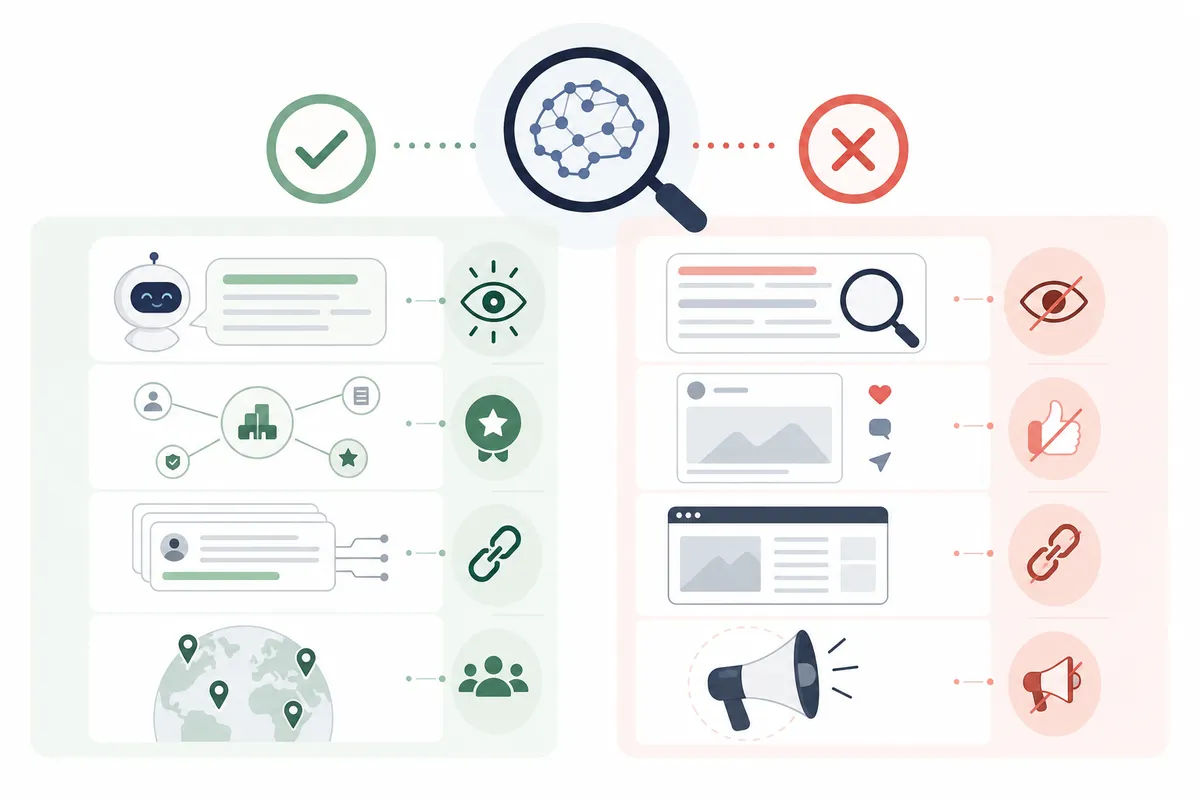
AI search visibility is whether an AI system, when asked a question in your category, names your brand, links to your content, or recommends you as an answer. It is a different measurement than a Google ranking. You can hold the top organic position for a keyword and still be absent from the AI-generated answer sitting above it. These systems retrieve and synthesize from sources they judge credible rather than simply ranking pages.
That distinction matters for how you plan. Traditional SEO earns access: clean site architecture, fast pages, and correct indexing controls give AI systems something to retrieve in the first place. Layered on top of that, generative engine optimization is what makes your content citable once it is found: direct answers, clear structure, and named expertise. Our guide to answer engine optimization breaks down how that citation mechanism actually works across ChatGPT, Perplexity, and Google's AI Overviews. It's worth reading before you build your own plan around it.
The practical difference: a search-visibility plan tracks rankings and clicks. An AI-visibility plan tracks whether your brand name, your data, or your page gets pulled into the answer itself, whether or not the reader ever clicks through.
Before You Start: What Has to Be in Place

A day plan only works if you can compare a real "before" to a real "after." Skipping the baseline step is the single most common reason these plans fail to prove anything. Four things need to exist before day 1:
- Executive buy-in, so the plan does not stall when it asks for engineering or content resources in week two.
- An owner, ideally someone with at least a significant chunk of their time set aside for this, since AI visibility work spans technical, content, and PR tasks that nobody does part-time by accident.
- Tracking access, meaning Google Search Console, Bing Webmaster Tools, and your analytics platform are already connected and reporting.
- A content inventory, so you know what you already have before you start deciding what to fix or write.
If any of these are missing, spend day 1 setting them up rather than starting the clock on a plan you cannot measure.
The 30-Day Plan, Phase by Phase
The plan runs in three roughly ten-day stretches. Each phase has one job, and trying to skip ahead (publishing content before you have a baseline, for example) is what turns a provable plan into an unprovable one.
| Phase | Days | Primary Job | How You Know It Worked |
|---|---|---|---|
| Foundation and baseline | 1 to 10 | Confirm AI crawlers can reach your site and document current citation share | A written baseline number, by platform and query type |
| Fix and publish | 11 to 21 | Close the highest-impact content and structure gaps | 5 to 10 pages upgraded, 1 to 2 new citation-targeted pieces live |
| Re-measure and report | 22 to 30 | Re-run the same test set and present the change | A before-and-after table stakeholders can read in one glance |
Days 1 to 10: Foundation and Baseline
Start with access. Check your robots.txt file to confirm you are not accidentally blocking AI crawlers such as GPTBot, PerplexityBot, or Googlebot. This is a common and completely silent failure: the block returns no error, your site just stops appearing.
Next, confirm the structural signals are in place. That means valid Organization, Article, and FAQPage schema markup on the pages you most want cited, plus a knowledge graph that is internally consistent. Your business name, description, and entity data need to say the same thing everywhere an AI system might check. If your schema or entity data is inconsistent across your site, fixing your knowledge graph SEO is usually a 2 to 4 week project on its own. It belongs in this first phase, not bolted on later.
Then baseline. Pick 20 to 30 queries a real buyer in your category would actually ask an AI assistant, split across category questions, problem questions, and "X vs Y" comparison questions. Run each one across at least three platforms and record whether your brand appears, what page (if any) gets cited, and who gets cited instead of you. This is tedious by hand, which is exactly why it needs to happen now, while the plan still has 20 days left to act on what you find.

Days 11 to 21: Fix and Publish
With a documented baseline, prioritize by two questions: which gaps cost the most revenue if left unfixed, and which can be closed fastest. Quick wins usually beat new content in week two. Upgrading five to ten existing pages with real data points, comparison tables, named author credentials, and clearer headings is faster than writing from zero. It also gives AI systems freshly-dated, more citable material to re-crawl.
Once the quick wins are live, publish the harder pieces: one or two definitive, data-backed guides targeting the gaps nothing on your site currently answers well. AI platforms increasingly reward genuinely new information over restated summaries, which is part of why AI Overviews now compete directly with organic clicks rather than simply sitting above them. A thin rewrite of what is already ranking rarely earns a citation next to a source with real numbers in it.
Days 22 to 30: Re-Measure and Report
Re-run the exact same query set from your baseline, on the same platforms. Do not swap in easier questions. The whole value of this phase is that the comparison is apples to apples.
Expect partial movement, not a clean sweep. AI citation changes typically take 4 to 8 weeks to fully materialize after content publication. These systems do not always re-index and re-weight sources on the same schedule search engines do. A 30-day check is a real progress read, but it is not the finish line. Our week-by-week guide to proving SEO and AI visibility in 30 days walks through what realistic movement looks like at each checkpoint. That way, you are not comparing your results against an unrealistic bar.
How to Measure AI Search Visibility Without Guessing
Manually asking an AI assistant "what is [my brand]?" a handful of times is not a measurement, it is an anecdote. Research from SparkToro found that asking an AI tool the identical question 100 times produced nearly 100 unique brand lists, in different orders, with different brands included. Any single query you run by hand could be the outlier.
That means your test set needs volume and repetition, not a single lucky prompt. Two practical options:
- Manual, structured testing: have two or three people each run the same 20 to 30 queries, paste every output into one shared document, and look for the pattern across all of it rather than trusting any one answer.
- Automated monitoring tools: several platforms track brand mentions across AI engines on an ongoing basis rather than a single snapshot, which matters given how much answer-to-answer variance exists. Our free AEO and AI-search scorer is a fast way to check how citable a given page currently reads before you commit a monitoring budget to tracking it over time.
Whichever method you use, test more than one platform. ChatGPT leans heavily on Bing's index and its own training data. Perplexity is citation-driven and pulls from live web sources on nearly every answer. Gemini blends Google's existing search index with its Knowledge Graph. A brand that is well-cited in Perplexity can be completely absent from ChatGPT, because the two systems are not reading the same signals.
How to Report AI Visibility to Stakeholders
The report that convinces a budget committee is not a screenshot of one good answer. It is the same before-and-after structure you built the plan around, presented plainly.
| Metric | Day 1 Baseline | Day 30 Result | What Changed |
|---|---|---|---|
| Total citations, your brand | Recorded count from your test set | Recorded count from the same test set | Direction and scale of movement |
| Citation share vs. top competitor | Your count out of total queries tested | Same comparison, re-run | Whether the gap closed or widened |
| Platform coverage | Which of ChatGPT, Perplexity, Gemini, Copilot cited you at all | Same check, re-run | New platforms gained, if any |
| AI-referred site visits | Baseline traffic from AI referral sources in analytics | Day 30 traffic from the same sources | Whether visibility is translating to visits |
Pair the numbers with what specifically changed: which pages were upgraded, which new content went live, and which technical fixes shipped. A stakeholder does not need to understand schema markup to understand "we fixed five inconsistent business listings and added structured data to twelve pages, and our citation share went from 2 of 10 category queries to 6 of 10." Keeping your SEO signals consistent across every channel, not just the blog, is also part of that story. If AI visibility is one piece of a broader reporting gap, enhancing cross-channel SEO to prove brand visibility covers how to tie those signals together in one report rather than three disconnected ones.
FAQs
What is a day plan to prove AI search visibility for brands?
It is a structured, time-boxed process, typically 30 days, that documents your brand's current citation rate across AI platforms like ChatGPT and Perplexity. It then fixes the highest-impact gaps and re-measures the same test set, so you have a real before-and-after number instead of a guess.
How long does it actually take to see results after fixing AI visibility gaps?
Most AI platforms take roughly 4 to 8 weeks to fully reflect content and structural changes in their citations. A 30-day check will usually show early movement, especially from quick technical fixes, but treat it as a progress read rather than a final score.
Which AI platforms should I test for brand visibility?
At minimum, test ChatGPT, Perplexity, and Google's AI Overviews or Gemini, since each pulls from different sources and weighs them differently. A brand strong in one can be invisible in another, so testing only one platform will overstate or understate your real visibility.
What is the difference between AI search visibility and traditional SEO?
Traditional SEO measures rankings and clicks on a results page. AI search visibility measures whether an AI system names your brand or cites your content inside a generated answer. That can happen even when the reader never clicks through to your site, and it can fail to happen even when you rank well organically.
How do I report AI visibility progress to stakeholders who don't work in SEO?
Use a simple before-and-after table: citation count, citation share against your top competitor, and which platforms cited you. Measure each on day 1 and again on day 30, against the same query set. Pair each number with the specific fix that produced it, rather than presenting the metric alone.
Get Your AI Citation Baseline Checked
Thirty days is enough time to know whether your brand is showing up in the answers your buyers are already reading. It's also enough time to start closing the gap if it isn't. If you want a professional read on where your citations, schema, and content stand before you build your own day plan to prove AI search visibility for brands, get a sample SEO report and see exactly what a baseline audit surfaces for a real site.
Sources
About the author
SearchBlueprint researched, wrote and scored this article with the content pipeline our customers run on their own sites. The score in the byline is what our content engine gave this page before it published. Nothing here is reviewed by hand, which is the point: it is the product's output, published where anyone can check it.