The Best AI Content Optimization & AEO Platforms, Ranked
SearchBlueprint · · 17 min read · scored 89/100

The best AI content optimization & AEO platforms in 2026 fall into four groups: dedicated AI visibility trackers like Profound and Peec AI, content optimization tools like Surfer SEO and MarketMuse, execution platforms like AirOps, and SEO suites like Semrush and Ahrefs that added AI tracking. The right pick depends on whether you need to measure AI visibility, produce citable content, or both, and budgets run from $29/month to $3,000/month.
That spread matters. Vendors now slap an "AEO" label on everything from keyword tools to enterprise attribution suites, and the pricing gap between them is roughly 100x. This guide sorts the substance from the repositioning, with listed prices, engine coverage, and review data for every platform worth evaluating.
Why You Need Both Content Optimization and AEO Now

A growing share of buying research now starts in ChatGPT, Perplexity, Gemini, and Google's AI Overviews instead of a page of blue links. When those engines answer, they cite a handful of sources, and if yours isn't one of them, your #1 Google ranking can still produce zero visibility where the decision actually happens.
The catch is that AI answers are volatile. Profound's research on answer engine citations reports that cited domains turn over 40 to 60% month to month, and that 97.4% of AI citations come from non-Tier-1 earned media, Reddit threads, niche vertical sites, LinkedIn posts, rather than major publications. Two consequences follow:
- You can't measure AI visibility once and move on. You need ongoing tracking across multiple engines, because the answer set keeps churning.
- You can't win with tracking alone. Visibility data only pays off when it feeds back into content that's structured the way answer engines extract and quote.
That's why this comparison covers both halves. A tracker without a content workflow leaves you staring at a declining line. A content tool without visibility data leaves you optimizing blind.
What Separates the Best AI Content Optimization & AEO Platforms
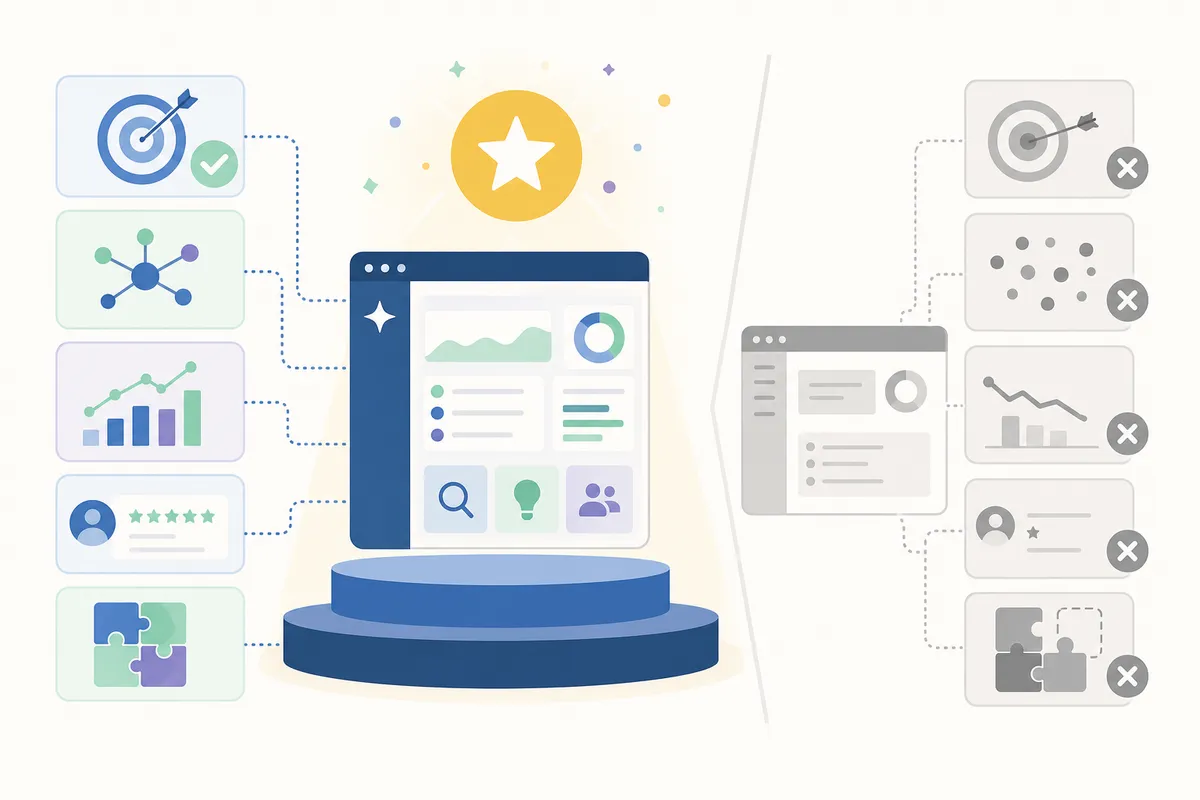
Before the individual reviews, here are the criteria that consistently separate platforms that hold up in real use from ones that don't.
Multi-engine coverage on the tier you'd buy
ChatGPT, Perplexity, and Google AI Overviews are the minimum. Depending on your audience, Gemini, Claude, Copilot, and Grok matter too. Watch for tier-gating: Profound's published pricing starts at $99/month tracking ChatGPT only, scaling to 9 engines on Enterprise. Gauge's listed pricing runs ChatGPT-only at $99/month and multi-engine at $599/month, with Claude and Grok reserved for Enterprise plans. A cheap plan that watches one engine shows you a fraction of the picture.
Real prompt data, not keyword guesses
There's a hard line between platforms mining what people actually ask AI engines and platforms inferring demand from an SEO keyword database. Published dataset sizes are one honest signal: Profound claims 1.9+ billion real user prompts behind its Prompt Volumes feature, and Ahrefs Brand Radar lists 405M+ prompts behind its $199/month add-on. Most vendors publish no dataset size at all, worth asking about before you sign.
Content workflows that close the loop
Monitoring tells you where the gaps are. The stronger platforms also generate briefs, drafts, or structural fixes so you can close those gaps without stitching together three more tools. AirOps built its whole product around this loop; most pure trackers haven't.
Proof, compliance, and reviews
If you're in a regulated industry, SOC 2 Type II is a procurement gate, not a nice-to-have. AirOps states SOC 2 Type II compliance since January 2023; Scrunch AI, Athena HQ, Writesonic, and Frase also publicly state it. Review volume matters too: a 4.9/5 rating across 38 reviews and a 4.7/5 across 2,124 reviews are not equally strong evidence.
Quick Comparison: 15 Platforms at a Glance

Listed prices and engine counts below come from vendor pricing pages and published comparisons as of mid-2026; they change often, so verify before buying.
| Platform | Best for | Listed starting price | Engines tracked (entry → top tier) | Noted rating / proof |
|---|---|---|---|---|
| Profound | Enterprise AEO programs with attribution | $99/mo (Starter, ChatGPT only) | 1 → 9 | Ranked #1 on G2 for AEO; SOC 2 Type II, HIPAA |
| Peec AI | Clean, precise citation tracking | $95/mo | 3 of your choice → 11 | 4.8/5 on G2 (18 reviews) |
| Otterly.AI | Affordable monitoring for small teams | $29/mo | 4 on all tiers; some engines are add-ons | 4.8/5 on G2 (54 reviews) |
| Scrunch AI | Competitive share-of-voice benchmarking | $300/mo ($250/mo annual) | 7 on all tiers | SOC 2 Type II; 4.6/5 (73 reviews) |
| Athena HQ | Brand integrity plus optimization agents | $295/mo (free plan with $25 credit) | 5 free → 8 paid | SOC 2 Type II; 4.9/5 (38 reviews) |
| Rankshift | Dedicated multi-engine tracking on a budget | From $82/mo annual | 9 on all tiers | 30-day free trial |
| Evertune | Brand perception and share-of-voice trends | ~$3,000/mo | ChatGPT, Gemini, Claude, Perplexity | 25M consumer panel claim |
| AirOps | Turning visibility data into content at scale | Sales-led | Multi-engine on Pro | SOC 2 Type II since Jan 2023; 4.7/5 (134 reviews) |
| Writesonic | High-volume AI writing with tracking | $12–$79/mo depending on plan | 3 paid → 10 Enterprise | SOC 2 Type II; 4.7/5 (2,124 reviews) |
| Surfer SEO | Optimizing content structure for extractability | $49/mo annual ($99/mo listed elsewhere) | 0 → 5 by tier | 4.8/5 on G2 (546 reviews) |
| Frase | Question-based research and drafting | $49/mo ($39/mo annual) | 2 → 5 | SOC 2 Type II; 4.8/5 (309 reviews) |
| Semrush AI Toolkit | Adding AEO to an existing Semrush stack | $99/mo per domain annual (suite from $139.95/mo) | 4 on all tiers | 4.4/5 (4,029 reviews, whole suite) |
| Ahrefs Brand Radar | Adding AI data to Ahrefs workflows | $199/mo add-on | 7 platforms | 405M+ prompt dataset |
| Conductor | End-to-end enterprise AEO + SEO | $1,500/mo | ChatGPT, Gemini, Perplexity, Google AIO, Claude, Grok, Copilot and more | SOC 2 Type II; 4.5/5 (788 reviews) |
| HubSpot AEO | Teams already running HubSpot | $50/mo ($45/mo annual) | 3 on all tiers | SOC 2 Type II |
Best Dedicated AEO Platforms for AI Visibility Tracking
These tools exist to answer one question: where does your brand show up when AI engines answer buyer questions?
Profound, deepest data, enterprise price ceiling
Profound is the reference point most other AEO platforms get measured against. It tracks all major answer engines daily through front-end browsers rather than APIs, so you see the answer a real user sees. The company claims 1.9+ billion real user prompts behind its Prompt Volumes feature, segmented by intent and demographics, and its Agent Analytics reads server logs through CDN integrations (Cloudflare, AWS, Fastly, and others) to tie AI crawler activity to actual traffic and conversions via GA4.
It's SOC 2 Type II certified and HIPAA compliant, which makes it one of the few options regulated industries can even shortlist. Reviewers rank it #1 on G2 for AEO, the vendor cites 300-plus reviews at 4.6/5, while a third-party comparison recorded 4.5/5 across 1,128 reviews, the largest verified review base of any pure-play AEO platform either way. Published entry pricing starts at $99/month tracking ChatGPT only; multi-engine coverage and the content and attribution features live in higher, sales-led tiers. If you just want a lightweight visibility score, you'll pay for depth you won't touch.
Peec AI, the clean monitoring dashboard
Peec AI does precise citation tracking with daily monitoring and screenshot audit trails that make reports easy to share with stakeholders. Listed pricing starts at $95/month (one comparison lists a €89/month tier), with 3 engines of your choice on Starter scaling to 11 on Enterprise. Reviewers rate it 4.8/5 on G2 across 18 reviews. Its limitation is honest and structural: it's monitoring only. You'll need a separate tool to act on what it finds.
Otterly.AI, the budget entry point
At a listed $29/month, Otterly.AI is the cheapest credible way to start tracking AI citations. You get prompt monitoring across 4 engines on all tiers (Claude, AI Mode, and Gemini are paid add-ons), plus basic GEO recommendations and content briefs. Reviewers rate it 4.8/5 across 54 reviews. There's no real prompt-volume data and no in-platform content generation, but for a small team confirming whether AI search matters for its category, that's a fair trade at this price.
Scrunch AI, competitive benchmarking
Scrunch AI, listed at $300/month (or $250/month billed annually), tracks 7 engines on all tiers and focuses on share-of-voice: how your citation rate compares to named competitors over time. Its distinctive bet is an Agent Experience Platform that serves AI-optimized pages to crawlers without changing what human visitors see. It carries SOC 2 Type II and a 4.6/5 G2 rating across 73 reviews, with a 7-day no-card trial. Monitored prompts are configured by you rather than pulled from real conversation data, so demand discovery is on you.
Athena HQ, recommendations you can act on
Athena HQ pairs brand integrity monitoring with content optimization agents, listed at $295/month with a free plan that includes a $25 credit, 5 engines on free, 8 on paid. Its Action Center turns visibility data into prescriptive next steps, which reviewers clearly value: 4.9/5 on G2, though across just 38 reviews. Two caveats from published comparisons: prompt volume relies on an undisclosed estimation model, and generated recommendations often need editing before they're usable.
Rankshift, nine engines, no tier games
Rankshift's pitch is simple: dedicated AI answer engine tracking across 9 engines on every tier, from a listed $82/month billed annually, with a 30-day free trial, the longest trial in this comparison. It has no G2 listing yet, so you're trading social proof for coverage-per-dollar. For teams whose main frustration is engine-gating on other platforms, that trade can make sense.
Evertune, brand perception at enterprise scale
Evertune sits at roughly $3,000/month per published comparisons and focuses on share-of-voice and brand perception across ChatGPT, Gemini, Claude, and Perplexity, backed by a claimed 25-million-person consumer panel and a built-in Content Studio. It clusters at the topic level rather than tracking prompt-level demand, and it hasn't published SOC 2 Type II, a real gap at this price. It fits brand and reputation teams more than content teams.
Best AI Content Optimization Platforms for Citable Content
These tools work the other side of the problem: making your content the kind answer engines extract, quote, and cite.
| Tool | Core job | Listed price | AI visibility tracking | Where it falls short |
|---|---|---|---|---|
| Surfer SEO | Structuring content for AI extractability | $49/mo billed annually ($99/mo on some listings) | 0 engines on Discovery, 1 on Standard, 5 on Pro+ | Tracking is an add-on to an SEO-first product |
| MarketMuse | Topical authority planning | Mid-range to enterprise; not consistently published | None, no cross-engine monitoring | Not a visibility tracker at all |
| Clearscope | Editorial-grade optimization scoring | Premium; not consistently published | Minimal | No AEO monitoring or citation data |
| Frase | Question-based research and drafting | $49/mo ($39/mo annual) | 2 engines on Starter → 5 on Scale | Light on competitive benchmarking |
| Writesonic | AI writing volume plus tracking | $12–$79/mo depending on plan and billing | 3 on paid tiers → 10 on Enterprise | Methodology is SEO-derived, not prompt-demand-driven |
Surfer SEO, structure for extraction
Surfer built its name on content scoring for Google, and it has extended that into AI extractability: clear heading hierarchies, self-contained passages, and answer-first structure. Published pricing starts at $49/month billed annually (some comparisons list $99/month), with AI engine tracking gated by tier, zero on Discovery, one on Standard, five on Pro and above. At 4.8/5 across 546 G2 reviews, it's the safest pick for content creators extending into AEO without abandoning their SEO workflow.
MarketMuse, topical authority as an AEO strategy
MarketMuse doesn't track citations at all, and that's fine, its job is deep topical-authority analysis, mapping what a genuinely comprehensive content cluster looks like and where your coverage is thin. That matters for AEO because answer engines weigh demonstrated topic depth when choosing sources. Treat it as a planning layer that pairs with a tracker, not a replacement for one.
Clearscope, editorial quality control
Clearscope remains the tool editorial teams reach for when consistency across many writers is the problem. Its optimization reports and readability grading keep large content operations aligned. It sits at the premium end for what it does, and it offers no meaningful AEO monitoring, so, like MarketMuse, it belongs alongside a tracker rather than instead of one.
Frase, question-first research on a budget
Frase starts at a listed $49/month ($39/month billed annually) and is built around question-based research: what people actually ask, structured into briefs and drafts. It now tracks 2 AI engines on Starter and 5 on Scale, states SOC 2 Type II, and holds a 4.8/5 G2 rating across 309 reviews. For solo marketers and small teams, it's one of the highest-leverage entry points in this list.
Writesonic, volume plus visibility
Writesonic combines high-throughput AI writing with visibility tracking, 3 engines on paid tiers up to 10 on Enterprise. Listed entry pricing varies by comparison, from $12/month on basic plans to $79/month billed annually for the tiers most teams actually use. It's SOC 2 Type II and holds a 4.7/5 rating across 2,124 G2 reviews, one of the largest review bases in this space. The honest critique from published comparisons: its content methodology is SEO-derived, with no real prompt-demand data behind it.
Best Platforms for Turning AI Visibility Into Execution
A third category connects the two halves: when tracking finds a gap, the platform produces the fix.
AirOps, the insight-to-action loop
AirOps is the strongest example of a closed loop: its Insights module tracks citation rate, mention rate, and sentiment across ChatGPT, Gemini, Perplexity, and Google's AI surfaces, then its agent system drafts optimized refreshes grounded in your brand guidelines and queues them for human review. Pricing is sales-led across all tiers, aimed squarely at enterprise content teams. It holds a 4.7/5 G2 rating across 134 reviews and has stated SOC 2 Type II compliance since January 2023. Published case studies claim large citation lifts from scaled refresh programs; the recurring caveat in third-party reviews is that agent output usually needs human cleanup, which AirOps itself builds into the workflow.
xSeek and AIclicks, execution at lower price points
For teams that want tracking-to-execution without enterprise procurement, two smaller options show up in published comparisons: xSeek, listed at $249.99/month covering ChatGPT, Gemini, Perplexity, Google AI Overviews, and Claude with content creation built in; and AIclicks.io, listed at $59/month with 3 engines on Starter scaling to 6, rated 4.9/5 on G2 across 46 reviews. Both are younger products, weigh the price advantage against thinner track records.
AEO Features Inside SEO Suites You Already Pay For
If you already run a major SEO platform, the cheapest move may be switching on its AI features rather than buying a new tool. The trade-off is consistent across all four: convenience over depth.
| Suite | AI offering | Listed price | Engines | Main trade-off |
|---|---|---|---|---|
| Semrush | AI Toolkit / AI visibility reports | $99/mo per domain annual; suite from $139.95/mo | 4 on all tiers (comparisons note Google AIO + ChatGPT focus on lower plans) | AI data sits apart from SEO reports; generic recommendations |
| Ahrefs | Brand Radar add-on | $199/mo add-on | 7 platforms incl. ChatGPT, Perplexity, Gemini, Copilot, Grok | Prompts are keyword-derived, not real conversations; slower refresh on most engines |
| Conductor | End-to-end AEO + SEO platform | From $1,500/mo, usage-based, custom enterprise | ChatGPT, Gemini, Perplexity, Google AIO/AI Mode, Claude, Grok, Copilot and more | Learning curve; costs scale with scope and add-ons |
| HubSpot | AEO features in Marketing Hub | $50/mo ($45/mo annual) | 3 on all tiers (ChatGPT, Gemini, Perplexity) | Shallow next to dedicated trackers; only sensible if you're already on HubSpot |
Two of these deserve a closer word. Conductor is really an enterprise AEO platform in its own right, not a bolt-on: it connects AI visibility tracking to content creation and technical monitoring on a decade of unified website data, holds SOC 2 Type II with unlimited users, and reviewers rate it 4.5/5 across 788 G2 reviews. At a listed $1,500/month starting point, it competes with Profound and AirOps, not with the add-ons.
Ahrefs Brand Radar, meanwhile, publishes one of the few hard dataset numbers in the category, 405M+ prompts, which makes its $199/month add-on price look reasonable for teams already living in Ahrefs. Just know that its prompts are derived from keyword data rather than real AI conversations, and most engines refresh monthly rather than daily.
Free AEO and Content Optimization Tools to Start With
You don't need a contract to find out whether you have an AI visibility problem. A sensible free-first sequence:
- Score a page for AI-readiness. A free answer engine optimization scorer will grade an existing URL on the structural signals answer engines extract, answer-first paragraphs, self-contained passages, clean heading hierarchy, before you spend anything on tracking.
- Spot-check the engines manually. Ask ChatGPT, Perplexity, and Gemini the five questions your buyers actually ask. Note who gets cited. It's crude, but it's free and it's real data.
- Use vendor trials strategically. Rankshift offers 30 days, Scrunch and Semrush's AI Toolkit offer 7, Frase offers 7 with no card, and Athena HQ has a free plan with a $25 credit. Run one buying-cycle's worth of prompts through a trial before committing.
- Mine free question data. AnswerThePublic-style question discovery shows what people ask, including on AI platforms, useful input for briefs even though it tracks nothing.
If manual spot-checks show competitors getting cited where you aren't, that's your business case for a paid platform. If nobody in your category appears at all yet, a content optimization tool plus free monitoring may be enough for now.
How to Choose: A Decision Framework by Team and Budget
Match the platform to your situation, not to a ranking position.
| Your situation | Sensible pick | Why | Realistic monthly spend |
|---|---|---|---|
| Solo marketer or small business testing the water | Otterly.AI or Frase + free scoring tools | Cheapest credible tracking ($29/mo) or content-first entry ($39–49/mo) | $29–$99 |
| Content team extending SEO into AEO | Surfer SEO or Writesonic + a tracker like Peec AI | Keeps your optimization workflow, adds citation visibility | $150–$300 |
| Mid-market team needing competitive benchmarking | Scrunch AI or Athena HQ | Share-of-voice data plus actionable recommendations, SOC 2 Type II | $295–$300 |
| Already on Semrush, Ahrefs, or HubSpot | Switch on the native AI features first | Zero new vendors; upgrade only if depth runs out | $50–$199 on top of your suite |
| Enterprise or regulated industry building a funded program | Profound, Conductor, or AirOps | Real prompt data, attribution, compliance, dedicated support | $1,500+ and sales-led |
One rule cuts across every row: buy tracking and content capability as a pair. A team that only tracks will watch its citation share erode without a mechanism to respond. A team that only optimizes will never know which of its changes moved anything.
What Actually Gets Content Cited by AI Engines
Whichever platform you buy, it will point you toward the same underlying work, so it's worth knowing what that work is. Correlation analysis published by search analyst Kevin Indig found that classic SEO metrics like backlinks and total traffic show almost no relationship with AI citations. What correlates, weakly but consistently: comprehensive word and sentence counts (especially for Perplexity and AI Overviews) and domain trust plus readability (for ChatGPT).
The practical translation:
- Front-load answers. A 20–60 word self-contained passage that directly answers the question is what engines lift and quote.
- Structure for extraction. Descriptive H2/H3 headings, comparison tables with labeled columns, and rows that make sense out of context.
- Cover the topic fully. Thin pages don't get synthesized into answers; comprehensive ones do.
- Keep it readable. Everyday words and mostly short sentences help both humans and models.
If AEO is new territory for your team, a grounding in how answer engine optimization works and how to get cited by AI will make every platform on this list more useful, the tools measure and accelerate this work; they don't replace it.
FAQs
What's the difference between an AEO platform and an AI content optimization tool?
An AEO platform tracks where your brand appears in AI-generated answers across engines like ChatGPT, Perplexity, and Google AI Overviews, usually with competitive benchmarking. An AI content optimization tool helps you research, structure, and write content that those engines are more likely to cite. Trackers like Peec AI do the first; tools like Surfer SEO and MarketMuse do the second; platforms like AirOps and Conductor attempt both.
How much do AEO platforms cost in 2026?
Published entry pricing runs from $29/month (Otterly.AI) through a $82–$300/month middle band (Rankshift, Peec AI, Athena HQ, Scrunch AI) to $1,500/month and up for enterprise suites like Conductor, with Evertune listed around $3,000/month. Watch tier-gating: many entry plans track only one to three engines, and multi-engine coverage often costs several times the advertised starting price.
Do I still need traditional SEO tools if I buy an AEO platform?
Yes. AI engines pull heavily from content that's already crawlable, indexed, and well-structured, so technical and on-page SEO remain the foundation. Most teams either add a dedicated tracker alongside their existing SEO suite or switch on the AI features their suite already offers, Semrush's AI Toolkit at a listed $99/month per domain, or Ahrefs Brand Radar at $199/month.
Which AEO platform is best for a small business?
For most small teams, Otterly.AI at $29/month is the cheapest credible tracker, and Frase at $39–49/month is the strongest low-cost content option with basic engine tracking included. Start with a free AI-readiness score and manual spot-checks in ChatGPT and Perplexity first, if nobody in your niche is being cited yet, well-structured content may matter more than paid monitoring.
How do I know if my AEO investment is working?
Track three numbers over time: citation rate (the share of tracked prompts where you're cited), share of voice versus named competitors, and referral or conversion activity from AI engines where your analytics can see it. Because cited domains reportedly turn over 40–60% month to month, judge trends across quarters, not weeks, and expect volatility even when the direction is right.
Score Your Site Before You Shortlist Vendors
Before you sit through a single sales demo, get a baseline: know which pages are structurally ready for AI citation, which aren't, and what a fixed version looks like on paper. Seeing a real audit makes every vendor conversation sharper, because you'll know exactly which gaps you're paying to close. Browse a sample SEO and AI-visibility report to see what that baseline looks like, then talk to the team about running one for your own site, choosing among the best AI content optimization & AEO platforms is far easier once you know what your site actually needs.
Resources / References
Sources
About the author
SearchBlueprint researched, wrote and scored this article with the content pipeline our customers run on their own sites. The score in the byline is what our content engine gave this page before it published. Nothing here is reviewed by hand, which is the point: it is the product's output, published where anyone can check it.