The Role of AI in SERP Analysis: What Changed and What to Do About It
SearchBlueprint · · 10 min read · scored 94/100
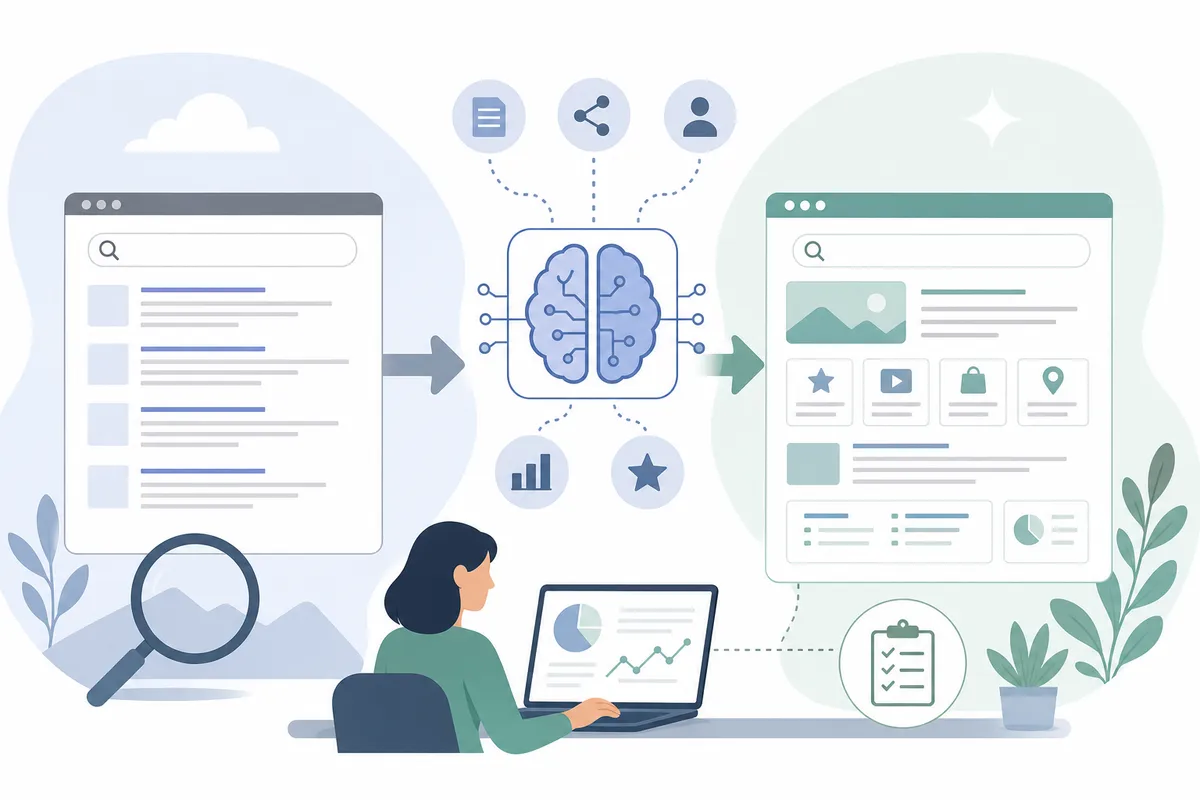
The role of AI in SERP analysis is to read, summarize, and rank search results at a scale no human team can match, while generating the AI Overviews that now sit above organic listings. AI is no longer just a tool for studying the SERP; it is reshaping the SERP itself.
If you have watched organic click-through rates soften over the past two years while your rankings held steady, this is why. Google's AI Overviews now occupy the most valuable real estate on the page. Understanding how they select, cite, and reward content has become as important as understanding the ten blue links ever were.
What Is the Role of AI in SERP Analysis, Exactly?

AI shows up in SERP analysis in two distinct ways, and conflating them is the most common mistake teams make.
The first is AI as a research tool: software that reads thousands of search results, clusters keywords by intent, and flags patterns you'd never spot by hand. The second is AI as part of the SERP itself: Google's AI Overviews. They generate a synthesized answer at the top of the page before a single organic result appears.
How AI Overviews actually process a query
When someone searches, Google's AI model analyzes the query and pulls from its index of web content. It identifies pages it judges authoritative and writes a summary that answers the question directly on the results page. It then shows citation links back to the sources it used. According to Semrush's documentation on the feature, in most cases AI Overviews cite trusted websites, publishers, blogs, and forums as source material. Ranking as one of those cited sources is functionally a new kind of visibility, separate from, but connected to, your organic position.
Why this changes how you read your own SERP data
Before AI Overviews, "am I ranking" had one answer: your position in the ten blue links. Now it has two: your organic position, and whether you're cited in the summary sitting above it. A page can lose clicks even while holding position one, because the searcher got their answer without scrolling down. That is the practical role AI plays in SERP analysis today, it adds a second scoreboard, and the two don't always move together.
The Role of AI in SERP Analysis, By the Numbers
The clearest way to see what AI Overviews actually did to search behavior is to look at controlled before-and-after data. Skai's data science team analyzed more than 300 million organic queries and 286 billion impressions across health, beauty, food and grocery, and business verticals. The analysis compared the four months before and after AI Overviews rolled out broadly in the US in May 2024.
The pattern differs by industry, which matters if you're trying to decide how urgently to act.
| Vertical | What changed post-rollout | What it signals |
|---|---|---|
| Health | Weekly ratio of longer, more detailed organic queries rose to roughly 3% | Searchers want in-depth, specific answers, not surface-level content |
| Beauty & personal care | Informational paid queries fell from 18% to 8% of total paid searches, while CTR on them held at 14% | Informational search volume is consolidating, but the traffic that remains still converts |
| Business & industrial | Average paid query length grew from 3.4 to 3.7 words; organic informational queries rose from 1.24% to 1.52% of all organic searches | Buyers are asking more specific, nuanced questions before they click anything |
SE Ranking's separate research on citation behavior adds the piece that matters most if your goal is to get cited rather than just indexed:
| Data point | Figure | Source | What it means for you |
|---|---|---|---|
| AI Overviews linking to a top-10 organic domain | 92.36% of cases | SE Ranking AI Overview research | Ranking in the top 10 is still the strongest predictor of citation |
| AI Overviews pulling content from a top-10 page | 63.19% of the time | SE Ranking AI Overview research | Getting to page one still does most of the work |
| Blog pages ranking in AI Overviews that also rank top 10 organic | 70% (40% rank top 5) | SE Ranking, own blog performance data | Organic strength and AI citation move together, not apart |
| Queries of 4+ words that trigger an AI Overview | 60.85% of cases | SE Ranking AI Overview research | Long-tail, specific content has more surface area to be cited |
| Fact density in cited vs. non-cited articles | Cited articles cover ~62% more facts | SE Ranking AI Overview research | Depth and specificity outperform thin, generic pages |
The takeaway from both data sets together: AI-driven SERP analysis hasn't replaced traditional ranking signals. It has made them the entry ticket to a second, higher-stakes competition for the citation itself.

How AI Changes What Actually Ranks
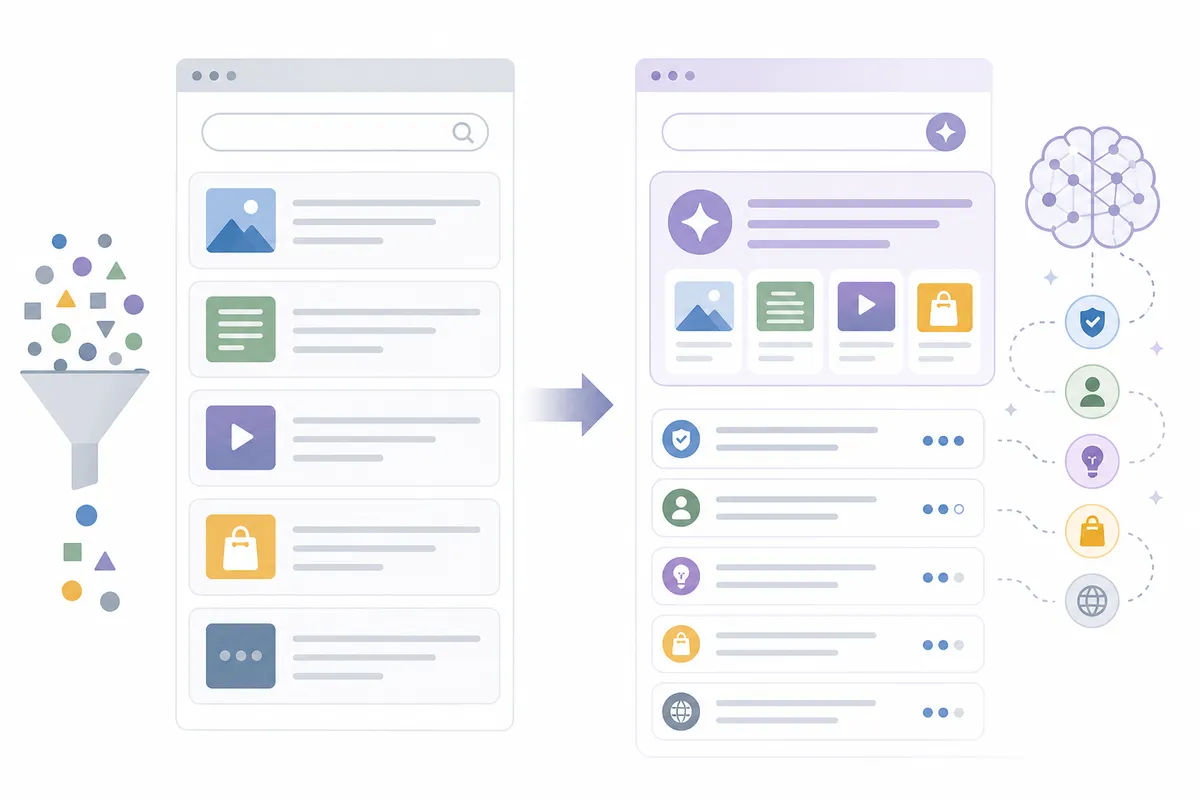
Here's the part worth being blunt about: nothing in the data above says AI has invented new ranking factors. What still moves the needle on keywords in a page's rankings hasn't fundamentally changed, and what actually moves rankings through backlinks hasn't either. What changed is the shape of the reward.
Keyword research gets faster, not different
AI tools can cluster thousands of keywords by intent in minutes, spotting related questions and latent phrasing you'd otherwise miss by manual review. That speed is genuinely useful for scoping a content plan. But speed isn't accuracy. The role of AI in keyword expansion (and where it breaks) is worth understanding before you let a tool auto-generate your target list. Clustering algorithms can group phrases that share words but not intent, which sends writers down the wrong angle on a topic.
Competitive analysis compresses from weeks to hours
Reverse-engineering why a competitor's page outranks yours used to mean a manual audit. Word count, heading structure, backlink profile, and on-page signals were checked one at a time. AI-assisted tools now run that comparison automatically and flag the gaps. A five-step workflow for AI-driven competitive analysis can get you from "they're beating us" to "here's specifically why" in an afternoon instead of a sprint.
Content structure now serves two readers at once
Every page you publish is now read by two audiences: a human scanning for an answer, and a language model deciding whether to quote you. Both reward the same things, a direct answer near the top, short paragraphs, clear headings, and claims backed by real data. SE Ranking's own testing found that placing a plain-answer paragraph in the first few sentences, followed by supporting detail, correlates with citation. That's not a new SEO tactic. It's the old "answer the question first" rule, just with a second, more literal reader.
Practical Strategies to Adapt for AI-Augmented SERPs
None of this requires throwing out your existing process. It requires reordering a few priorities.
- Audit your top pages for citation, not just position. Check which of your ranking keywords now trigger an AI Overview, and whether you're the cited source. A page holding position three with no citation is a different problem than a page holding position three that gets quoted verbatim.
- Lead every important page with a direct, quotable answer. Twenty to sixty words, no throat-clearing, stated as fact rather than a promise to explain later.
- Increase fact density, deliberately. Given that cited articles carry roughly 62% more facts than uncited ones on the same topic, thin pages are now competing at a structural disadvantage. That disadvantage isn't just about content quality.
- Keep content genuinely current. Freshness correlates with citation, but it isn't the whole story, a meaningful share of citations still come from older, well-established pages. Update facts and figures on a schedule rather than chasing a republish date for its own sake.
- Don't neglect local and off-site signals. If your goal is to get on the first page of Google in your own city without paid ads, AI Overviews haven't changed the underlying signals. Reviews, citations, local content, and links are still what gets you there. AI Overviews have just added a new layer of visibility on top of it.
- Track outcomes, not vanity metrics. Measuring what actually pays off in SEO analytics matters more now that a page can rank and still lose clicks to a summary above it. Watch assisted conversions and branded search lift alongside raw click volume.

A quick gut-check table for prioritizing pages
| Page situation | Priority | Why |
|---|---|---|
| Ranks top 10, gets cited in AI Overview | Maintain | Already capturing both forms of visibility |
| Ranks top 10, not cited | High | Closest win, needs answer-first structure and more fact density |
| Ranks page two or lower | Medium | Needs traditional SEO work before AI citation is realistic |
| No ranking, high-intent keyword | Foundation | Build the page properly first; citation follows ranking, not the reverse |
Where AI in SERP Analysis Still Gets It Wrong
Honesty matters here, because overselling AI's reliability sets you up for bad decisions.
Large language models can misread nuance, and AI-generated summaries occasionally overweight a source that happens to be well-structured over one that's more accurate. AI tools for competitor and keyword analysis inherit the same risk. They process patterns at scale, but they don't understand your business context the way a person reviewing the same data would. Treat every AI-assisted finding as a hypothesis to check, not a verdict to publish against.
Google itself frames the standard the same way it always has. Its own Search Essentials guidance states that following core SEO best practices improves your chances of being featured in AI Overviews. Those practices include helpful content, crawlable pages, clear structure, and demonstrated expertise. As Google's Brendon Kraham has noted, people who use AI Overviews search more and report higher satisfaction with their results. That suggests the feature is staying, not fading. Betting your strategy against it, rather than adapting to it, is the riskier move.
FAQs
What is the role of AI in SERP analysis?
AI in SERP analysis does two jobs at once. It helps you process search data faster by clustering keywords, spotting competitor patterns, and flagging content gaps. It also now generates the AI Overview summary that sits above organic results, deciding which pages get cited directly on the results page.
Do AI Overviews reduce organic traffic?
Often, yes, for informational queries where the summary fully answers the question. Data from Skai's analysis shows organic click-through rates softening after AI Overviews rolled out, particularly on informational searches. Paid listings captured more attention in several verticals.
How do I know if my page is cited in an AI Overview?
Search your target keyword and check whether an AI Overview appears with a link back to your domain in its sources. Some rank-tracking platforms also flag which of your tracked keywords trigger AI Overviews and whether you're among the cited pages.
Does ranking well in organic search still matter if AI Overviews exist?
Yes, more than ever. Research shows AI Overviews link to a top-10 organic result in over 92% of cases. They pull content from a top-10 page nearly two-thirds of the time. Citation is built on top of ranking, not instead of it.
Should I write content specifically to get cited by AI, or for human readers?
Write for the human reader first. The patterns that earn AI citation are a direct answer up front, real detail, clear structure, and credible sourcing. Those are the same patterns that make content genuinely useful to a person. Optimizing for one tends to serve the other.
See Where Your Own Pages Stand in the AI SERP
Start with your five highest-value keywords: check whether you rank in the top 10, then check whether an AI Overview appears and cites you. That single comparison tells you more about your real search visibility than your rank tracker alone. Understanding the role of AI in SERP analysis matters, but seeing where your own pages stand matters more. If you want a second set of eyes on it, talk to the team at SearchBlueprint. Look through a sample SEO report to see exactly what that kind of audit surfaces.
Resources / References
Sources
About the author
SearchBlueprint researched, wrote and scored this article with the content pipeline our customers run on their own sites. The score in the byline is what our content engine gave this page before it published. Nothing here is reviewed by hand, which is the point: it is the product's output, published where anyone can check it.