The Role of SEO in Digital Growth, and When It Pays Off
SearchBlueprint · · 14 min read · scored 95/100

The role of SEO in digital growth is to turn search demand into customers you don't pay for per click. It makes your pages easy to find in Google, Bing and AI answers, lowers acquisition cost over time, and keeps working after you stop spending. Most businesses see it pay off within six to 12 months.
This guide is for business owners and marketing leads deciding where SEO fits beside paid ads, social media and email. It covers five things: how search sends traffic, what each type of SEO does, how long the payoff takes, the mistakes that stall it, and how to tell whether it's working.
What SEO actually does for a growing business
Search engine optimization makes your pages easy to find, understand and trust, so search engines show them to people looking for what you sell. That sounds narrow, but it reaches your content, your site's code, your reputation on other websites and, for local firms, your map listing.
Search is where buying intent shows up
Most marketing channels interrupt people. An ad appears in a feed, or an email lands in an inbox. Search works the other way around. The person types a problem or a product name, and your page answers it. Organic visitors tend to convert well because they arrived with a question you can solve.
This is the heart of SEO's role in digital growth. SEO catches demand that already exists, at the moment it is strongest. For the long-term business case, see why organic SEO pays off for lasting business growth.
How search engines pick the pages they show
Google and Bing work in three steps:
- Crawlers find pages by following links.
- The engine indexes each page, storing what it says and how it is built.
- When someone searches, ranking systems sort the indexed pages by relevance, quality and usability.
Google Search Central documents each stage, including what stops a page from being indexed at all.
Every SEO task maps to one of those steps. A broken sitemap is a crawling problem. A thin page is a ranking problem. A page with a stray noindex tag never gets a chance to rank. Once you know which step is failing, you know which fix comes first.

Why SEO drives digital growth differently from paid channels
Every channel buys attention. What differs is how you pay for it and what you keep when you stop paying.
Paid attention keeps getting more expensive
Paid search is SEO's closest rival because it sells space on the same results page. PwC, cited by Coursera, projects that worldwide search advertising spending will reach $402.7 billion by 2030, growing at a compound annual rate of 6.1%. When more money chases the same clicks, bids tend to rise.
SEO still costs money. You pay for content, technical fixes and expertise. The difference is that the page keeps working after you pay for it: once it ranks, it sends visitors without a charge per click. The real business case for optimizing for Google goes through the trade-off in more detail.
Clicks cluster at the top
Page two of the results is close to invisible. Backlinko data cited by Coursera found that the first organic result on Google gets 27.6% of clicks, and clicks drop sharply on the second page. For a keyword with real buying intent, moving from position eight to position two can change a month's pipeline.
Customers cost less to win
The strongest argument for SEO as a growth channel is cost per customer. A report in American Impact Review, cited by Coursera, found that improving organic search traffic can cut customer acquisition cost by 41%. The same report found that organic traffic's ratio of customer lifetime value to acquisition cost was more than double that of paid search. When customers cost less to win, you have more budget for product, service and keeping the customers you have.
| Channel | How you pay | When results show | What happens when you stop | Best suited to |
|---|---|---|---|---|
| SEO | Content, fixes and expertise, with no charge per click | Typically six to 12 months | Rankings fade slowly and traffic continues for a while | Long-term digital growth, evergreen products, brand trust |
| Paid search (PPC) | A fee each time someone clicks the ad | As soon as ads go live | Traffic stops the same day | Launches, promotions, testing an offer quickly |
| Social media marketing | Time spent creating posts, or paid reach | Fast for paid posts, slow for organic reach | Reach drops once posting stops | Awareness, community, visual products |
| Email marketing | Email software and list building | Right away, once you have a list | Sales from the list slow down, but you keep the list | Repeat sales, following up with leads you already have |

The four types of SEO and what each adds to growth
Most guides split SEO into on-page, off-page and technical work. Local SEO is the fourth type, and it matters most to businesses that serve a set area. Each type solves a different problem, so a site that works on only one of them usually stalls.
| Type of SEO | What it covers | How it drives growth | A good first task |
|---|---|---|---|
| On-page SEO | Content, headings, title tags, meta descriptions, image alt text | Matches each page to what people search for, so the right visitors click | Rewrite title tags to 50 to 60 characters, including the page's main keyword |
| Technical SEO | Site speed, mobile layout, crawlability, site structure, internal links | Lets search engines find and index every page worth ranking | Check that your key pages are indexed and load quickly on a phone |
| Off-page SEO | Backlinks, brand mentions, reviews, digital PR | Builds the authority that decides close ranking contests | List the sites that link to your competitors but not to you |
| Local SEO | Google Business Profile, local citations, location pages | Puts you in map results for nearby searches with high intent | Fill in every field of your Google Business Profile |
On-page SEO: say clearly what each page is for
Most SEO growth starts with on-page work, because you control all of it. Each page should target one main search, answer it fully and make the next step obvious. Coursera's guidance puts title tags at 50 to 60 characters and meta descriptions at up to 160. Both should include the keyword and describe what the page offers.
Content is the bigger half of on-page SEO. Pages that rank usually answer the question better than the alternatives. They are specific, clearly structured and give the reader a reason to trust the writer. The six steps in how to create SEO content that keeps growing traffic cover planning, drafting and updating pages so they keep their rankings.
Technical SEO: remove what blocks search engines
Technical SEO keeps the foundation sound. Slow pages, broken links, duplicate URLs and pages left out of the sitemap waste good content. Speed matters here too. web.dev publishes the Core Web Vitals thresholds, which measure how fast and stable a page feels to a visitor.
Small fixes can help. Coursera's example is shrinking a 5,000-pixel-wide image to 1,200 or 2,000 pixels so it loads faster. Its other example is renaming "image1.jpg" to something descriptive, such as "dark-roast-coffee.jpg".
Off-page SEO: earn trust from other websites
Search engines read links from reputable sites as a sign that your pages are worth showing. Quality counts far more than quantity. One link from a respected industry publication can outweigh dozens from unrelated directories. Reviews and brand mentions add to the same signal. For a practical plan, read how to build organic search authority and why it pays.
Local SEO: win the searches near you
If you serve customers in one area, local SEO often pays off fastest. Searches like "plumber near me" or "best Italian food near me" show a map pack above the regular results. Three things improve your chances of appearing there: a complete Google Business Profile, the same contact details across every directory, and a page for each area you serve.
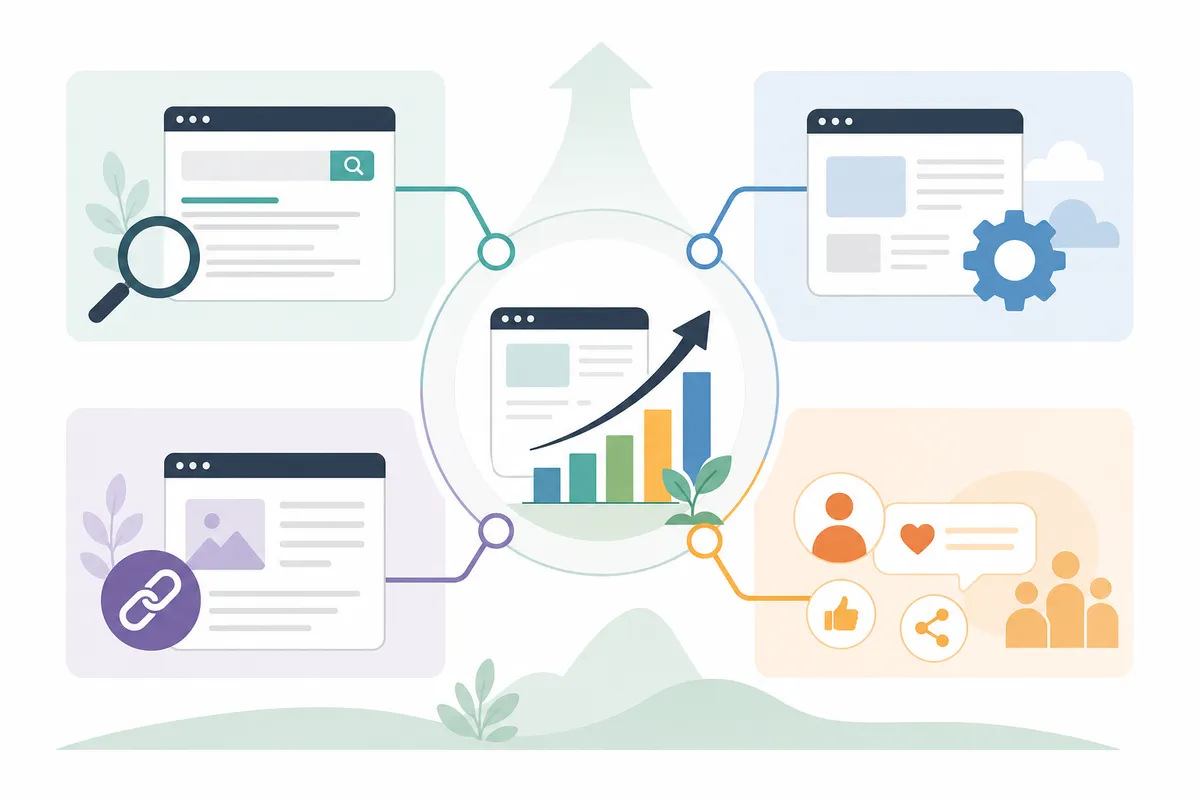
How SEO supports the rest of your marketing
SEO rarely works alone. It makes your other channels cheaper and more effective, and that support across channels is a large part of what it does for growth.
It makes paid ads work harder
When a brand shows up in both the paid and the organic results, searchers see it as more established. Coursera notes that becoming a trusted source in organic results can make paid ads more effective. Organic data also shows which keywords convert, so you can stop bidding on terms that never do.
It shows you what customers want
Keyword research is market research you can see. It shows the exact words customers use, the questions they ask before they buy and the products they compare. Search intent tells you whether someone wants to learn, compare or buy. You can use all of this in product pages, sales scripts, ad copy and email topics as well as blog posts.
It feeds AI answers as well as search results
Google AI Overviews, ChatGPT, Claude and Perplexity now answer many questions directly and cite web pages as sources. The pages they draw on tend to have the SEO basics in place: they can be crawled, they are clearly structured, and they are specific and trusted. A paragraph that answers a question in plain words is easier to quote than a vague one.
Automation helps here. AI tools can speed up keyword grouping, first drafts, technical checks and reporting. They can't decide your positioning or confirm a claim about your own business. Use them for the routine work, and keep a person responsible for strategy and accuracy.
Social platforms are search engines too
People also search inside YouTube, TikTok, Instagram and Reddit. A Forbes Agency Council contributor notes that content that ranks and gets engagement on social media often supports search rankings as well. Treat your content as one library, and publish it in the format each platform rewards.

How long SEO takes to pay off
Geoff Crain, writing for the Forbes Agency Council, puts the typical wait for SEO results at six to 12 months. Where you land in that range depends on how competitive your market is, what shape your site is in now and how much you publish. The wait is why SEO suits long-term goals, evergreen products and brand awareness better than a campaign that has to deliver next week.
What the first year usually looks like
The early months go into the foundation. You fix technical problems, rewrite key pages and choose the keywords worth winning. Traffic may barely move. Next comes steady publishing and link building. Search engines start to trust the site and try your pages for more searches. After that, the gains stack up: older pages keep ranking while new ones add to the total.
That stacking effect is what makes SEO worth the wait. Paid traffic stays flat, because the same spend buys roughly the same clicks each month. Organic traffic builds on what you've already done. How passive traffic from SEO compounds for years explains why well-built pages keep bringing in visitors long after they go live.
When SEO is the wrong first move
Be honest about whether SEO fits. If a product only sells for a few weeks, paid search will serve you better. The same goes for testing whether an offer works at all. SEO rewards patience and products people keep searching for. Many businesses run both: paid search for speed now, and SEO for cheaper growth later.
Common SEO mistakes that stall growth
When SEO fails, the cause is usually a lack of focus or patience, or a shortcut that backfires. Watch for these:
- Chasing only broad, high-volume keywords. Broad terms have the most competition, and the people searching them are often not ready to buy. Longer, more specific searches convert better and are easier to win. Using long-tail keywords for traffic and sales shows how to find them.
- Writing for the engine instead of the reader. Stuffing in keywords makes a page harder to read and doesn't help it rank.
- Ignoring search intent. A how-to search needs a guide. A "near me" search needs contact details and a map, not a long essay.
- Skipping technical basics. Even great content can't rank if the page is slow, broken or never indexed.
- Buying links or copying content. Google Search Essentials lists the spam policies that can get a site removed from results. A shortcut can put your whole domain at risk.
- Quitting after a few months. If you stop before the six-to-12-month mark, you've paid for the hard part and missed the payoff.
- Tracking rankings instead of revenue. Ranking first for a keyword nobody buys from doesn't grow the business.
Can you do SEO yourself, or should you hire help?
You can handle a lot of SEO without an agency, especially at the start. The skills can be learned, and the most valuable fixes are often simple.
What you can do yourself
- Write clear title tags and meta descriptions for your main pages.
- Complete your Google Business Profile and keep it up to date.
- Compress large images and give them descriptive file names.
- Publish pages that answer the questions customers ask you on sales calls.
- Ask happy customers for reviews.
- Check Google Search Console each month for pages that aren't indexed.
For a structure to follow, building an SEO strategy from scratch sets out the order for keywords, pages and links.
When to bring in a professional
Get expert help when the stakes or the complexity go up. A site migration or redesign is the clearest case, because missing redirects can wipe out years of rankings. Other good reasons are a site with hundreds of pages, heavy competition in your market or a technical problem you can't diagnose. A good specialist shows you what they found and explains why it matters.
How to measure SEO's role in your growth
Measure SEO by what it does for the business. Rankings and traffic are early signals. Revenue and cost per customer are the results that count.
Track these over time:
- Organic sessions and new users from your analytics tool, broken down by landing page.
- Rankings for the keywords that bring in sales.
- Clicks and impressions in Google Search Console. These show demand before your rankings rise.
- Conversions from organic visits, such as leads, calls, sign-ups or orders.
- Cost per customer by channel, so you can compare SEO with paid search fairly.
- Mentions in AI answers for your main topics, since those now send visitors too.
Look at the numbers monthly and judge progress quarterly. Movement from one week to the next is mostly noise. Understanding organic website traffic and how to grow it explains where organic visitors come from and what moves the number.
For one reference point, SearchBlueprint published a case study on running its own process on its own site, and it reported a 347% rise in traffic. Your results will depend on your market and your starting point. The method stays the same: fix, publish, earn links, measure and repeat.
FAQs
What is the role of SEO in digital marketing?
SEO makes your website show up in organic search results, so people already looking for what you sell can find you. It also helps your other channels by lowering ad costs, providing keyword data and building trust in your brand.
How long does SEO take to work?
A Forbes Agency Council contributor puts typical results at six to 12 months. It can take longer in competitive markets or on sites with technical problems. Small fixes, like better title tags, can work sooner.
Is SEO better than paid search?
Neither one wins every time. Paid search brings traffic the day your ads go live, but the traffic stops when your spending does. SEO is slower but keeps working. A report cited by Coursera found that organic search can cut customer acquisition cost by 41%. Most growing businesses use both.
Does SEO still matter now that AI tools answer questions?
Yes. AI answer engines like Google AI Overviews, ChatGPT and Perplexity draw on pages that are crawlable, clear and trusted. The work that helps a page rank also makes it more likely to be cited in an AI answer.
Can a small business do SEO without an agency?
Yes, for the basics. You can write good title tags, complete your Google Business Profile, publish helpful pages and ask for reviews. Bring in a specialist for a site migration, a large site or a technical problem you can't solve.
Compare a sample report with your own site, then talk to the team
Open this sample SEO report and check your own site against it: titles, speed, links and the keywords you already rank for. Then talk to the team about which gaps are costing you traffic. Looking at the gaps on your own pages is the quickest way to see the role of SEO in digital growth for your business.
Resources / References
Sources
About the author
SearchBlueprint researched, wrote and scored this article with the content pipeline our customers run on their own sites. The score in the byline is what our content engine gave this page before it published. Nothing here is reviewed by hand, which is the point: it is the product's output, published where anyone can check it.