Top 6 Organic Traffic Solutions: What Actually Works Now
SearchBlueprint · · 16 min read · scored 91/100

The top 6 organic traffic solutions in 2026 are intent-mapped keyword research, consistent quality content, technical SEO health, authority building, genuine engagement signals, and AI search visibility. Tools like SEMrush, Ahrefs, Surfer, and MarketMuse support each one, but no single subscription replaces the six working together.
That answer matters because most "top solutions" lists are really tool ads. They rank six products, quote a discount, and skip the harder question: which underlying strategies produce organic visitors that keep arriving after you stop paying attention. This guide covers both, the six solutions themselves, the tools that deliver each one, real listed pricing where it exists, and an honest look at the one "solution" you should probably avoid.
Key Takeaways
- Organic traffic compounds: unlike paid ads, a page that ranks keeps sending visitors without a per-click cost, and users tend to trust organic listings more than sponsored ones.
- The six solutions are keyword research, content production, technical SEO, authority building, engagement signals, and AI search (GEO/AEO) visibility, in that rough order of priority.
- Tool pricing varies wildly: one all-in-one platform lists plans at $99/month (discounted from $247/month), while a click-buying service starts at $197/month, and only one of those is a safe spend.
- Google's NavBoost system, confirmed through leaked documents and DOJ antitrust testimony, rewards genuine clicks and engagement, which is why earned CTR beats purchased clicks.
- Measure before you spend: get a traffic baseline and a competitor comparison first, then pick the one or two solutions with the biggest gap.
What Counts as an Organic Traffic Solution?

An organic traffic solution is any strategy, process, or tool that increases the number of visitors who reach your site from unpaid search results, Google, Bing, and increasingly AI answer engines like ChatGPT and Perplexity. It excludes paid ads, which stop delivering the moment your budget does.
This guide is written for business owners, in-house marketers, and agency teams who publish content and want more of the right visitors, not just more visitors. If you run an e-commerce store, a service business, or a SaaS blog, all six solutions apply. What changes is the weighting: a slow site needs technical fixes first, while a fast site with thin content needs the content solutions first.
One more framing point before the list. Some vendors now sell "organic traffic" as a product, real humans paid to click your listings. That approach exists, it has a sales pitch built on real leaked-document evidence, and we cover it honestly in Solution 5. Spoiler: the evidence about engagement signals is real; the conclusion the vendors draw from it is where things get risky.
The Top 6 Organic Traffic Solutions at a Glance
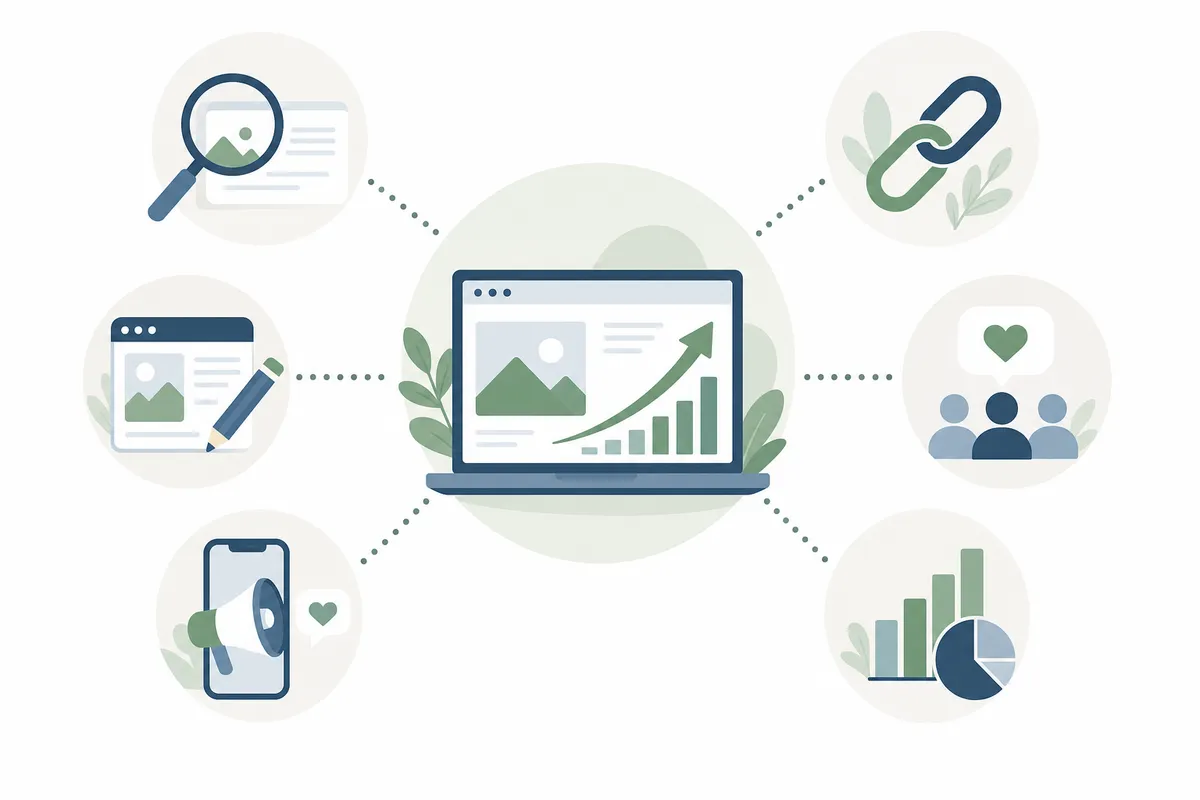
Here is the full set, summarized so you can jump to what you need. Each row stands alone: the solution, the job it does, who benefits most, and the effort involved.
| Solution | Core job | Best for | Effort required |
|---|---|---|---|
| 1. Intent-mapped keyword research | Finds queries real buyers type and matches each to the right page type | Any site publishing content; essential before writing anything | Moderate upfront, light ongoing |
| 2. Consistent quality content | Produces pages that satisfy searchers and meet Google's E-E-A-T bar | Blogs, e-commerce category pages, service pages | High and ongoing; AI assistance reduces it |
| 3. Technical SEO health | Makes the site fast, crawlable, and indexable so rankings aren't capped | Sites with speed issues, crawl errors, or messy architecture | Front-loaded; then periodic audits |
| 4. Authority building | Earns backlinks, reviews, and mentions that lift the whole domain | Newer domains competing against established rivals | Slow, relationship-driven, compounds over time |
| 5. Engagement signals | Improves click-through rate and dwell time on listings you already have | Sites ranking on page one but positions 4–10 | Low effort, fast feedback |
| 6. AI search visibility (GEO/AEO) | Gets your content cited in AI Overviews, ChatGPT, and Perplexity answers | Brands whose buyers now ask AI assistants first | Moderate; builds on solutions 1–3 |
Solution 1: Intent-Mapped Keyword Research

Keyword research is the foundation every other solution builds on. Get it wrong and you produce content nobody searches for, or content that ranks for queries your buyers never type.
Match Every Keyword to One of Four Intents
Searcher intent is the "why" behind a query, and mismatching it is the most common reason pages fail to rank. Four types cover nearly everything:
| Intent type | Example query | Content that matches | Funnel stage |
|---|---|---|---|
| Informational | "how to start an online store" | Blog post, guide, tutorial | Early, learning |
| Navigational | "shopify login" | The brand's own page; rarely worth targeting | N/A |
| Commercial investigation | "best e-commerce SEO tools" | Comparison post, review roundup | Middle, evaluating |
| Transactional | "buy waterproof trail running shoes" | Product or service page | Late, ready to buy |
The rule is one page, one primary keyword, one intent. A product page chasing an informational query will lose to a blog post every time, and vice versa. Map your keyword list to these four buckets before assigning a single article.
Mine Competitors for Keywords You Missed
Your rivals have already spent money finding out what ranks. Look at the keywords driving their traffic, the pages earning their links, and the gaps where they rank and you don't. A free competitor analysis that compares your organic rivals side by side is the fastest way to surface those gaps without a paid subscription. Prioritize keywords where a competitor ranks in positions 4–15 with a weak page, those are winnable fights.
Go Long-Tail and Chase "People Also Ask"
Long-tail keywords, longer, specific phrases like "best waterproof trail running shoes for wide feet", carry lower volume but far higher intent. Searchers using them are closer to buying. One Forbes Business Council contributor notes that a "People Also Ask" box appears in almost half of all Google searches, and that writing content answering those exact questions can win those placements directly (Forbes, 15 Low-Cost Tactics To Increase Organic Traffic). Pull the PAA questions for your main topics and answer each one in a dedicated section or post.
Then organize everything into topic clusters: one comprehensive pillar page per broad topic, with spoke pages covering subtopics and linking back. Search engines read that structure as topical authority.
Solution 2: Consistent, Quality Content Production
A keyword list is worthless until it becomes pages. The second solution is a repeatable production system that turns your research into content Google wants to rank and readers actually finish.
What "Quality" Means: The E-E-A-T Bar
Google's quality guidelines center on E-E-A-T: Experience, Expertise, Authoritativeness, and Trustworthiness. In practice that means content showing first-hand knowledge, written or reviewed by someone qualified, published on a site with a track record, and accurate enough to trust. Beyond E-E-A-T, ranking content in 2026 needs originality (not a rehash of the current top ten), depth (a complete answer, not a teaser), and formatting that scans, short paragraphs, descriptive headings, lists, and tables.
On-page basics still matter more than most teams admit:
- Title tags around 50–60 characters, with the primary keyword and a reason to click.
- Meta descriptions around 150–160 characters, not a direct ranking factor, but a click-through lever.
- One H1, logical H2/H3 structure, and descriptive image alt text.
- Internal links from every new page to related pages, so authority flows and crawlers find everything.
Using AI Without Publishing Slop
AI drafting has changed the economics of content. Platforms in this space now automate topical maps, briefs, drafts, and even publishing. Surfer, for example, combines a content editor with real-time optimization data, a content audit tool, and a topical map, a sensible workflow is to run the audit first, then use the editor and topical map to build a 30-day publishing plan. MarketMuse takes a strategy-first angle: one documented B2B use case had a team audit its blog, identify coverage gaps, and generate briefs that became a prioritized 90-day editorial plan focused on high-impact pages.
The honest caveat: raw AI output rarely meets the E-E-A-T bar on its own. The teams winning with AI content run every draft through structured checks, factual grounding, intent match, internal links, schema, readability, and add genuine expertise before publishing. AI compresses the drafting hours; it doesn't replace the judgment.
Refresh and Prune What You Already Own
Your fastest content wins usually hide in your archive. Audit existing pages for three situations:
- Decaying winners, pages that ranked well and slipped. Update facts, add missing subtopics, and re-optimize.
- Near-misses, pages sitting in positions 5–15. Small improvements here move real traffic.
- Thin overlap, multiple weak pages on one topic. Consolidate them into one strong page and redirect the old URLs.
A refresh often moves rankings faster than a new post, because the page already has age, links, and indexed history.
Solution 3: Technical SEO Health
Technical SEO is the ceiling on everything else. Brilliant content on a slow, uncrawlable site underperforms mediocre content on a clean one.
Speed and Core Web Vitals
Google measures user experience through Core Web Vitals: Largest Contentful Paint (loading), Interaction to Next Paint (responsiveness), and Cumulative Layout Shift (visual stability). Slow pages frustrate users, inflate bounce rates, and get demoted. Run your key pages through Google's free PageSpeed Insights, then fix the usual suspects: oversized images, missing caching, render-blocking scripts. Mobile matters most, Google indexes the mobile version of your site first, so a desktop-perfect, mobile-broken page is a broken page.
Crawlability, Architecture, and Indexing
Search engines can only rank what they can find and understand. The checklist:
- Shallow structure, any important page reachable within a few clicks of the homepage.
- XML sitemap submitted in Google Search Console, listing your important URLs.
- Robots.txt that blocks what should be blocked and nothing more.
- No broken links or crawl errors, check Search Console regularly and fix what it flags.
- Deliberate internal linking, every orphaned page is a page Google may never rank.
Structured Data for Rich Results
Schema markup is code that tells search engines exactly what a page contains. Done right, it makes pages eligible for rich snippets, star ratings, prices, FAQ dropdowns, that stand out in results and lift click-through rates. Product, Review, FAQ, and Article schema are the highest-value types for most sites. Structured data also feeds Solution 6, since AI answer engines lean on it to understand and cite pages confidently.
Solution 4: Authority Building, Links, Reviews, and Borrowed Audiences
Content and technical work determine whether you can rank. Authority often determines whether you do, especially in competitive niches where every top-ten page is already well-optimized.
Backlinks That Actually Move Rankings
Quality beats volume, always. One relevant link from a respected industry publication outweighs dozens of directory listings. The tactics that reliably work:
- Linkable assets, original data, calculators, free tools, and definitive guides that other writers cite.
- Digital PR, pitching genuinely newsworthy angles to journalists and niche publications.
- Co-branded content, case studies and infographics produced with partners or customers, so both audiences see them and both sites link.
- Guest contributions, publishing expertise on external sites your buyers already read.
Some automated platforms now bundle backlink building through vetted partner networks into their subscriptions. Treat those claims carefully: verify the linking sites are real publications with real traffic, not link farms. A cheap link from a spammy network can hurt more than no link at all.
Reviews and User-Generated Content
Reviews are an underrated organic traffic solution. Google favors businesses with strong review profiles, review aggregators often dominate commercial search results, and review content on your own product pages adds fresh, keyword-rich text you didn't have to write. Pair collected reviews with Review schema so star ratings appear in your search listings, a direct click-through-rate lift that costs time, not money.
Borrowed Audiences: Podcasts, Communities, Social
Authority isn't only links. The Forbes panel's low-cost tactics cluster around one idea: show up where your audience already gathers. Pitch relevant podcasts with a genuine value-add for listeners. Answer real questions on Reddit, Quora, and industry forums, which increasingly matters because AI engines mine those threads. Post consistently on the social platforms your buyers use, and pull readers back to deeper content on your site. None of this ranks a page directly, but it builds the brand searches, mentions, and links that do.
Solution 5: Engagement Signals, The Honest Version
This is where the top-ranking pages for this topic diverge sharply, so let's separate the evidence from the sales pitch.
What NavBoost Confirmed
In 2023, leaked internal Google documents and testimony in the DOJ antitrust trial confirmed that Google uses a system called NavBoost to adjust rankings based on user click behavior, which listings people click, how long they stay, and whether they bounce back to click a competitor ("pogo-sticking"). According to the leaked documentation, NavBoost has been part of Google's ranking system for over 13 years and is considered one of the more important signals in the algorithm.
The practical takeaway is real: a listing that earns more clicks and satisfies more visitors can genuinely climb. The legitimate ways to feed that system:
- Write irresistible titles that promise a specific outcome, the single highest-leverage CTR improvement.
- Win rich results (Solution 3) so your listing visually outcompetes neighbors.
- Answer completely so visitors don't pogo-stick back to the results page.
- Improve above-the-fold content so the first screen confirms the click was right.
Should You Buy Organic Traffic?
An entire product category now sells paid clicks as an organic traffic solution. SerpClix, the most visible example, claims a network of over 400,000 real human clickers across 160+ countries who search your keyword, click your listing, and stay on the page, offered with a free 7-day trial and plans from $197/month. The pitch cites the NavBoost evidence above and vendor comparisons claiming organic results capture 70%+ of clicks versus ads.
Here's the honest assessment:
| Approach | How it works | Risk level | Durability |
|---|---|---|---|
| Earned CTR optimization | Better titles, rich snippets, complete answers attract genuine clicks | None, this is just good SEO | High; improvements persist and compound |
| Paid human click services | Real people are paid to search, click, and dwell on your listing | Significant, engagement is real but the intent is manufactured, and patterns can look anomalous | Uncertain; signals stop when payments stop |
| Bot traffic services | Scripts and proxies simulate visits for a few dollars per thousand | Severe, Google detects and discards bot signals, and patterns can trigger spam systems | None; can actively damage rankings |
The evidence that engagement influences rankings is solid. The leap from "engagement matters" to "purchased engagement is safe and durable" is the vendors' leap, not the evidence's. Google has spent enormous resources detecting artificial click patterns, and manufactured clicks that stop when your subscription lapses leave you exactly where you started, minus $197 a month. Spend that budget on titles, schema, and content depth instead. Those earn the same signals from people who might actually buy something.
Solution 6: AI Search Visibility (GEO and AEO)
The newest of the six solutions, and the one most 2026 buyers underweight. A growing share of "searches" now happen inside ChatGPT, Perplexity, Claude, and Google's AI Overviews, and those engines cite sources. Being the cited source is the new position one.
Why AI Answers Are the New Front Page
Generative engine optimization (GEO) and answer engine optimization (AEO) describe the same goal: getting your content quoted, cited, or recommended inside AI-generated answers. When an AI Overview answers a query directly, the classic blue links below it lose clicks, but the two or three cited sources gain visibility, credibility, and referral traffic. Tool vendors have noticed: several platforms in the comparison below now track brand appearances across ChatGPT, Claude, and Perplexity alongside traditional Google rankings, and some surface Reddit conversations where your brand could earn a mention, because AI engines weight those threads heavily.
How to Get Cited by AI Engines
AI engines quote content that is easy to lift and safe to attribute:
- Front-load answers. Open each section with a self-contained 40–60 word passage that answers the question directly, before the detail.
- Be specific. Concrete figures, named steps, and clear definitions get cited; vague claims don't.
- Use extractable structure. Tables, numbered lists, and Q&A formats are what answer engines lift verbatim.
- Add FAQ and Article schema so engines can parse your content confidently.
- Build entity presence, consistent brand information across your site, profiles, and the communities AI engines mine.
The good news: solutions 1 through 3 already do most of this work. GEO is largely rigorous SEO with an extraction-friendly writing style layered on top.
Which Tools Deliver These Six Solutions?
The top-ranking articles for this keyword mostly compare software, so here's the comparison, with the pricing those sources actually publish, and honest gaps where they don't. Every price below is as listed by the vendor or the comparison sources; verify current rates before buying.
| Tool | Primary strength | Listed pricing | Best fit |
|---|---|---|---|
| SEMrush | All-in-one toolkits spanning SEO, content, local, social, and ads | Multiple paid tiers plus free utilities; rates on vendor site, often cited as high for small businesses | Agencies and teams wanting one platform for everything, who can absorb a learning curve |
| Ahrefs | Backlink index and competitive keyword research depth | Tiered plans listed on vendor site | Teams prioritizing link analysis and competitor intelligence (Solutions 1 and 4) |
| Surfer | Real-time content editor, content audits, topical maps, plus AI visibility tracking | Not published in the comparisons reviewed; check vendor site | Content teams optimizing while drafting (Solution 2), with a noted learning curve for SEO beginners |
| MarketMuse | Topic authority analysis, gap identification, and automated content briefs | Free tier plus Optimize, Research, and Strategy paid tiers | Content teams and enterprises running large editorial operations; reviewers note it suits teams better than solo creators |
| Frase | Brief-to-draft content workflows built around answering search queries | Rates on vendor site | Smaller teams turning research into optimized drafts quickly |
| BabyLoveGrowth.ai | Automated content publishing, backlink network, and AI-answer tracking in one pipeline | Listed at $99/month, discounted from $247/month, with agency options | Agencies wanting automation across content and links, with due diligence on the backlink network's quality |
Two buying principles beat any single row in that table. First, match the tool to your weakest solution: a team with great content and no links needs Ahrefs-style analysis, not another editor. Second, never buy before baselining, a subscription can't tell you it worked if you don't know where you started.
DIY or Hire Help? An Honest Split
You do not need an agency for everything, and vendors won't tell you that.
Genuinely DIY-friendly: keyword research with free tools, refreshing existing content, writing titles and meta descriptions, collecting reviews, answering PAA questions, fixing broken links flagged by Search Console, and posting consistently in communities. A motivated owner can run these with a few hours a week.
Worth professional help: site migrations, deep technical audits on large sites, structured data implementation at scale, digital PR campaigns, and competitive niches where every rival has an in-house team. The cost of doing these wrong, a botched migration can erase years of rankings, usually exceeds the cost of doing them right.
Worth automating: the repetitive middle, briefs, drafts, internal link suggestions, rank tracking, reporting. This is where the platforms above earn their subscriptions, provided a human still owns strategy and quality control.
How to Measure Whether Any of This Works
Every one of the six solutions is measurable, and measuring is what separates strategy from hope.
Start with a baseline before changing anything. Run your domain through a free website traffic checker to estimate your current organic traffic, note your ranking keywords, and screenshot your Search Console clicks and impressions. Then track four numbers monthly:
- Organic sessions, the headline metric, from your analytics platform.
- Ranking keywords and average position, are you appearing for more queries, higher?
- Click-through rate by page, from Search Console; the direct readout on Solution 5.
- Conversions from organic, traffic that doesn't convert is a vanity metric.
Set expectations honestly. Organic growth is a compounding curve, not a switch: technical fixes and content refreshes tend to show movement first, new content and authority building take longer, and the gains stack. The businesses that win are the ones still publishing and refining in month six, when most competitors have quit.
FAQs
What is the fastest organic traffic solution?
Refreshing pages that already rank in positions 4–15 and improving their titles for click-through rate. These pages have existing authority, so small changes move measurable traffic faster than new content, which needs time to be crawled, indexed, and trusted.
Are organic traffic solutions better than paid ads?
They serve different jobs. Paid ads deliver instant visibility but stop the moment spending stops, and costs rise in competitive markets. Organic traffic requires upfront effort but keeps arriving without a per-click cost, and users generally trust organic listings more than sponsored ones. Most healthy strategies use ads for speed and organic for durability.
Does buying organic traffic through click services actually work?
The engagement signals these services target are real, Google's NavBoost system, confirmed in the DOJ antitrust trial, uses click behavior in rankings. But purchased clicks carry manufactured intent, the signals stop when payments stop, and services start around $197/month. Earning the same signals through better titles, rich snippets, and complete answers is safer and more durable.
How long until organic traffic solutions show results?
It varies by starting point and competition. Technical fixes and content refreshes typically show movement soonest, while new content, authority building, and AI-search visibility compound more gradually. Treat organic as a multi-month investment; sources across the industry consistently describe it as a marathon rather than a sprint.
Which of the six solutions should a small business start with?
Run a baseline first: check your current traffic, rankings, and site health. Then fix the weakest link. Most small sites get the best early return from intent-mapped keyword research plus refreshing existing content, because both are low-cost and use assets you already own.
Baseline Your Site Before You Buy Anything
Pick one solution from the top 6 organic traffic solutions above, measure where you stand today, and commit to ninety days of consistent execution before judging results. If you want to see exactly what a proper baseline looks like, rankings, technical issues, content gaps, and a prioritized plan in one document, browse a sample SEO report showing every metric worth tracking and talk to the team about running one for your site.
Resources / References
Sources
About the author
SearchBlueprint researched, wrote and scored this article with the content pipeline our customers run on their own sites. The score in the byline is what our content engine gave this page before it published. Nothing here is reviewed by hand, which is the point: it is the product's output, published where anyone can check it.