What an AI-Powered SEO Platform Really Does in 2026
SearchBlueprint · · 17 min read · scored 89/100

An AI-powered SEO platform is software that runs the full search workflow, auditing your site, researching keywords, drafting and publishing content, fixing technical issues, and tracking rankings in both Google and AI answer engines. The best ones execute the work; the weakest just add "AI" to a dashboard you already had.
That distinction matters more than any feature list. Pricing in this category runs from $14/month indexing utilities to $2,499/month done-for-you visibility services, and the gap between "genuinely useful" and "budget drain" is wide. One agency reviewer who tested more than 40 of these tools on client accounts put it bluntly: some changed how his team works, and the rest were pure budget drain.
This guide explains how these platforms actually work, what they cost in 2026, when they beat an agency or a DIY tool stack, and how to evaluate one before you pay.
Key Takeaways
- A true AI-powered SEO platform executes work, publishing content, applying fixes, verifying results at the live URL, rather than only reporting problems.
- Real 2026 pricing spans $16/month (Writesonic entry tier) to $2,499/month (OnCited's Scale plan), with most execution-grade platforms clustering between $99 and $399/month.
- Modern platforms must cover two surfaces: classic Google rankings and AI answer engines like ChatGPT, Perplexity, and Google's AI Overviews.
- Experienced reviewers reject tools whose data diverges from Google Search Console by more than 15–20%, and test for at least three months before trusting one.
- Automation without human review is a risk: Google's spam policies explicitly target scaled, low-value content, however it was produced.
What Is an AI-Powered SEO Platform?

An AI-powered SEO platform combines the jobs that used to require five separate tools, a crawler, a keyword database, a content editor, a rank tracker, and a reporting suite, into one system, then uses AI to do the labor between those steps. Instead of exporting a keyword list, briefing a writer, uploading a draft, and checking rankings a month later, the platform handles the sequence and shows you what changed.
The category exists because SEO's workload outgrew the humans doing it. One widely cited roundup frames the problem well: tasks that took 10 hours of manual work, like analyzing competitor keywords or checking hundreds of pages for technical issues, now finish in minutes with the right software. That freed time is the whole value proposition.
Monitoring Tools vs. Execution Platforms

Not everything sold under this label is a platform. Most products fall into one of two camps, and the difference determines what you actually get for your money.
Monitoring tools tell you where you stand. Rank trackers, AI visibility scorers, and audit crawlers all fit here. They are useful, but the work still lands on your desk. Execution platforms close the loop: they draft the article, publish it to your CMS, build the internal links, submit the page for indexing, and then measure whether it moved. SearchBlueprint's AI SEO agent is built on this model, you give it one URL and it runs the audit-plan-publish-measure cycle from there.
A quick test: if the tool's output is a to-do list, it's a monitor. If its output is a published, verified change on your site, it's a platform.
Who These Platforms Are For
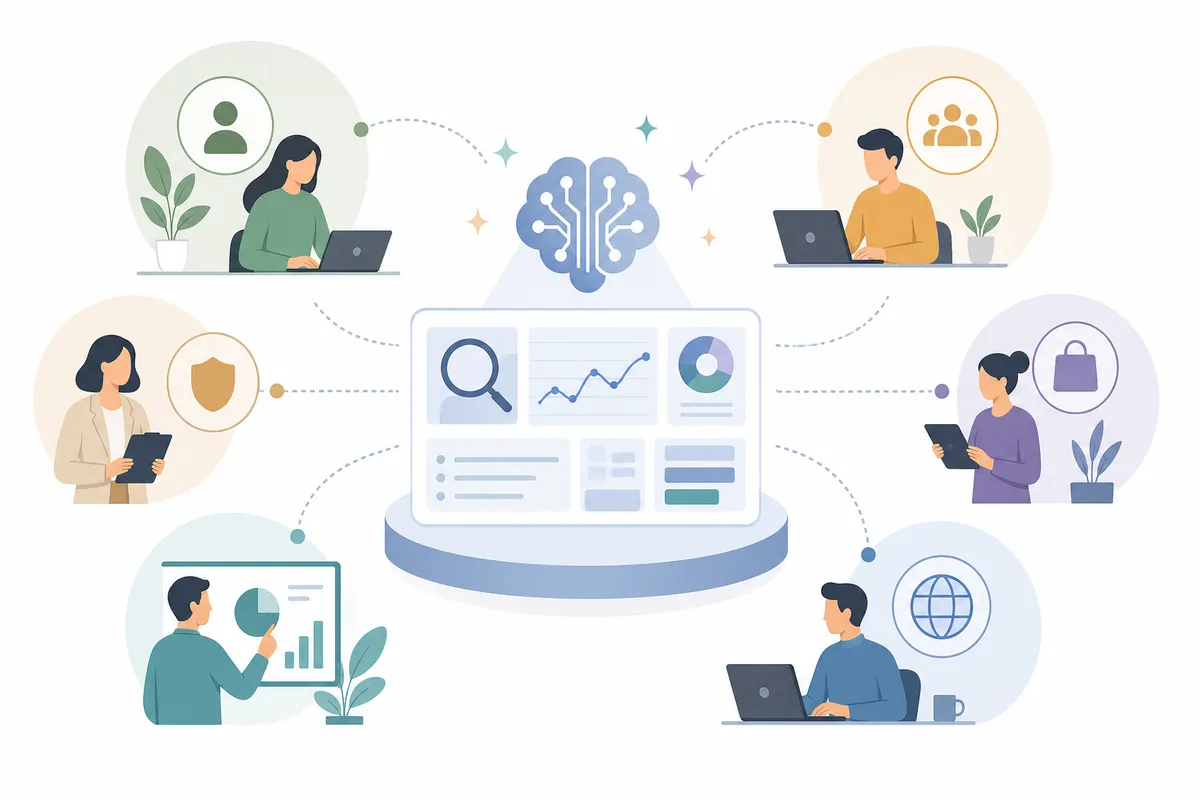
Three groups get the most from an AI SEO platform:
- Small business owners who can't justify a $2,000+/month agency retainer but need consistent publishing and technical hygiene.
- In-house marketers who own SEO alongside four other channels and need the repetitive 80% automated.
- Agencies that want to serve more clients per strategist, using the platform for production and their people for judgment.
If you run a large enterprise site with dedicated SEO engineers, you may prefer raw data APIs and custom builds, DataForSEO, for instance, offers pay-as-you-go access with a $50 minimum for exactly that audience. For everyone else, the packaged platform is usually the faster path.
How an AI-Powered SEO Platform Works, Step by Step
Under the hood, most credible platforms run the same four-stage loop. What differs is how much of each stage is automated and how much lands back on you.
Stage 1: Crawl and audit
The platform crawls your site the way a search engine would, flagging broken links, missing meta tags, thin pages, slow templates, and indexing blockers. Scale varies by tier, Search Atlas's $99/month Starter plan, for example, is listed with 50,000 site audit pages and 2,000 tracked keywords on a single project.
The audit's usefulness depends on prioritization. A raw list of 400 issues is noise. A good technical SEO audit puts the fixes in order by expected impact, so you (or the platform itself) tackle the ten changes that matter before the 390 that don't.
Stage 2: Keyword and content planning
Next, the system maps what your audience searches for against what your site already covers. AI helps here in two specific ways: clustering thousands of keywords by actual SERP similarity rather than phrase matching, and scoring difficulty against your domain instead of a generic 0–100 number. The output is a content plan, which pages to create, which to update, which to merge.
Stage 3: Drafting and publishing
This is where platforms diverge most. Basic tools hand you a brief. Mid-tier tools generate a draft you copy-paste. Full platforms write, check, and publish. SearchBlueprint's AI article writer runs 36 checks on every draft, covering structure, keyword placement, internal links, and readability, before anything goes live, which is the kind of guardrail that separates usable output from generic filler.
Publishing integration matters more than it sounds. The Writesonic review in one 2026 roundup found the tool could push directly to WordPress, "which can save you hours." The stronger version of that feature is publish verification: the platform confirms the change actually rendered at the live URL, not just that the API call succeeded. If your site runs on Shopify, Webflow, WordPress, or another CMS, check that the platform publishes natively to where your site already lives.
Stage 4: Tracking and iteration
Finally, the loop closes with measurement. Weekly rank tracking per market shows whether each published change moved positions. Indexing automation, a niche that tools like Indexly serve from $14/month, makes sure new pages don't sit in "Discovered, not indexed" limbo, a state documented in Google's own Page Indexing report, for weeks. And increasingly, tracking extends beyond Google into AI answer engines, which we'll cover in its own section below.
The loop then restarts. That's the honest description of what "autopilot SEO" means: not magic, but a cycle that runs weekly without you pushing every step.
What an AI SEO Platform Costs in 2026
Pricing spreads across a huge range because the category mixes single-purpose utilities with full execution platforms and done-for-you services. Here are representative listed prices from 2026 vendor pages and independent roundups.
| Tool / Plan | Category | Listed Price (2026) | What You Get at That Price |
|---|---|---|---|
| Indexly | Indexing automation | Free plan; paid from $14/month | Automated index submissions so new pages appear in search faster |
| Writesonic | AI content creation | From $16/month, tiered by users/projects | Research, drafting, and optimization with real-time SEO data |
| Rankscale.ai | AI visibility tracking | From $20, credit-based, no subscription | Brand visibility in AI engines by keyword, engine, and region |
| Ranking Raccoon | Link exchange community | Free plan; Pro at $25/month | Moderated backlink exchanges with vetted websites |
| AIclicks | AI visibility tracking | From $59/month, 3-day trial | Brand tracking across 10+ AI search engines, free brand audit |
| SE Ranking (AI Tracker) | SEO suite + AI tracking | From $95.20/month billed annually | Google AI Overview tracking compared against organic rankings |
| Search Atlas Starter | Execution platform | $99/month | 50,000 Universal Credits: ~50 AI articles, 100 content edits, or 1,500 rank checks; 7-day free trial |
| Semrush AI Visibility Toolkit | AI visibility tracking | $99/month | Prompt tracking and cited-source analysis across major AI surfaces |
| Ahrefs (AI Content Helper) | SEO suite add-on | From $129/month | Intent-based content optimization inside the Ahrefs subscription |
| Semrush (SEO plans) | SEO suite | From $139/month | Traditional SEO toolkit; bundled SEO + AI plans at higher tiers |
| Pitchbox | Outreach automation | From $165/month | Backlink outreach with AI personalization and tracking |
| Clearscope | Content optimization | From $189/month | Optimization scoring for human-written content |
| Semrush One Starter | SEO + AI visibility suite | $199/month, 14-day trial | Combined SEO toolkit and AI Visibility Toolkit, one login |
| OnCited | Done-for-you AI visibility | $399/month (Starter) to $2,499/month (Scale) | Prompt tracking plus a team publishing brand mentions for you |
Prices above are as listed by vendors or reported in 2026 reviews; check current pages before buying.
Reading the Price Bands
Three bands emerge from that table, and each answers a different question:
- Under $100/month buys a point solution. You solve one job, indexing, drafting, or visibility tracking, and stitch the rest together yourself.
- $99–$199/month buys an actual platform: audit, content, publishing, and tracking under one login. Search Atlas at $99 and Semrush One Starter at $199 bracket this band. This is where most small businesses and lean teams should shop.
- $399/month and up buys service, not just software. OnCited's plans include a team that writes and publishes brand mentions across Reddit, Quora, review sites, and forums on your behalf, closer to a productized agency than a tool.
One more budgeting note from the reviewers who test these tools professionally: annual billing typically saves 20–30% over monthly, but always run the free trial on your own site first. Search Atlas offers 7 days, Semrush One 14, AIclicks just 3, enough to check data accuracy, not enough to see ranking results, so judge the trial on workflow fit and data quality rather than traffic.
Platform vs. Agency vs. DIY Tool Stack
The real buying decision usually isn't "which platform", it's "platform, agency, or a pile of individual tools." Each model trades money against time and control differently.
| Factor | AI-Powered SEO Platform | SEO Agency | DIY Tool Stack |
|---|---|---|---|
| Typical monthly cost | $99–$399 for execution-grade plans | Commonly several times platform pricing; done-for-you AI visibility services alone list at $399–$2,499/month | $50–$300 across 3–5 separate subscriptions |
| Who does the work | Software executes; you approve | The agency's team executes end to end | You execute everything manually |
| Speed to output | Audits in minutes; drafts same day; publishing automated | Days to weeks per deliverable, depending on retainer scope | Limited by your own hours |
| Strategic judgment | Built-in playbooks; human judgment is yours to add | Highest, senior strategists on complex problems | Entirely dependent on your own expertise |
| Best fit | Small businesses and lean teams that need consistent volume | Competitive niches, complex migrations, PR-driven link building | Hobbyists, single-site owners, and specialists who enjoy the craft |
When the platform wins
A platform wins when the bottleneck is throughput: you know roughly what needs doing, and nobody has time to do it. Publishing two verified articles a week, fixing meta tags across 300 product pages, keeping internal links current, this is machine work, and paying agency rates for it is inefficient. It's especially true for storefronts, where e-commerce SEO on Shopify or BigCommerce involves hundreds of near-identical category and product pages that automation handles far better than a human with a spreadsheet.
When an agency wins
An agency earns its retainer when the bottleneck is judgment: a penalized site, a domain migration, digital PR that requires real journalist relationships, or a niche so competitive that strategy beats volume. The OneLittleWeb case study behind one top-ranking guide, an AI SaaS client reaching 18.5M SEO visits and 40K LLM visits per month within 12 months, and another client growing SEO traffic 76% and LLM traffic 1,900% in a year, reflects what senior human strategy plus tooling can do at the high end. Tools track visibility; closing the gaps is still work, and sometimes it's specialist work.
When DIY tools win
If you run one site, publish monthly, and genuinely enjoy SEO, a free-tier stack plus a $16–$25/month tool or two covers you. You can go a long way with free SEO and AI-search tools, rank checkers, on-page scorers, keyword suggesters, before paying for anything. The honest trade-off: your time is the subscription fee.
Many teams land on a hybrid. The platform runs the weekly loop; a consultant or agency handles quarterly strategy. That combination often costs less than a full retainer while producing more shipped work.
The Features That Separate Real Platforms From AI Wrappers
Roundup after roundup in 2026 lands on the same complaint: too many tools "repackage basic data and slap AI-powered on the label." Regulators have noticed the same pattern, the FTC has explicitly warned companies to keep their AI claims in check rather than exaggerate what their products do. Here's the filter that catches them.
1. Execution with publish verification
The platform must be able to do things, publish an article, update a title tag, add internal links, and then verify the change at the live URL. An API success message is not proof; sites cache, plugins conflict, and themes strip markup. Verification at the rendered page is the difference between "we published" and "we hope we published."
2. Quality gates on generated content
Unreviewed AI output is a liability, not a shortcut. Look for a platform that runs structured checks on every draft, fact patterns, heading logic, keyword balance, link placement, rather than shipping raw model output. There's a real craft to using AI writers without tanking your rankings, and the platform should encode that craft as enforced rules, not leave it to hope.
3. Prioritized technical fixes
Every crawler finds issues. The valuable platforms rank them by impact and, where safe, apply the fix themselves. If a tool's audit output is an undifferentiated CSV of 2,000 warnings, you've bought a homework generator.
4. Internal linking from a real crawl
Internal links are one of the highest-leverage, most-neglected SEO tasks, and they're perfect automation territory, but only if suggestions come from an actual crawl of your pages, so every recommended link points somewhere that exists and is relevant. Generic "add more internal links" advice fails this test.
5. Dual-surface visibility tracking
In 2026, tracking Google alone is half a scoreboard. The platform needs to show where you appear in AI Overviews, ChatGPT, Perplexity, and similar engines alongside classic rankings. SE Ranking bundles an AI Overview tracker into its Pro and Business plans; Semrush built an entire Visibility Toolkit around it. Whatever you choose, insist on this.
6. Fit for your actual business model
A local service business needs rank-grid tracking and location pages far more than it needs a backlink database. If that's you, evaluate the platform's local SEO capabilities, rank grids and location page generation, before anything else. An online store needs product-feed and collection-page handling instead. Match the tool to the job, not the marketing site to your hopes.
AI Search Visibility: The Half of the Job That's New
The reason "AI-powered SEO platform" replaced "SEO tool" as the category name isn't just that the software uses AI. It's that search itself now runs on AI, and the platform has to optimize for both surfaces at once.
The scale of the shift shows up in vendor data. Semrush's prompt database, the largest exposed inside a commercial platform, per one 2026 review, now monitors 261 million prompts across 32 countries, with daily prompt tracking and weekly brand-performance updates. Semrush's own research, cited in a Whatagraph roundup, suggests AI search visitors could surpass traditional search visitors for digital marketing topics by early 2028. Whether that timeline holds or slips, the direction is not in dispute.
What "AI visibility" actually means
Three measurable things, in practice:
- Mentions: does ChatGPT, Perplexity, or Gemini name your brand when a buyer asks a relevant question?
- Citations: when an AI answer links sources, is your page one of them?
- Sentiment and positioning: when you're mentioned, are you framed as a leader, an alternative, or a caveat?
A dedicated sub-industry now tracks these, Rankscale.ai from $20 credit-based, AIclicks from $59/month across 10+ engines, OnCited from $399/month with done-for-you publishing. Full platforms fold the same tracking into the main workflow, which is usually the better buy unless AI visibility is your only concern.
Optimizing for Answer Engines
The good news: content that wins AI citations looks a lot like content that wins featured snippets. Clear, self-contained answers near the top of a section. Specific figures instead of vague claims. Structured headings a machine can parse. The strategic implications run deeper than formatting, though, how AI search engines are reshaping SEO strategy in 2026 is worth understanding before you rebuild your content plan, because query behavior, not just result formatting, is changing.
A capable platform bakes these patterns into its drafting checks, so every published page is answer-engine-ready by default rather than retrofitted later.
How to Evaluate an AI SEO Platform Before You Pay
The professionals who review these tools for a living follow a consistent method, and you can copy it in a single trial period.
Test data accuracy against your own Search Console
The benchmark experienced reviewers use: cross-check the platform's keyword volumes and ranking positions against Google Search Console and GA4. If numbers are consistently off by more than 15–20%, or the tool suggests optimizations that contradict what GSC shows, walk away. One agency tester applies this over three or more months across multiple accounts before a tool earns a permanent slot, you won't have three months in a trial, but even one week of side-by-side comparison exposes flaky data.
Run the trial on real work, not sample projects
Point the platform at your actual site and your actual next task. Generate a draft on a topic you know cold and grade it yourself, SearchBlueprint's free AI content writer lets you test draft quality before spending anything, which is a low-risk way to calibrate expectations for the category. Run the audit and check whether the top-priority fixes match what you already suspected. If the "AI insights" are things you'd find with a quick Google search, the tool failed the test one reviewer applies to every launch.
Score it on a consistent rubric
| Criterion | What to Check | Pass Signal | Fail Signal |
|---|---|---|---|
| Data accuracy | Compare volumes and positions with GSC/GA4 for a week | Within 15–20% of GSC consistently | Persistent divergence or unexplained numbers |
| Real AI vs. wrapper | Do insights reflect your specific site and domain? | Page-specific, actionable recommendations | Generic advice any LLM would give for free |
| Workflow fit | Integrations with your CMS, GSC, GA4, docs tools | Publishes and verifies without manual copy-paste | Every task ends in a manual export |
| Content quality | Generate one article on a topic you know well | Accurate, structured, needs light editing | Bland, generic, or factually shaky output |
| Scalability | Pricing at 3x your current sites/keywords | Predictable tiers you can grow into | Costs that balloon per added domain or seat |
Confirm the human handoff points
Finally, map where the platform expects your judgment. Every honest vendor has these points, approving a content plan, reviewing a draft, greenlighting a technical change. If a platform claims zero human involvement is needed, treat that as a warning sign rather than a feature. The evidence from hands-on testing supports this: even a well-regarded AI writer produced a draft one reviewer called "meh… bland and monotonous" despite uploaded brand guidelines. AI produces the volume; humans produce the voice. Knowing when AI content works and when a human writer is worth the cost is part of running any platform well.
The Risks: Where Automation Goes Wrong
An honest guide has to cover the failure modes, because they're common and mostly self-inflicted.
Scaled low-quality content. Google's spam policies, documented in Google Search Essentials, target scaled content created primarily to manipulate rankings regardless of how it was produced. An AI-powered SEO platform makes it trivially easy to publish 50 articles a month; if those articles are thin, that speed becomes a liability. Quality gates and human review aren't optional extras, they're what keeps the automation on the right side of the policy line.
Over-optimization. Reviewers of content-scoring tools note that following every recommendation rigidly produces "robotic content that reads like an SEO checklist." Scores are guidance, not gospel. A platform should let you decline suggestions without penalty.
Stale or hallucinated data. AI outputs are only as good as the data beneath them. Flaky connectors and outdated indexes produce confident, wrong recommendations. This is exactly why the GSC cross-check above matters, it's the one data source Google itself provides.
Tool sprawl in disguise. Buying a "platform" that still requires four other subscriptions to function isn't consolidation; it's the old stack with a new invoice. Count the total monthly cost of everything you'd actually need before comparing prices.
None of these risks argue against automation. They argue for automation with checkpoints, which is precisely what distinguishes the platforms worth $99–$199/month from the wrappers worth nothing.
FAQs
What is an AI-powered SEO platform?
It's software that automates the full SEO workflow, site audits, keyword research, content drafting, publishing, technical fixes, and rank tracking, using AI to handle repetitive work while you approve key decisions. The strongest platforms execute and verify changes on your live site; weaker tools only report problems.
How much does an AI SEO platform cost in 2026?
Point solutions start around $14–$25/month (indexing, link communities). Execution-grade platforms cluster between $99/month (Search Atlas Starter, listed with 50,000 monthly credits) and $199/month (Semrush One Starter). Done-for-you AI visibility services like OnCited run $399 to $2,499/month. Annual billing typically saves 20–30%.
Can an AI SEO platform replace an agency?
For routine execution, publishing, on-page fixes, rank tracking, internal linking, yes, often at a fraction of retainer cost. For high-judgment work like penalty recovery, site migrations, and digital PR, agencies still earn their fees. Many businesses run a platform for weekly output and bring in specialists for quarterly strategy.
Is AI-generated SEO content safe for rankings?
Yes, if it's reviewed and genuinely useful. Google's spam policies target scaled, low-value content regardless of whether a human or a machine wrote it, and Google's own guidance on AI-generated content confirms that quality matters more than how content is produced. The risk lies in publishing unedited volume, not in using AI. Platforms with built-in quality checks and mandatory human approval keep you on the safe side.
Do these platforms track visibility in ChatGPT and AI Overviews?
The current generation does, and it's now a must-have feature. Semrush monitors 261 million prompts across 32 countries; SE Ranking includes an AI Overview tracker in Pro and Business plans; dedicated tools like AIclicks cover 10+ AI engines from $59/month. Any platform that only tracks classic Google rankings is measuring half your search presence.
See the Output Before You Commit
The fastest way to judge any AI-powered SEO platform is to look at what it actually produces for a real site, the audit, the priorities, the tracked results, rather than the marketing page. Review a sample SEO report built by SearchBlueprint, see whether the depth matches what your site needs, and talk to the team about running the same analysis on your own domain.
Resources / References
Sources
- 17 Best AI SEO Tools in 2026: Tested by SEO Experts
- What are the top ai powered seo services to boost search ...
- Search Atlas: AI SEO Automation Platform
- We Tested the 14 Best (& Underrated) AI SEO Tools in 2026
- I Tried 18 AI SEO Tools. Here Are The Ones That Really Work
Disclaimer: This article is general information about rules and figures that applied when it was written, not personalised financial, tax or investment advice. It does not take account of your income, obligations, risk tolerance or goals, and rates and thresholds change. Verify the current position with the relevant authority, and speak to a licensed adviser or a qualified accountant before acting.
About the author
SearchBlueprint researched, wrote and scored this article with the content pipeline our customers run on their own sites. The score in the byline is what our content engine gave this page before it published. Nothing here is reviewed by hand, which is the point: it is the product's output, published where anyone can check it.