What Is Content Syndication SEO? Republishing That Helps, Not Hurts
SearchBlueprint · · 11 min read · scored 92/100

Content syndication SEO is the practice of letting other sites republish your articles while your original keeps the rankings. It works when three things are true. You publish on your own site first. The partner labels its copy with a noindex tag or a clear link back to your original. And you republish only on sites whose audience overlaps yours. Get those three right and syndication extends your reach without any duplicate content problem.
Syndication means letting another site republish a piece you already published, with permission and visible credit. This guide is for site owners and content teams who publish original articles and want more return from each one. It covers how republishing affects rankings, which tag to request from partners, where to syndicate, and how to measure the result.
What content syndication is (and what it is not)
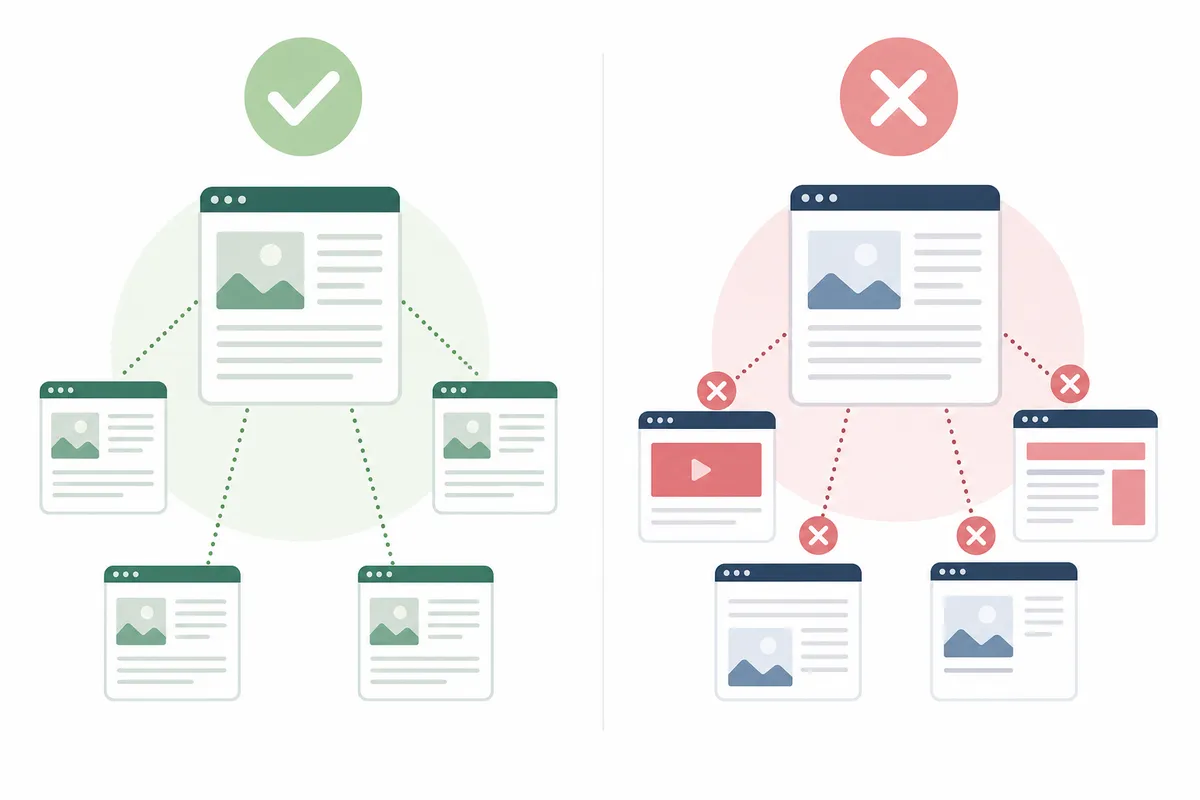
Content syndication is the authorized republishing of existing content on third-party sites. The copy names you as the original author and links back to the source URL. Both sides gain something. The publisher fills its feed without commissioning new writing. You reach readers who would never have found your site on their own.
Syndication vs. guest posting vs. scraping
A guest post is a new piece written for someone else's site, so only one version exists. Syndication takes a piece that already lives on your site and gives it a second home. Two or more versions exist by design. Scraping is republishing without permission or credit. Google treats it as spam rather than marketing. Permission and credit are what separate a fair tactic from a violation.
Syndication sits inside off-page SEO, the work that happens beyond your own pages. If that discipline is new to you, start with what off-page SEO means and why it moves rankings, then come back here.
The four common formats
- Full republication: the entire article runs on the partner site with credit and the agreed tag.
- Partial syndication: an excerpt or summary runs, with a link to read the rest on your site.
- Self-syndication: you republish your own work on platforms like Medium or LinkedIn under your own account.
- Paid distribution: a network places your content across publisher sites for a per-click budget.
How content syndication affects your rankings
Duplicate content is filtered, not punished
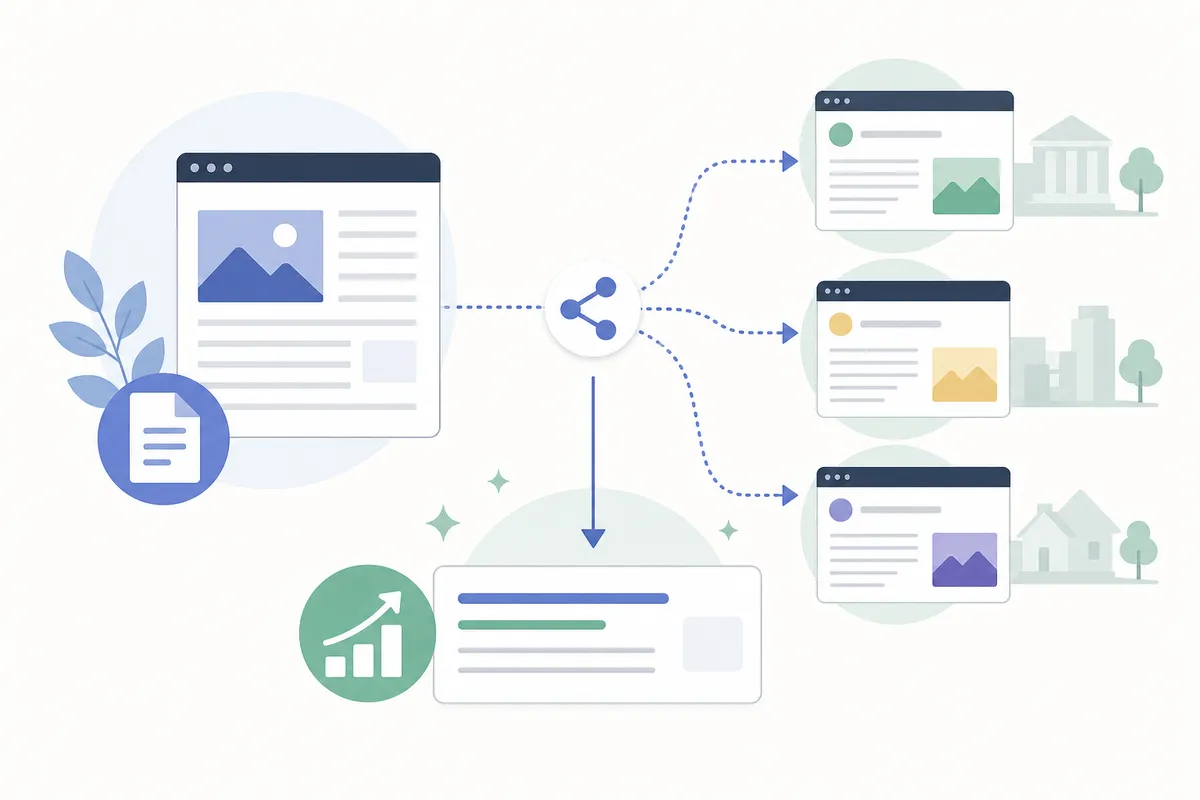
Google does not penalize authorized syndication. When several URLs carry the same article, Google groups them, picks one version to show, and filters the rest out of results. That is a selection process, not a punishment. The spam policies in Google's Search Essentials are aimed at scraped content republished without permission or added value. That is a different practice with a different intent.
The selection step still matters, though. If nothing tells Google which version is the original, it chooses for itself, and it does not always choose you.
Where the SEO value comes from
Every authorized copy links back to your original. Links from relevant, established publishers remain among the strongest signals a page can earn. Syndication produces them one placement at a time. For the mechanics of why that matters, read what role backlinks actually play in rankings.
The links are not the whole story. Copies put your byline in front of new readers. Some click through, stay, and later search for your brand by name. Industry guides lean hard on E-E-A-T here, and the logic holds. A byline on a respected trade publication is public, checkable proof that you know your subject.
The real risk: the copy outranks you
A larger site republishing your article word for word can outrank your original, especially if its copy gets crawled first. Syndication vendors concede this in their own guides. An untagged copy is sometimes indexed ahead of the source and takes its place in results. The fix is technical, cheap, and covered next.
Noindex or canonical: which tag to request
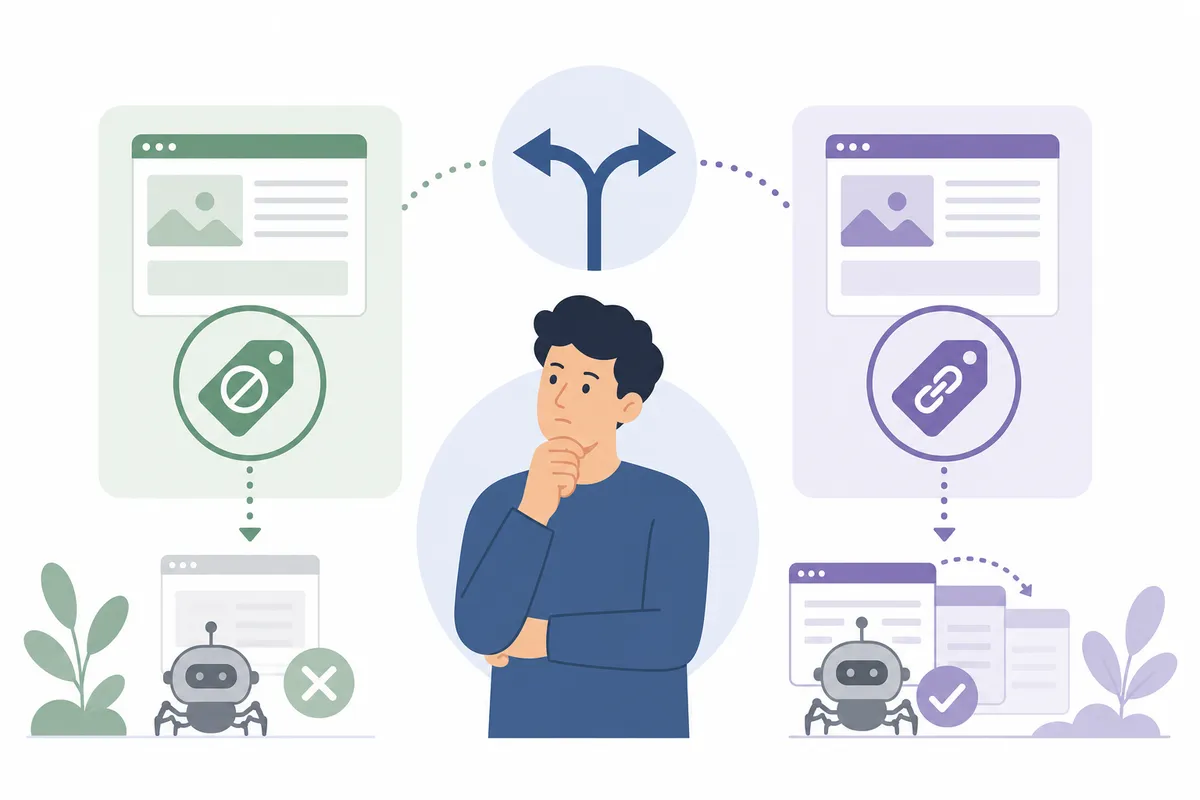
Ask for noindex first. Google's guidance for publishers who syndicate is direct: if you want the original to be the version that ranks, ask partners to block their copy from indexing. The cross-domain canonical was the standard advice for years. Google treats it as a hint rather than a directive, and hints can be ignored. Vendor guides refreshed for 2026 still argue this point. It is worth reading Google Search Central directly instead of settling the question from marketing blogs.
| What you request | What it tells search engines | When it is realistic | Trade-off |
|---|---|---|---|
| Noindex on the copy | Keep the syndicated page out of search results entirely | Partners who control their own CMS and templates | The copy earns no rankings of its own, which is exactly the point |
| Cross-domain canonical to your URL | Treat the original URL as the version to rank | Partners who refuse noindex but will edit head tags | A hint, not a directive, so Google may still index the copy |
| Visible credit link only | A weak originality signal that readers, and crawlers, can see | Partners locked into rigid templates | Least protection; the copy competes with your original |
| No attribution at all | Nothing; two identical pages simply compete | Never acceptable for syndication | Decline the deal rather than run untagged |
When the partner says no
Template limits are real, so refusals happen. Work down the ladder: canonical if noindex is impossible, and a prominent "Originally published on" credit link if both tags are. If a partner will not even credit the source, walk away. You would be trading your search visibility for their traffic. Two softer moves also help. Offer an excerpt instead of the full text, or hold the copy until your original has been indexed for a few weeks and has a head start.
Where to syndicate, and how to pick partners

Three channel families cover almost every syndication program: platforms you control, networks you pay, and editors you persuade.
Self-syndication platforms
LinkedIn articles, Medium's import tool, Substack, SlideShare for decks, Flipboard, and YouTube for video versions all let you republish under your own account. They are free, fully in your control, and a sensible first move. One habit worth keeping: view the head of your first Medium import and confirm the canonical reference points at your site. Do not assume it does.
Paid distribution networks
Outbrain, Taboola, and Dianomi are the networks most guides name. They place your content across large publisher sites in exchange for a per-click budget. Links from paid placements carry the sponsored attribute, so expect little direct ranking credit. That does not make them worthless. Nofollow and sponsored links help in quieter ways, but reach and lead capture are what you are actually buying.
Editorial partners, and how to vet them
Finding partners is a search problem. Queries like "republished with permission" your topic or "originally appeared on" your topic surface publications that already syndicate in your niche. Then vet each one the same way you would vet any authority-building tactic that is not spam. Look for real audience overlap without competing for your exact keywords, visible editorial standards, genuine organic traffic, and the willingness to add the tag you agreed on.
| Channel | Examples | Cost | SEO value | Best for |
|---|---|---|---|---|
| Self-syndication | LinkedIn articles, Medium, Substack | Free | Modest; brand exposure plus referral clicks | Small teams building an audience from scratch |
| Editorial partners | Trade publications, established niche blogs | Outreach time | Highest; relevant attribution links plus qualified referrals | Evergreen guides and original research |
| Paid networks | Outbrain, Taboola, Dianomi | Per-click budget | Low direct value; links are marked sponsored | Lead generation and gated assets |
| Aggregators | Flipboard, niche industry aggregators | Free | Small; discovery and occasional citations | Timely pieces with a short shelf life |
A repeatable content syndication SEO workflow
The eight steps
- Publish on your own site and confirm the page is indexed before offering it anywhere.
- Shortlist five to ten partners using the vetting criteria above.
- Pitch a specific piece, and say why their readers, not yours, will care.
- Agree terms in writing: attribution wording, the tag, whether edits are allowed, takedown rights, and whether they may pass the piece on to other sites.
- Deliver clean copy so the partner has no reason to rewrite anything.
- Verify the live page. View source and confirm the tag and the credit link actually shipped. A written yes is not a shipped tag.
- Add UTM parameters to the links pointing home so referral traffic is attributable.
- Log every placement with its URL, date, and tag status, and recheck the log quarterly.
Where automation fits
Self-syndication is the automatable half. Pushing a published post to Medium, LinkedIn, and an aggregator on a schedule is exactly the kind of repetitive work automated content publishing handles well. The step automation usually skips is verification: a successful API write is not a live, correctly tagged page. That gap is the same one publish verification closes in CMS integrations that confirm a page is really reachable. Your syndication log deserves the same discipline. Republishing partners' pages change templates, and a canonical that existed in March can be gone by June.
How to measure whether syndication is working
Measure the original, not the copies
Every signal worth tracking attaches to your original URL. The copy's own pageviews belong to the partner; unless the deal is lead generation, they tell you little.
| Signal | Where to look | A good result looks like |
|---|---|---|
| Referral sessions | Analytics, filtered by partner domain or UTM tag | Visitors who read further pages instead of bouncing |
| Links earned | Your backlink reports | Attribution links live, followed or not, pointing at the original |
| Rankings on the original | A rank tracker watching the source URL | Positions hold or improve after copies go live |
| Branded queries | Search Console query reports | Brand-name impressions trending up over months |
| Assisted conversions | CRM records carrying the UTM source | Any signups or inquiries that touched a partner referral |
How long to wait
Referral traffic shows up the day a placement goes live. The authority effects compound slowly. Each placement adds one more link and one more pocket of readers, so judge the channel over months rather than after a single article. When the numbers say it works, resist the urge to flood every partner at once. The playbook for scaling content output without losing quality or rankings applies to distribution just as much as to production.
Risks, rights, and staying out of trouble
Contract terms that protect you
Syndication is a license, not a transfer. Keep the agreement short but explicit:
- Scope: one named site, with no right to pass the piece to other domains.
- Edits: none without approval, so your claims and links survive intact.
- Attribution: the exact credit line and the tag, spelled out.
- Takedown: you can require removal if the terms stop being met.
- Ownership: copyright stays with you, always.
Over-syndication and bad neighborhoods
More copies is not always better. Dozens of identical versions dilute the originality signal you are trying to protect. Placements on thin, auto-republishing networks tie your brand to junk. At the far end, mass automated republishing starts to resemble the scraped-content patterns Google's spam policies name. The consequences land on visibility. If you are unsure where the line sits, review the seven triggers that draw Google penalties and how to fix each before you sign anything. A handful of strong, correctly tagged placements beats fifty careless ones every time.
FAQs
Does content syndication hurt SEO?
Not when it is authorized and attributed. Google filters duplicate versions rather than penalizing them. Its spam policies target scraped, uncredited copying. The one practical risk is a partner's copy outranking your original. The noindex or canonical request exists to prevent exactly that.
Is syndicated content the same as duplicate content?
Technically the text is duplicated, but duplication by itself is not a violation. Search engines simply pick one version to show. Your job is to make sure the signals, the tag, the credit link, and the earlier publish date all point at your original as the version to pick.
Should I ask for a noindex tag or a canonical tag?
Ask for noindex first. It keeps the copy out of search results entirely and matches Google's guidance for syndicated content. Accept a cross-domain canonical as the fallback, and a visible "Originally published on" link as the minimum. Untagged, uncredited republishing is the only arrangement worth refusing outright.
Can I republish my own blog posts on Medium or LinkedIn?
Yes, and it is the easiest way to start. Publish on your own site first, wait until the page is indexed, then republish. Check that the copy carries a canonical reference to your original, or at least a prominent link home near the top of the piece.
How long does content syndication take to show results?
Referral clicks arrive as soon as a placement goes live. Ranking and authority effects build over weeks and months as links and brand searches accumulate. Evaluate the channel on a quarterly view rather than expecting one placement to move a keyword by Friday.
Talk to the team
Before you pitch a single partner, know what your original pages can already do: which ones rank, which ones carry links, and which ones are worth republishing. Look through a sample SEO report to see what that baseline covers, then talk to the team about where content syndication SEO fits in your plan. One evergreen post you are proud of is enough to start.
Resources / References
- Search Essentials
- block their copy from indexing
- a hint rather than a directive
- Google Search Central
- the sponsored attribute
- a license, not a transfer
Sources
About the author
SearchBlueprint researched, wrote and scored this article with the content pipeline our customers run on their own sites. The score in the byline is what our content engine gave this page before it published. Nothing here is reviewed by hand, which is the point: it is the product's output, published where anyone can check it.