What Is Local SEO Automation, and What Actually Runs Itself in 2026?
SearchBlueprint · · 11 min read · scored 89/100
Local SEO automation is software that keeps your business listings accurate, publishes Google Business Profile activity, drafts review responses, and tracks your map rankings on a schedule instead of by hand. It matters because the work it replaces is repetitive, error-prone, and now judged daily by both Google and AI assistants.
That last part is the change worth paying attention to. The routine tasks have not changed much in five years. What changed is who reads the output. Google still crawls your listings, but so do ChatGPT, Gemini, and Perplexity. They reward the same things automation is good at: consistency, recency, and structured data. This guide covers what to automate, what to keep human, how the tool categories differ, and how to tell whether any of it is working.
What local SEO automation actually does
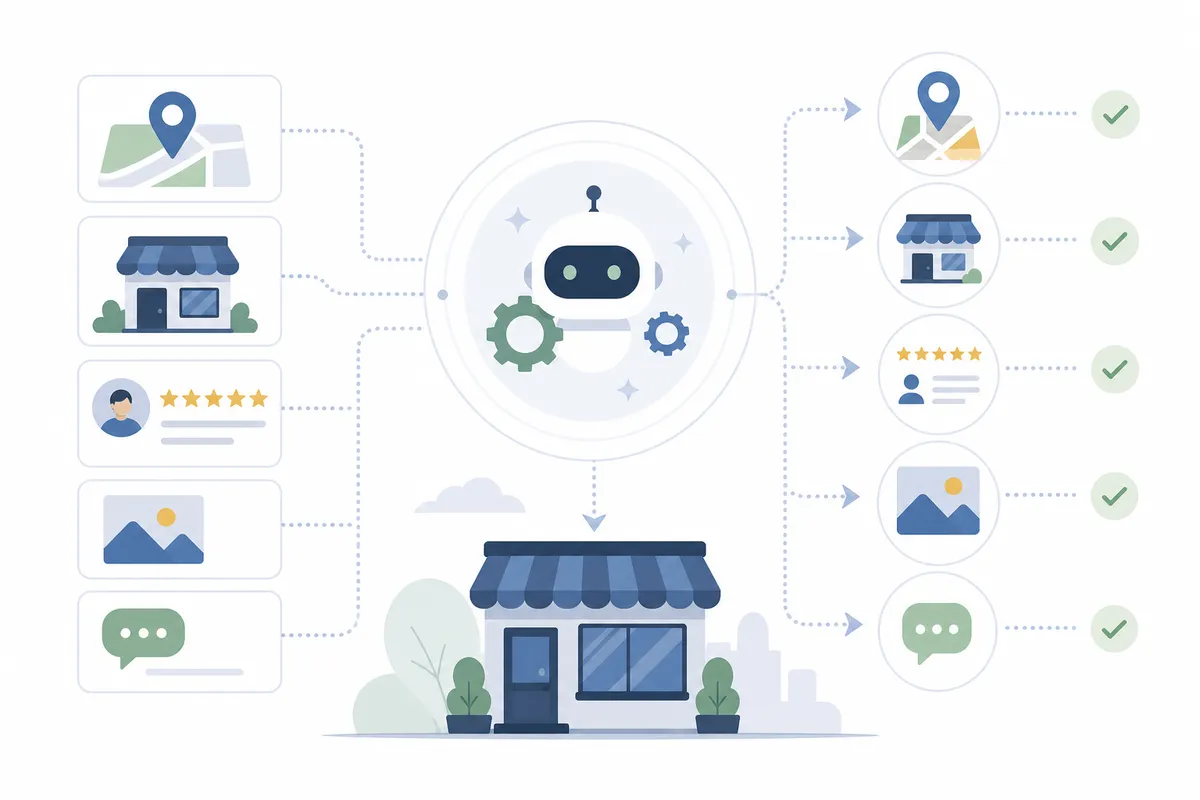
At its core, this software takes the recurring work of maintaining a local presence and runs it on schedules or triggers. You configure the rules once. The platform then runs them daily or weekly without you opening a dashboard.
The jobs it takes over
The standard set looks like this. It pushes your name, address, phone number, hours, and services to Google Business Profile and the directories that matter. It publishes posts and photos on a cadence. It drafts responses to reviews and profile questions. It checks your rankings for each keyword and location. And it assembles the report that proves any of it moved.
None of these tasks is hard. All of them are relentless. A single location can keep up manually. A business with six locations, or an agency with thirty clients, cannot. The failure mode is quiet: an old phone number on one directory, a profile that has not posted in two months, a ranking drop nobody noticed for three weeks.
What it cannot do
Software cannot decide what your business is. It cannot pick your primary Google category. It cannot judge whether an angry review deserves a phone call instead of a reply. It cannot know that you stopped offering a service last quarter. Automation executes decisions. It does not make good ones on its own. Vendors who claim otherwise are selling past the point where their product stops.
Why local SEO automation matters more in 2026

Two shifts pushed this from convenience to requirement.
The first is scale of demand. By figures the industry has cited for years, 46% of all Google searches carry local intent. And 76% of people who run a "near me" search visit a business within 24 hours. Local visibility converts fast, which means gaps in it cost real revenue fast.
The second is where the searches happen. Gartner projects that traditional search engine volume will drop 25% by 2026 as consumers shift to AI platforms for local queries. When someone asks an assistant for "a dentist near me that takes walk-ins on Saturdays," the assistant builds an answer from the data it can verify. That means your profile, your reviews, your structured data, and your recent activity. There is no page two to fall back to. You are either in the answer or absent from it.
These assistants weight recency and consistency heavily. A profile updated three weeks ago reads as less alive than a competitor posting daily. No human team holds that signal steady across many locations. A machine holds it without effort. Google's own documentation at Google Search Central explains how structured data helps its systems understand what a page and a business are. That is the same machinery AI answers lean on.
The five jobs worth automating first
Start where the payoff is highest and the risk is lowest.
Listings and data sync
Your name, address, phone, hours, and services should be identical everywhere they appear. Inconsistent data confuses ranking systems and customers alike. Sync automation catches drift the day it happens instead of the month a customer complains. This is the least glamorous automation and the one with the fewest downsides. There is no creative judgment in a phone number.
Profile activity
Regular Google Business Profile posts signal an active business to Google and to the LLMs reading your profile. Automation can draft and schedule these, including seasonal and holiday variants. Review the drafts. A queue of ten approved posts publishing over five weeks beats both silence and unreviewed machine output.
Review responses, with a gate
AI drafts replies well for the routine cases: thanks for praise, acknowledgment for mild complaints. Run those through an approval workflow rather than straight to publish. The serious complaint, the legal threat, the review that names an employee: those need a person. A good platform flags them instead of answering them.
Rank tracking
Manual rank checks are spot checks, and spot checks miss grid-level movement. You can hold position 2 near your storefront while sliding to position 9 six blocks away. Automated tracking with a rank grid that maps your positions block by block turns rankings from an occasional anxiety into a weekly data series you can act on.
Reporting
If you run client accounts, report assembly may be your largest recoverable time cost. Auto-generated weekly or monthly reports that you check and send convert hours of screenshot work into minutes of review.
What to keep human
The honest half of any automation guide is the list of things it should not touch.
| Task | Verdict | Why |
|---|---|---|
| Listing and NAP sync | Automate fully | No judgment involved; errors compound silently across directories |
| Rank tracking and reporting | Automate fully | Scheduled measurement beats spot checks every time |
| Routine review replies | Automate with approval | Templates handle praise; a human must own complaints and disputes |
| Profile posts | Automate drafting, review before publish | The activity signal matters weekly, but generic output erodes trust |
| Category and service selection | Keep human | The wrong primary category caps your visibility; this is strategy, not admin |
| Review acquisition | Keep human, never buy | Purchased and incentivized reviews get detected and deleted |
That last row deserves its numbers. Localo analyzed 335,520 deleted Google reviews from November 2023 to January 2026. It found that Google's detection now catches rating-only reviews as fast as detailed ones, and that bought review velocity is itself a detection signal. The same research team has profiled over 16,000 Google Business Profiles by ranking position. The pattern across that data is consistent: profiles win on legitimate, steady signals, not manufactured ones.
The boundary between automatable and human work applies well beyond local. The reasoning behind each call is laid out in this broader look at what to automate in SEO and what to leave alone.
Choosing your automation level
The market sorts into five categories. The meaningful difference between them is not features. It is how much of the work still lands on you.
| Tool type | Example | What it automates | What you still do |
|---|---|---|---|
| Fully autonomous GBP management | Paige by Merchynt | Posts, review replies, and profile optimization end to end; Merchynt reports over 10,000 businesses on it | Set direction, spot-check output |
| Task-based assistant | Localo | Audits your profile, then issues weekly "Smart Tasks"; offers a 14-day free trial with no card | Complete each recommended task yourself |
| AI visibility monitoring | LocalRank.so | Tracks whether ChatGPT and Perplexity mention you; places you in the listicles LLMs crawl | Act on everything the monitoring reveals |
| Enterprise multi-location suite | SOCi | Brand-consistent posting and reputation across thousands of locations | Staff a team to operate it |
| Citation and audit platform | BrightLocal, LocalSEO.ai | Citation building (LocalSEO.ai submits to over 400 sites), rank grids, structured audits | Choose and implement the fixes |
A note on vendor claims: Merchynt's own research says businesses using Paige see an average of 5x more views than incomplete or manually managed listings. Treat any vendor's study of its own customers as a directional claim, not a benchmark. Run your own before-and-after instead.
The practical selection question is simpler than the comparison charts suggest. Solo owner with one location: a task-based assistant teaches you the work while doing the tedious parts. Agency or multi-location operator: you need autonomy or an enterprise suite. Task lists multiplied by thirty clients are just a different kind of manual labor. Anyone competing for AI recommendations: add visibility monitoring, because you cannot fix an absence you cannot see.
Local content automation without the slop
Content is where automation has the worst reputation, and earned it. The old pattern was one template, twenty city names, twenty near-identical pages. Google's spam policies have been explicit about doorway pages for years, and AI-generated filler gets neither rankings nor citations.
The version that works treats automation as a drafting layer under human judgment. Location pages built this way carry genuinely local material: the neighborhoods you actually serve, the routes customers take, the local conditions that drive demand. The template supplies structure. The specifics come from the business, and a person confirms them before anything publishes.
The same standard applies to blog content supporting your local pages. Volume without editorial control produces text that reads machine-made, because it is. Readers, Google, and AI answer engines have all become good at spotting it. There is a disciplined way to get the speed without the stigma, covered in depth in this guide to scaling article production without the slop.
One useful test before you publish any automated page: would this exist if the automation did not? A page answering a real question about a real place passes. A page that exists to hold a keyword does not.
Getting recommended by AI assistants
Ranking in an AI answer is not a separate discipline from local SEO. It is the same discipline with stricter verification.
Assistants recommending local businesses cross-check what they can. They test your profile data against your website, your reviews against your claims, and your presence across the directories and "best of" lists they crawl. Three practices raise your odds, and all three are automatable in part.
Structured data. Marking up your business with LocalBusiness schema gives machines a clear statement of who you are, where you are, and what you do. The vocabulary is maintained at Schema.org. Generating and validating the markup is a solvable software problem, not an ongoing chore.
Entity consistency. Every mention of your business across the web either reinforces or contradicts your identity. Citation automation keeps the record coherent, which is exactly what a verification-minded model needs before it will name you.
Sustained activity. Fresh posts, new photos, and recent reviews all read as recency. This is the signal manual teams drop first when busy and automation never drops.
What does not work is shortcutting the trust layer. The Localo deleted-review research above shows detection improving on exactly the signals people try to fake. Reviews feed AI recommendations too, so a purge does not just dent your star rating. It removes evidence assistants were citing.
Measuring whether local SEO automation is working
Automation produces activity by default, and activity is not the goal. Measure outcomes.
| Metric | What it tells you | Where to check |
|---|---|---|
| Local pack appearances | Whether Maps shows you in the top 3 for your keywords | Rank grid, tracked weekly |
| Click-to-call rate | Whether your profile converts attention into contact | Google Business Profile performance stats |
| Direction requests | Foot-traffic intent from search | Google Business Profile performance stats |
| Review velocity | Whether genuine reviews arrive steadily | Review manager trend view |
| AI recommendation frequency | Whether ChatGPT or Gemini names you for local queries | An AI visibility monitor |
Give any change a fair window before judging it. Hold one variable steady at a time. If you turn on posting automation, citation building, and review workflows the same week, you will never know which one moved the number.
A rollout order that works
- Audit first. Get a baseline of your rankings, listing consistency, and review profile before changing anything. Without it, every later claim of improvement is a guess.
- Fix data, then sync it. Correct your core business data once, then let automation propagate and hold it.
- Turn on tracking. Rankings and profile stats start recording now, so the effect of everything else is measurable.
- Add activity automation. Posts and review workflows, with approval gates on anything customer-facing.
- Expand to content and citations. The heavier projects come last, once the foundation is holding.
- Review monthly, not daily. The point of automation is reclaiming attention. Spend it on the monthly report and the judgment calls, not on watching dashboards.
FAQs
What is local SEO automation?
It is software that performs recurring local search tasks on schedules or triggers: syncing business listings, publishing Google Business Profile posts, drafting review responses, tracking local rankings, and generating reports. You set the rules and approval gates. The platform runs them without daily manual effort.
Can automation get my business recommended by ChatGPT and Gemini?
It helps with the inputs those assistants verify: consistent business data, structured markup, steady activity, and a genuine review stream. No tool can force a recommendation. Any vendor promising guaranteed AI placement is overclaiming. Monitoring tools can at least tell you whether you currently appear, which is the starting point.
Is manual local SEO still enough for a single location?
It can be, if you are disciplined. One location with a well-kept profile, weekly attention, and honest reviews competes fine. The case for automation grows with every added location or client. Manual consistency slips exactly as the stakes multiply. Even solo operators usually benefit from automated rank tracking, since that is measurement rather than labor.
Will automated review responses hurt my reputation?
Unreviewed ones can. A templated reply to a serious complaint reads as indifference in public. The safe pattern is automation with an approval gate: AI drafts every response, routine ones go out quickly, and flagged ones wait for a person. That keeps response times fast without letting a machine speak for you on the cases that matter.
How much does local SEO automation cost?
Pricing spans a wide range, from free trials (Localo offers 14 days without a card) through mid-market subscriptions to enterprise contracts for multi-location suites like SOCi. Cost generally scales with locations and automation depth. Price it against the hours it replaces and the revenue a missed ranking costs, not against the sticker alone.
Talk to the team
Local SEO automation earns its keep fastest when the rollout starts from an honest audit rather than a feature list. Look through a sample SEO report to see exactly what an automated audit surfaces on a real site. Then talk to the team about which of these jobs your business should hand off first.
Resources / References
Sources
About the author
SearchBlueprint researched, wrote and scored this article with the content pipeline our customers run on their own sites. The score in the byline is what our content engine gave this page before it published. Nothing here is reviewed by hand, which is the point: it is the product's output, published where anyone can check it.