What is local SEO? How nearby businesses win the map pack
SearchBlueprint · · 16 min read · scored 92/100

Local SEO is what puts a business in front of people searching nearby: in Google's map pack, on Google Maps and in the local organic results below them. It runs on three signals Google names (relevance, distance and prominence), and you can start most of the work yourself.
This guide is for owners and marketers of businesses that serve a place: a dental clinic, a bakery, a plumber who drives to customers, a law firm with two offices. It covers how local rankings work, which signals matter, how to do the work step by step, and how to tell whether it is paying off.
What is local SEO, in plain terms?
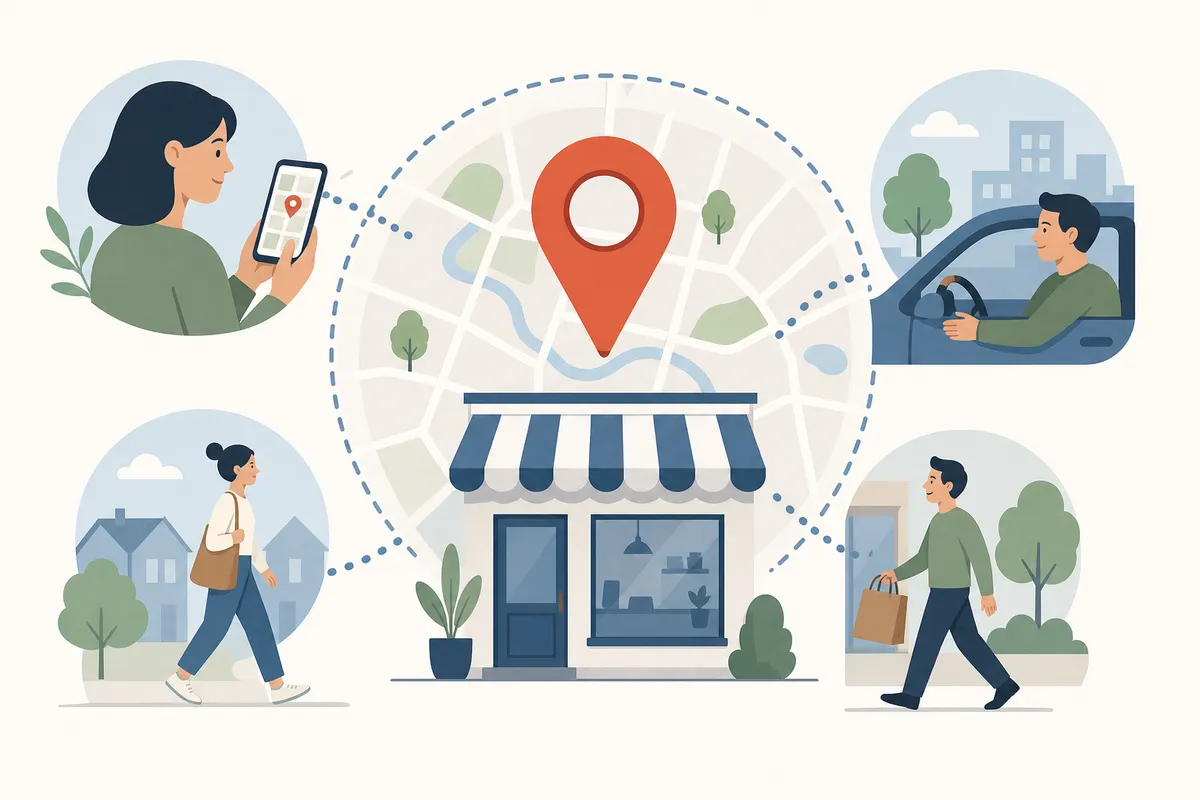
Local search engine optimization is the practice of improving how often and how high a business appears when someone searches for something nearby. The search might say "near me" or name a city. Often it says neither. Someone types "dentist" on their phone, and Google assumes they want one close by.
Standard SEO competes for a whole country, while local SEO competes for the radius around you. A pizzeria in Chicago has no use for a ranking in Dallas. What it needs is to be found by hungry people a few miles away, right now.
Local results began showing up between 2003 and 2005, when search engines started returning places near the searcher along with store hours and map listings. Since then local search has grown its own algorithm and its own ranking factors.
Who local SEO is for
Two kinds of businesses need it:
- Businesses with a storefront customers visit, such as restaurants, dental clinics, gyms, salons, shops and car repair garages.
- Service-area businesses that travel to customers, such as plumbers, electricians, cleaners, tutors and dog walkers. These can rank locally without showing a street address.
If you sell only online and ship nationwide, local SEO is not your main game. Traditional SEO is.
The two places you can rank
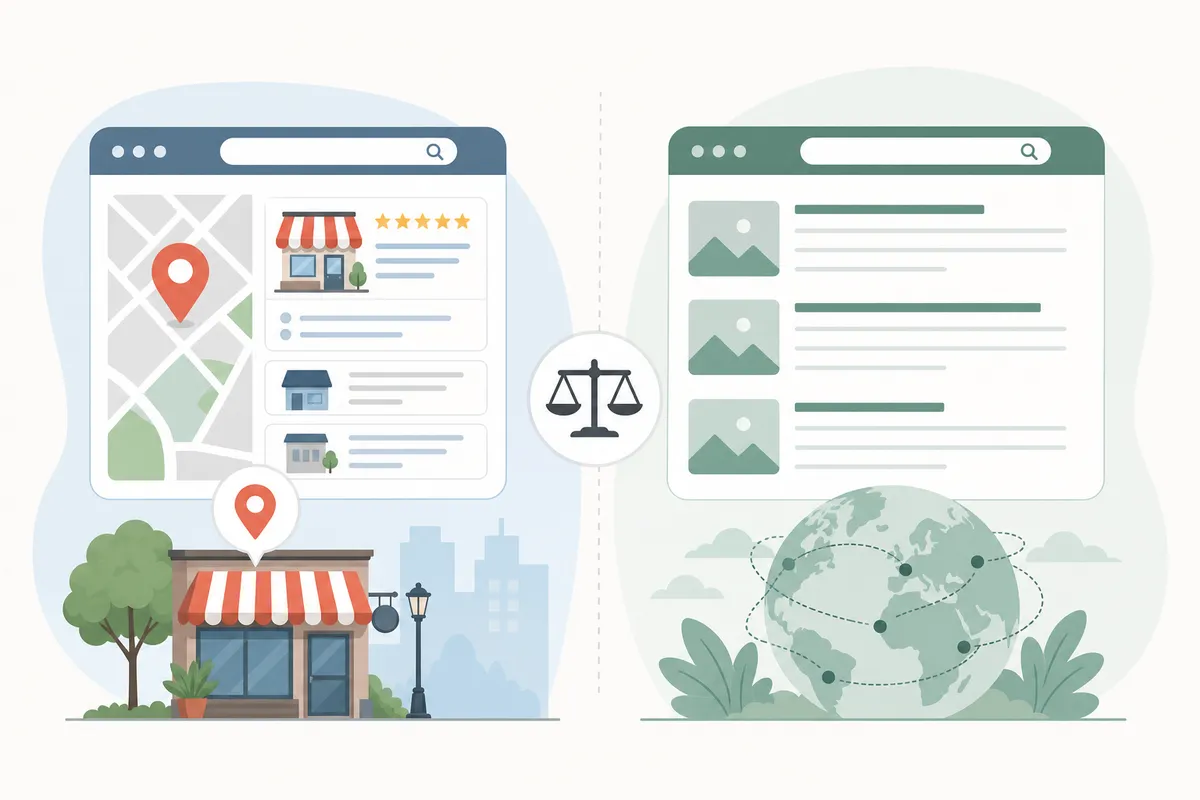
A local search usually returns two kinds of results on the same page.
- The map pack, also called the local pack. This is the box with a map and three business listings, pulled from Google Business Profiles. It often sits at the very top of the page.
- Localized organic results. These are the familiar blue links below the map, filtered for the searcher's area. Directories like Yelp often appear here next to business websites.
Separate systems rank these two sections. So one business can appear in both at once and take up twice the space for the same search. Ahrefs shows this with a pizzeria that ranks first in both the map pack and the organic links. It is close by, it sells exactly what was searched for, and it holds a 4.7 rating from 994 reviews.

Why local SEO matters for businesses that serve an area
People search for local businesses all the time, and they act fast when they do. Figures from Google make the point:
- Google reported in 2018 that 46% of all search queries have local intent. BrightLocal notes the figure is still widely quoted across the industry.
- According to Google, 30% of all mobile searches are related to location.
- 78% of people who search for something nearby on their phone visit a business within a day.
- 28% of searches for something nearby result in a purchase.
Those numbers describe buyers, not browsers. Someone searching "emergency plumber" or "florist open now" usually wants to call or visit today.
A complete listing pays off too. Google states that customers are 70% more likely to visit businesses with a complete Business Profile, and 50% more likely to consider buying from them.
Now picture the other side. A nail salon in Lincoln Park competes with salons that have hundreds of reviews, well-kept profiles and strong local pages. Without local SEO, it will struggle to show up at all, and a business that doesn't show up rarely gets the call.
How local SEO works: relevance, distance and prominence
Google says three main factors decide which businesses appear in local results. Everything else in this guide feeds one of them.
Relevance
Relevance is how well your business matches the search. Google reads your Business Profile category, your description, the services and products you list, and the content on your website. A bakery with "Bakery" as its primary category and a page about custom cakes sends a clear signal for "custom birthday cake".
Distance
Distance is how far your business is from the searcher, or from the place named in the search. If no place is named, Google works out distance from what it knows about the searcher's location. Search "pizza delivery" at work and you see pizzerias near the office. At home? A different list.
You can't change distance without moving. That is why most local SEO effort goes into the other two factors.
Prominence
Prominence is how well known and well regarded your business is. Google weighs fame in the offline world, so a famous museum or a landmark store gets extra credit. It also reads online signals: review count and rating, links to your website, and mentions in articles and directories.
How the organic half differs
The blue links below the map run on the same core systems as any Google search. Semrush sums up the factors for those results as relevance, content quality and usability. Usability here is about speed and how well a page works on a phone. Area still matters. But in this half of the page a strong website counts for more than a strong Business Profile, because Google is ranking pages here, not listings. For the full picture of how those core systems pick pages, read this explainer on how search engines decide who gets found.

Local SEO vs traditional SEO
Both rest on the same foundations: a site Google can crawl, useful content and good links. The difference is in the target and the tasks.
| Area | Traditional SEO | Local SEO | What carries over |
|---|---|---|---|
| Who you compete with | Every site ranking for the term nationwide | Businesses within reach of the searcher | Content quality counts in both |
| Main result types | Organic blue links, shopping and news results | Map pack, Google Maps and localized organic links | Organic links appear in both |
| Core listing | Your website | Your Google Business Profile plus your website | Your website feeds both |
| Key signals | Content, backlinks and technical health | Business Profile, reviews, citations, proximity and local links | Backlinks and technical health help in both |
| Ranking without a website | Not possible | Possible in the map pack with a claimed Business Profile | No website means no organic rankings in either |
That last row surprises people. BrightLocal points out that a business can rank in local results without a website, as long as it has claimed its Google Business Profile. It will still miss the organic half of the page, and it gives Google fewer relevance signals to work with.
What moves local rankings
Nobody outside Google knows the exact weights. What exists is survey data from practitioners and correlation studies, and both point the same way.
How SEOs rate the main signals
BrightLocal has asked local SEOs for years which factor matters most. Ahrefs compiled the answers from 2013 to 2021:
| Ranking signal | Rated most important for the map pack, 2013 | Rated most important for the map pack, 2021 | Rated most important for local organic results, 2021 |
|---|---|---|---|
| Google Business Profile signals | 23% of SEOs | 36% of SEOs | 6% of SEOs |
| Review signals | 12% of SEOs | 17% of SEOs | 5% of SEOs |
| Citation signals (name, address and phone listings) | 18% of SEOs | 7% of SEOs | 7% of SEOs |
Three trends stand out. Business Profile signals have gained ground in every survey since 2017, when 19% of SEOs picked them. By 2021 it was 36%. Reviews have climbed in every survey since 2015, from 11% to 17%. Citations fell from a peak of 20% in 2014 to 7%, so they now read as housekeeping rather than a lever.
Look too at how small the Business Profile and review figures are for organic results. For the blue links, your website does the heavy lifting.
What correlation studies found
A 2016 study compared businesses in local packs against more than 100 possible ranking factors. It could not copy Google's algorithm, but its findings match what practitioners report:
- Backlinks had the strongest correlation with local pack rankings.
- Review count and star rating correlated strongly with higher positions.
- Photos, a verified profile and posted opening hours helped, though less than reviews did.
- Citations were "foundational but not a competitive advantage". You need them clean, but piling up more won't lift you past a rival.
- A keyword in the business name was one of the strongest factors. That explains the spam in local packs, where some listings cram "Best Plumber Dallas" into their name.
The filters that hide listings
Google also filters listings that look alike. The Possum update on 1 September 2016 began filtering businesses that share an address and a category. If several dentists work in one building, Google may show only one of them. The same update lifted businesses just outside city limits.
The Hawk update on 22 August 2017 narrowed that filter. After it, the filter seemed to apply only to listings in the same building or very close (around 50 feet apart), not to ones further off, such as 325 feet away.
If you share a building with a rival in the same category, keep this in mind before you blame your profile for a missing ranking.
How to do local SEO, step by step
Local SEO is part setup and part habit. The setup is quick. The habits (reviews, updates and links) are what separate the top three from everyone else.
1. Claim and complete your Google Business Profile
Your Google Business Profile is a free listing, and you need one to appear in the map pack at all. Claim it, verify it, then fill in every field:
- Primary category. Be specific. "Italian restaurant" beats "Restaurant". This is one of the strongest relevance signals you control.
- Hours, holiday hours too. Wrong hours cost you visits and earn angry reviews.
- Address if customers visit you, or a service area if you travel to them.
- Products and services, written in the words customers use.
- Photos and videos of the storefront, the team and the work.
- Attributes such as outdoor seating, wheelchair access or free Wi-Fi.
Then keep it active. Post updates about offers and events, answer questions, and change details the day they change.
2. Find the keywords local customers actually use
Owners often describe their business one way while customers search another. Start by listing every service you offer. A plumber might list drain unblocking, boiler repair, boiler installation, radiator installation and burst pipe repair. Each is a separate search, and often deserves a separate page.
Then widen the list:
- Type your services into Google and read the autocomplete suggestions. They are partly based on your location.
- Search as a customer would, and note who ranks and what their pages are called.
- Run a seed term through a free long-tail keyword suggestions tool to catch variations you missed.
Start with terms that show clear buying intent, such as "nail salon near me" or "best pedicure lincoln park". Informational terms can come later. For worked examples of turning one seed term into a full list, these real keyword research scenarios walk through several.
3. Build a page for each service and each location
Google needs a page to rank. One "Services" page that lists ten things gives it little to match. A page for each core service, and one for each town or district you serve, gives it clear targets.
Location pages need real local detail. Name the neighborhoods you cover and the local conditions that drive demand. Add directions, where to park, and photos of jobs you did in that area. A page that swaps the town name into the same template is a doorway page, and the spam policies in Google Search Essentials treat those as a problem. A location page generator can give you a structured first draft, as long as you add the local detail yourself.
On every page, show your name, address and phone number as plain text, usually in the footer. Add LocalBusiness structured data as well. The vocabulary is defined at Schema.org, and Google Search Central documents how Google reads it. It states your hours, address and business type in a form machines can read without guessing.
4. Make your name, address and phone number match everywhere
A citation is any online mention of your business name, address and phone number, often shortened to NAP. Structured citations sit in directories such as Yelp, Apple Maps, Facebook and Bing Places. Unstructured citations turn up in articles, blogs and local news.
Consistency is the whole point. If one site says "Joe's Pizza" and another says "Joe's Pizzeria", or an old phone number lingers somewhere, Google has less confidence in which details are right.
Work in this order:
- Fix your Google Business Profile and your website first. They are the source of truth.
- Update the big platforms: Apple Maps, Bing Places, Yelp, Facebook and any directory that ranks for your main search.
- In the U.S., submit to the main data aggregators (Data Axle, Localeze and Foursquare), which feed many smaller sites.
- Add industry and local directories, such as your chamber of commerce or trade association.
5. Earn reviews, and answer them
Reviews help rankings, and they help people choose. The rules are short:
- Ask customers for a review right after the job, while it is fresh. Send your review link by text or email.
- Make it easy offline. Cards on restaurant tables and a QR code at the counter both work. Restaurants live and die by reviews, which is why SEO for restaurants puts them near the top of the list.
- Reply to every review, good and bad. A calm, specific reply to a one-star review often reassures more readers than the review worried.
- Never pay for reviews or offer anything in exchange. Don't ask for good reviews specifically, and don't discourage customers from leaving bad ones. Google's terms forbid all of it.
6. Earn local links and mentions
Links from respected local sites build prominence. The best sources are usually close to home: a local news story, a youth team you sponsor, a supplier's "where to buy" page, a charity event you backed, or a neighborhood guide.
Ahrefs suggests a quick way to find them. Look at which sites link to several of your local competitors but not to you. A site that links to many of them is probably a directory or community page where you can get listed too.
7. Keep the website fast and easy to use on a phone
Most local searches happen on phones, often on the move. A slow page, or a phone number you can't tap, loses the customer. Core Web Vitals, the speed and stability measures Google uses, are explained at web.dev. Check your service pages against them.
How to measure local SEO results
Local rankings depend on where the searcher stands. A search from your own office shows where you rank at one spot on the map, and says nothing about the customer three miles east.
So check from many spots at once. A grid check runs the same search from points spread across your service area and records where you rank at each one. A free local rank grid shows this as a map, so you can spot the neighborhoods where you drop out of the top three. To track that grid over time alongside your location pages, SearchBlueprint's local SEO tools put both in one place.
| Metric | What it tells you | Where to find it | How often to check |
|---|---|---|---|
| Map pack position across a grid | Where in your area you appear in the top three | A local rank grid tool | Monthly, and after a big change |
| Calls, direction requests and website clicks | Whether your Business Profile turns views into contact | Google Business Profile performance reports | Monthly |
| Review count and average rating | How your prominence compares with local rivals | Your profile and your competitors' profiles | Weekly |
| Organic traffic to service and location pages | Whether your website ranks in the blue links | Google Search Console and your analytics | Monthly |
| Citation accuracy | Whether your name, address and phone match everywhere | A listing audit or manual spot checks | Every few months |
Track business results next to the rankings: calls booked, visits and quotes requested. Position is the means. Revenue is the point.
Can you do local SEO yourself?
Yes, much of it. The most important steps cost nothing but time, and nobody knows your customers better than you do. Here is an honest split:
| Task | Can you do it yourself? | What it takes | When outside help makes sense |
|---|---|---|---|
| Claim and complete your Business Profile | Yes | An afternoon, then a few minutes a week | Rarely needed |
| Ask for and reply to reviews | Yes | A habit built into every job | When you want review requests automated at volume |
| Fix name, address and phone listings | Yes, for one location | A few days of careful checking | Many locations, or years of messy old listings |
| Write service and location pages | Yes, if you write clearly | Several hours per page done well | When you need many pages and lack the time |
| Technical fixes and structured data | Sometimes | Comfort with your site's settings | Speed problems or schema errors you can't trace |
| Tracking rankings across your area | Yes, with a grid tool | A monthly check | When you report on several sites |
The work gets harder with many locations, a crowded category (lawyers, dentists and plumbers in big cities are tough), or a history of duplicate listings. Those are the cases where a specialist earns the fee. For the order to tackle things in, this SEO roadmap for business owners sets out the priorities. This guide to reaching the first page of Google in your city without ads goes deeper on the organic side.
Mistakes that set local rankings back
A few errors undo good work fast:
- Stuffing keywords into your business name. It may lift you for a while, but it is treated as spam and puts your listing at risk.
- Duplicate listings for one location, often left over from an old move or phone number.
- Buying or trading reviews. It breaks Google's terms and puts your reviews and your listing at risk.
- Copy-paste location pages with only the town name changed.
- Forgetting holiday hours. A customer who arrives to a locked door tends to leave a review about it.
- Checking rank from one spot and assuming the whole area sees the same result.
FAQs
Do you need a website to rank in local search?
Not for the map pack. A claimed, complete Google Business Profile can appear there without a website. You do need a site to rank in the localized organic results, and its content also strengthens the relevance signals behind your profile.
How long does local SEO take to show results?
It depends on your competition and your starting point. Fixes such as the right category or a complete profile can show up fairly quickly. Reviews and local links build over months, so treat local SEO as ongoing work rather than a one-off project.
Should you add "near me" to your pages?
Not as a phrase you repeat. Google works out distance from the searcher's location even when "near me" isn't typed. Write your pages about the service and the areas you cover, in the words your customers use.
Can a business without a storefront do local SEO?
Yes. Service-area businesses such as plumbers, cleaners and tutors can set a service area on their Business Profile and hide their street address. Reviews, citations, location pages and local links all work the same way.
Is local SEO the same as Google Ads?
No. Ads are paid placements that stop when your budget stops. Local SEO earns unpaid spots in the map pack and the organic results, and that visibility holds as long as you keep up the work.
Check your map pack position this week
Pick your main service, search it from three different spots in your area, and write down where you appear each time. Then look through a sample SearchBlueprint SEO report to see what a full audit covers, and talk to the team about what yours would show. You will know what local SEO is worth to your business before you spend a dollar on it.
Resources / References
Related reading: Why Prioritize Local SEO Before Any Other Marketing Channel.
Sources
About the author
SearchBlueprint researched, wrote and scored this article with the content pipeline our customers run on their own sites. The score in the byline is what our content engine gave this page before it published. Nothing here is reviewed by hand, which is the point: it is the product's output, published where anyone can check it.