Win AI citations by fixing knowledge graph SEO in 2-4 weeks
SearchBlueprint · · 14 min read · scored 92/100

You win AI citations by fixing knowledge graph SEO in three layers: schema markup with one stable @id per entity, a canonical home for that entity on your site, and independent confirmation from sources you do not control. Only the first two fit inside a plan to win AI citations by fixing knowledge graph SEO in 2-4 weeks.
Google's AI Overviews and assistants like ChatGPT and Perplexity do not pick answers the way ten blue links did. They ground answers in entities, which are named things their systems can verify. You can rank first for your category query and still watch the AI answer name three competitors. Those brands exist in the graph, and yours reads as an unconfirmed name.
What knowledge graph SEO actually fixes
A knowledge graph is a database of entities, relationships, and attributes. An entity is a thing with a name: a company, a person, a product, a place. A relationship connects two of them, such as founded or makes. An attribute is a fact attached to one of them, such as a founding year or a price. Google's version of this database powers Knowledge Panels and supplies the factual backbone AI Overviews lean on when they generate an answer.

Knowledge graph SEO is the work of getting your brand into that database as a verified record. It is a different job from ranking a page. Ranking matches the words on your page to the words in a query. A graph matches meaning: it knows that a founder's name and a company name describe connected facts about the same organization, even on pages where the two never appear together. When search shifts from listing pages to answering questions, the record wins over the page. Our guide on why entities decide AI visibility makes the longer version of that argument.
Where the graph gets its facts
Google fills its graph from three sources. Public references such as Wikipedia and Wikidata supply baseline facts and canonical identifiers. Licensed data feeds supply specialized categories such as sports results, stock prices, and product catalogs. Site owners supply the rest through structured data published on their own pages.
Only that third source is yours to edit this week, which is why schema work comes first in the plan below. The other two are where the later weeks, and the later months, go.
Why entities, not keywords, win AI citations
Ask ChatGPT for the best personal injury lawyer in Los Angeles and it does not run one search. Law-firm SEO Jason Hennessey describes it running dozens of fan-out queries behind the scenes. They check whether anyone at the firm has held leadership roles in legal associations, what the Yelp and Glassdoor reviews say, and what former employees report. They also check what the actual verdicts were and whether there has been recent press. Everything comes back in seconds and gets merged into one reply.
His conclusion from watching this happen: "SEO can only handle 50% of this equation." The other half is how the business actually operates and treats people, because the fan-out queries read the receipts.
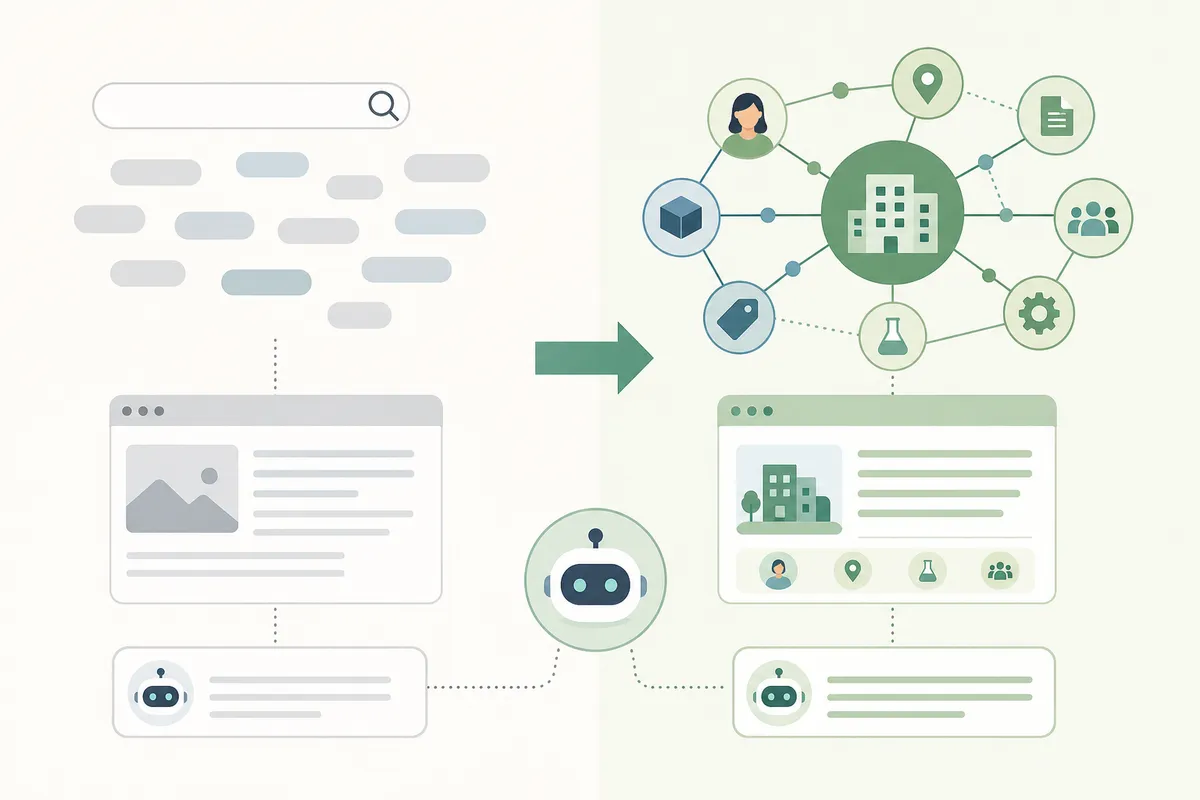
What happens when you are not in the graph
When a query touches a verified entity, an AI Overview pulls attributes straight from the graph: founding year, headquarters, product line, hours. It then layers context from crawled pages on top. When the query touches a brand the graph cannot verify, the system does something quieter than getting the facts wrong: it leaves the brand out of the answer entirely. No error message appears anywhere, and no penalty notice either, because the answer simply names the entities it trusts.
That has a cost even when you are included, because a good citation often replaces the click. A panel that shows your hours answers the query on the spot. The trade is worth measuring rather than mourning, and winning citations as clicks get scarce covers how to measure it. The short version: the contest has moved from who gets the click to who gets named, and being named requires being a record, not a string.
The signals that verify you as an entity
Google does not take your word for who you are. It cross-checks what you declare against what independent sources confirm, and it keeps unverified entities out of panels and grounded answers indefinitely. The table below lists the signals that move that verdict, what each one proves, and how long each one takes.
| Signal | What it proves | Where it lives | Time to fix |
|---|---|---|---|
Organization or Person schema with a stable @id |
Your pages describe one entity rather than a pile of disconnected fragments | JSON-LD on every entity-bearing page | Hours to days |
sameAs links to profiles you own |
Your site and your social and business profiles belong to the same organization | Home page or about page markup | Hours |
| Wikidata item with a Q-ID | A third party holds a structured, sourced record of your brand | wikidata.org | 30-60 minutes to create, per agency playbooks; weeks to stabilize |
| Wikipedia article | Independent editors judged your brand notable | Wikipedia, once real press coverage exists | Months, and only after 4-6 substantive independent articles |
| Consistent name, address, and phone | Your local identity checks out across sources | Google Business Profile and directories | Days |
| Mentions in outlets AI engines already cite | Someone with no stake in you confirms your claims | Press and industry coverage | Ongoing; one playbook budgets 4-8 substantive mentions per quarter |

Schema a crawler can join up
Two properties do most of the work. @id gives an entity one permanent identifier that every other schema block on your site can point at. Schema.org defines sameAs as a reference to a page that unambiguously identifies the same item elsewhere, such as your Wikidata entry or your LinkedIn page. Together they turn separate JSON-LD blocks into a graph a crawler can walk.
The common failure is minting a slightly different @id on every template. Google evaluates markup page by page, so when your product pages, author bios, and home page each invent their own identifier, nothing connects them. You have shipped fragments instead of an entity. Standardize the identifier, then paste your blocks into a free schema validator before they ship. The structured data guidelines at Google Search Central also require markup to describe content actually visible on the page, so anything you declare in JSON-LD needs a plain-text counterpart a reader can see.
Confirmation you do not control
Self-declared facts get you into the queue, not through it. Google looks for a second, independent source saying the same thing, such as a Wikidata item with sourced statements or coverage in outlets with editors. One agency playbook budgets four to eight substantive third-party mentions per quarter to keep this signal current. A few pieces in outlets the AI engines already quote do more for you than a page of directory submissions.
Consistency everywhere your name appears
Pick one canonical entity home, usually your home page or about page, and make every other page reference its @id rather than founding a rival record. Then check the boring things: the same business name everywhere, the same logo file, the same address on your site and your Google Business Profile. Mismatches read as doubt, and doubt keeps an entity unverified. This is also where sloppy old markup hurts you, because a stale phone number in a forgotten footer block counts as a conflicting source.
A 2-4 week plan to fix your knowledge graph SEO
The guides ranking for this topic promise the whole job in 2-4 weeks. Half of that promise is honest. The on-site work, meaning the audit, the schema, the identifiers, and the entity home, genuinely fits in that window for most small and mid-sized sites. The trust half does not, because editors and journalists move on their own schedule. Run the four weeks below, then treat off-site corroboration as a standing habit rather than a sprint.
| Window | Focus | You ship | Done when |
|---|---|---|---|
| Week 1 | Audit and home page schema | Organization markup with logo, one @id, and an honest sameAs list |
The home page block validates and names exactly one entity |
| Week 2 | Identifier cleanup and the entity home | Every entity-bearing page referencing the same @id; an about page stating the facts in plain text |
A crawler can join your pages into one graph |
| Week 3 | Off-site anchors | A sourced Wikidata item plus cleaned-up LinkedIn, Crunchbase, and business profiles | Every sameAs link resolves and matches your site |
| Week 4 | Consistency and baseline | Matching names, logos, and addresses everywhere; a logged set of AI test prompts | You know exactly which AI answers name you today |
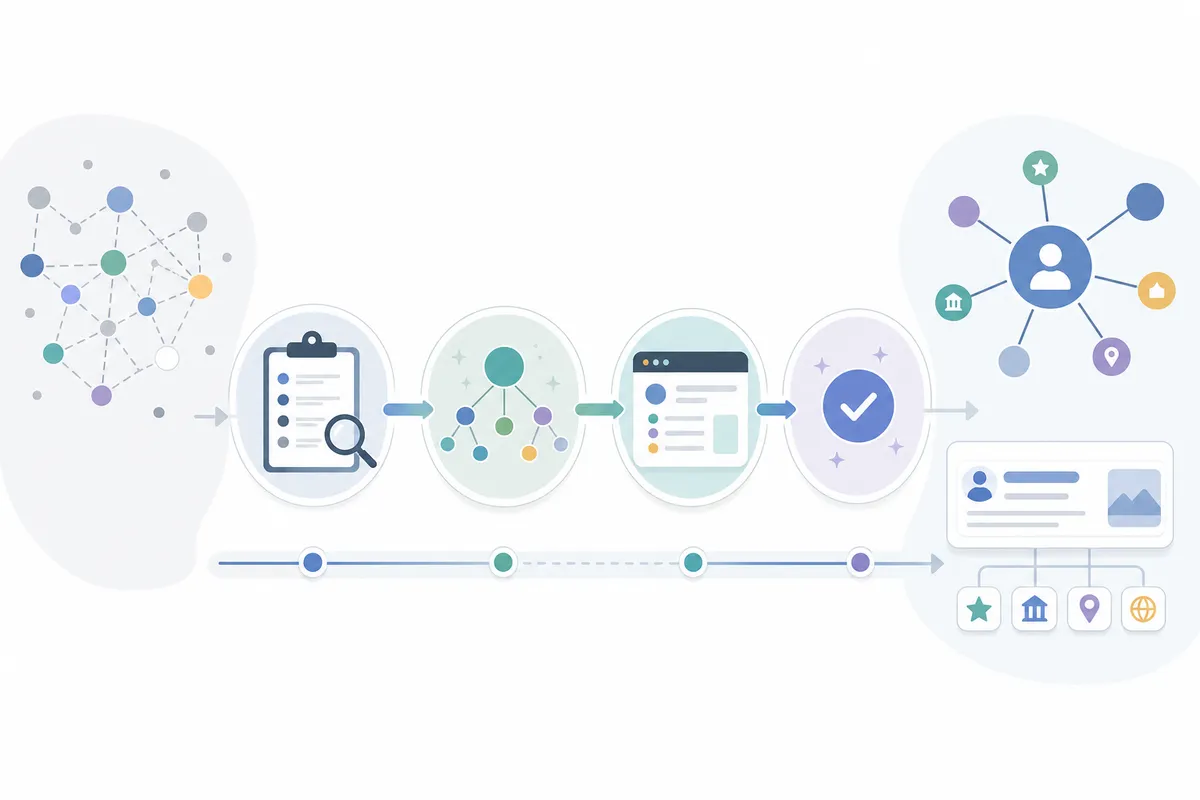
Week 1: find out what Google already believes
Run your domain through a structured data test and search your own brand name. Most sites find the gaps in an afternoon: missing logo markup, an empty or padded sameAs array, three name variants across templates, or Organization schema that exists on the blog but not the home page. Fix the home page before anything else, since it is almost always the page Google treats as the entity's front door.
Week 2: one identifier, one home
Standardize the @id across every page that describes your organization or its people. Then build the about page into a real entity home: founding year, leadership, what you make, where you operate, stated in plain sentences rather than slogans. Machines quote pages that commit to facts. If your pages talk around their subject instead of stating it, start with the signs your content is not AI search ready and repair those first, because a verified entity attached to unquotable pages still loses the citation.
Week 3: give the graph a second source
Create or fix your Wikidata item. The agencies that do this work put a well-formed item at 30 to 60 minutes for a competent editor: label, description, instance-of, country, official website, founder, founding date, and a citation on each statement. Then clean the profiles your sameAs array points to, and point their website fields back at you. Corroboration is a loop, and both directions have to hold.
Week 4: freeze a baseline you can retest
Align every remaining inconsistency. Then write down 10 or 20 questions a real buyer would ask an assistant about your category, and run them. Log which brands each answer names and which sources it cites, so you have a baseline to retest against. Rerun the log monthly by hand, or let an answer engine optimization tool run the visibility checks on a schedule while you work the gaps it finds.
Wikidata or Wikipedia first
Teams get this order wrong more than any other part of the job, and the wrong order carries a real penalty. Wikipedia looks like the prize, so brands attempt it first, thin sourcing and all. A failed deletion discussion then becomes a permanent, public Google result attached to your name, and second attempts rarely go better.
| Question | Wikidata | Wikipedia |
|---|---|---|
| Who qualifies | Almost any operating brand with a website and a public footprint | Subjects covered substantively by multiple independent, reliable sources |
| Time to stand up | 30-60 minutes for a competent editor, per the agencies selling this work | Months, with no guarantee the article survives review |
| Risk of going early | Low; an incomplete item can be improved quietly | A failed deletion discussion becomes a visible search result under your brand |
| What it feeds | A structured Q-ID your sameAs links and Google's graph can reference |
Training data and live retrieval for every major AI engine |
| When to attempt | Now | After 4-6 substantive independent articles exist, or a 5-15 year record of documented category influence |
Wikidata first, in every case. It is fast, it persists once stable, and every major AI engine consumed it in training. Wikipedia can wait until the coverage exists to survive scrutiny. The practitioners who run these projects advise waiting for four to six pieces of substantive independent editorial coverage. The other route is the kind of 5-15 year documented history that makes notability hard to argue against. Until then, spend the effort earning the coverage itself.
The half your markup cannot fix
Those fan-out queries from earlier read your reviews, your Glassdoor profile, your case results, and your press. No schema property overrides a two-star average or a thread of former employees describing the same problem. One SEO in the Hennessey discussion put the manipulable share even lower than half: in his words, 95% of it is simply being a better business.
The practical response is to fix signals at their source. Answer the bad review and change the policy it names. Publish the case results you want quoted, with numbers. Get the founder into the industry coverage the engines already cite. Knowledge graph SEO makes you legible to machines; the fan-out layer decides whether what they read is worth citing. The content side of that work is its own discipline, and the 2026 guide to answer engine optimization covers how to write the pages an engine can lift.
Measuring knowledge graph SEO results
Traditional click-through reporting understates this work, because entity visibility pays out in places your analytics does not watch by default. Whether the investment is worth continuing is an empirical question, and you set up the answer in week 4 when you froze a baseline.
The work earns its keep fastest in three situations. Your buyers already ask assistants for recommendations, which you can confirm by running your own prompt set and counting how often any brand in your category gets named. Your brand shares a name with something else, because disambiguation is precisely what a graph record fixes and what a keyword-matched page cannot. Or your local facts keep coming out wrong in answers, since hours and addresses are attributes the graph serves directly. The case is weaker for a business with no search demand at all, where the same effort put into the coverage and reviews described above pays first. Even then, the on-site half costs days rather than quarters. The sensible default is to do the 2-4 week block once, properly, and let the monthly retest tell you how much further to push.
Numbers to watch monthly
Track branded search volume, because entity visibility tends to lift branded queries even when blue-link clicks stay flat. Track Knowledge Panel presence and accuracy, because a panel showing a dead address is a conversion leak rather than a cosmetic bug. Track which AI answers name you, from your logged prompt set. One published B2B rollout reports click-through on branded queries up 8% after the company modeled its organization, products, and integrations as entities. That is the shape of result this work produces: real movement that a rank tracker never sees.
Prompt testing as a habit
Rerun your prompt log monthly in AI Overviews and Perplexity, plus whichever assistant your buyers use most. When an assistant omits you or states something wrong, trace it. A missing fact usually means weak corroboration, and a wrong fact usually means a conflicting source you have not cleaned up. Then fix that specific input and retest next month. The walkthrough on getting your site cited by ChatGPT and Gemini covers building a prompt set that maps to real buying questions instead of vanity queries.
FAQs
What is knowledge graph SEO?
Knowledge graph SEO is the work of structuring your site's markup and its off-site profiles so search engines and AI systems can verify your brand as a distinct entity. Verified entities become eligible for Knowledge Panels and for named citations in AI answers, from Google's AI Overviews to assistants like ChatGPT.
Can you really fix knowledge graph SEO in 2-4 weeks?
The on-site half, yes. Auditing your markup, standardizing @id, building an entity home, and creating a Wikidata item fit inside 2-4 weeks for most sites. Third-party corroboration, meaning press coverage and a possible Wikipedia page, accrues over months and never fully finishes.
Do you need a Wikipedia page to get cited by AI?
No. A sourced Wikidata item, consistent schema with working sameAs links, clean business profiles, and a few substantive press mentions are enough for many brands to be verified and named. Wikipedia adds weight, but attempting it without 4-6 pieces of real independent coverage risks a public deletion discussion that helps nobody.
What is the difference between @id and sameAs?
@id is an entity's permanent identifier inside your own markup, and every schema block describing that entity should reference the identical string. sameAs points outward, linking your entity to authoritative records of it elsewhere, such as a Wikidata item or a LinkedIn page. One joins your site into a graph; the other joins your graph to the web's.
Does schema markup guarantee a Knowledge Panel or an AI citation?
No. Structured data makes you eligible and legible, and Google's documentation frames it as an input rather than a promise. Corroboration decides the rest: independent sources that confirm your facts, and a business record the fan-out queries can respect.
Check what the graph says about you first
Check your home page markup in a validator today, search your brand in one AI assistant, and write down every name variant and dead link you find. That one-hour audit is the honest start if you want to win AI citations by fixing knowledge graph SEO in 2-4 weeks. It tells you whether your problem is markup or corroboration, and a sample SEO report shows how the same checks look across a whole site.
Resources / References
Sources
About the author
SearchBlueprint researched, wrote and scored this article with the content pipeline our customers run on their own sites. The score in the byline is what our content engine gave this page before it published. Nothing here is reviewed by hand, which is the point: it is the product's output, published where anyone can check it.