Building Backlinks for Sustainable SEO Growth That Outlast Updates
SearchBlueprint · · 10 min read · scored 95/100

Building backlinks for sustainable SEO growth means earning links from relevant, trustworthy sites through content and relationships, not renting them from a vendor. That distinction is what keeps your rankings standing after competitors' bought links get devalued in the next Google update. The work is slower than buying links, but it doesn't disappear the day Google notices.
Why Building Backlinks for Sustainable SEO Growth Beats Buying Rankings
A backlink is a vote of trust from one site to another. Search engines read a pattern of relevant, earned votes as a signal that your content deserves to rank. A pattern of paid or manipulative links reads as an attempt to game that signal. Google's own guidance is explicit: buying or selling links that pass ranking credit violates its search spam policies. A manual action for that kind of scheme can wipe out a year of organic traffic in a week.
Sustainable link building doesn't move as fast. But it compounds instead of decaying, because content and relationships keep earning mentions long after you stop actively pursuing them. If you're still sorting out which link types actually move rankings, start with our breakdown of what link building is and which links help or hurt. It's a useful primer before you build a strategy on top of it.

The Two Kinds of Links Behind Sustainable SEO Growth

Most link building programs fall into one of two categories, and confusing them is why so many campaigns stall. One type produces a high volume of links quickly. The other produces fewer links, but the kind that carries real brand association with sites search engines and AI systems already trust.
| Category | Typical Tactics | Time to Results | Best For |
|---|---|---|---|
| Link producers | Email outreach, reclaiming lost links, resource-page listings, broken link building | Weeks | Early-stage sites building initial link volume |
| Association producers | Original research, digital PR, becoming a source for journalists, guest posts on relevant sites | Months | Sites competing for authority in a crowded niche |
Neither category is optional. New sites usually need link producers first just to establish a baseline profile. Established sites get more value from association producers. Those links tend to come from higher-authority domains. They also build the kind of brand mentions that Google and AI answer engines associate with trustworthy sources.
Audit Your Backlink Profile Before You Chase New Links
Prospecting without an audit is how teams end up chasing links that don't move the needle. Start by pulling every backlink you currently have and sorting it by source quality, not just count.
What to Measure
Four things matter more than raw link count:
- Authority of the linking domain. A link from a site with a diverse set of its own referring domains, steady organic traffic, and a clear topical focus carries weight. A link from an unknown, newly launched blog usually doesn't.
- Relevance. A link from a site in your niche, placed in a paragraph actually about your topic, outweighs a link buried in an unrelated post.
- Placement. Links in the main body of a page tend to carry more signal than links in a sidebar or footer. Readers are more likely to actually click a link in the body text.
- Anchor text. Descriptive, natural anchor text helps search engines understand the linked page's topic. Over-optimized exact-match anchors on a large share of your links can read as manipulation.
Study Where Competitors Are Winning Links You Don't Have
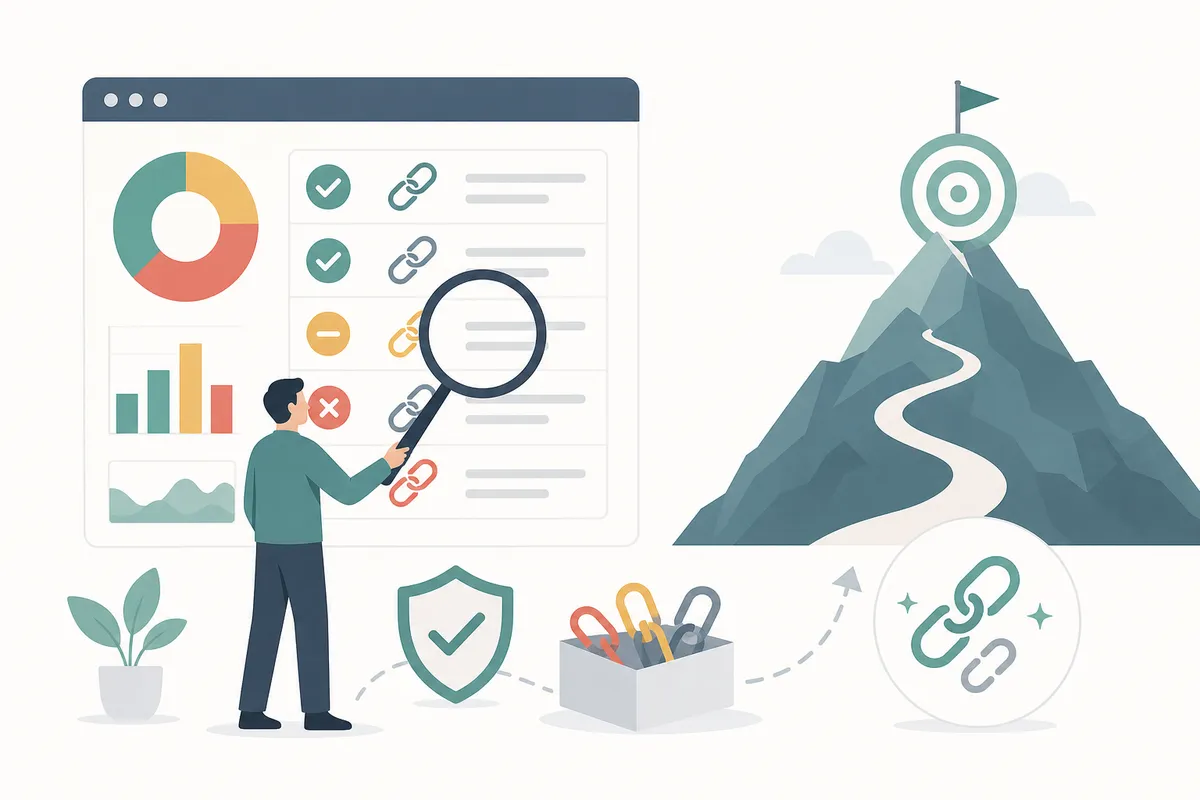
Once your own profile is mapped, look at two or three direct competitors and find the sites linking to them but not to you. These are your highest-probability targets, because they've already shown they'll link to a page like yours. Build a simple tracking sheet: source domain, why they linked to the competitor, and what you'd need to offer to earn the same link.
Five Ways to Earn Links Instead of Renting Them
Content that earns links does one of a few things. It saves the reader time, gives them data they can cite, or does something no one else has bothered to do properly.
- Build a genuinely comprehensive resource. A guide, tool, or original dataset that's more useful than what's currently ranking gets referenced by writers. They link to it instead of writing the same thing themselves.
- Pursue digital PR, not just guest posts. Getting quoted as a source in a journalist's story tends to land on a higher-authority domain than a guest post pitch. The same goes for pitching an original data point to a reporter covering your industry.
- Publish original research or data. A small survey, an analysis of your own usage data, or a breakdown of an industry question gives other writers something specific to cite. That's harder to find than opinion content.
- Fix broken links on relevant pages. Find dead links on authoritative pages in your niche and offer your live, relevant page as the replacement. It's useful to the site owner and gives you a natural reason to ask.
- Repurpose what already works. Turning a strong article into a video, a slide deck, or an infographic reaches people who'd never have linked to the original text. It also signals to search engines that the content is actively maintained.
For a closer look at how these tactics play out, nine backlink tactics that have actually worked walk through real examples.

Outreach That Gets Replies, Not Silence
The gap between a link building campaign that works and one that doesn't usually comes down to outreach quality, not volume. Generic, templated outreach emails are widely reported to convert at around 2%. The recipient can usually tell in one line that the message was never really about their site.
A better outreach message does three things. It names something specific about the recipient's page, explains why your content is relevant to their readers, and asks for one clear, small action. Skip the flattery and the vague "great content!" opener. Editors and site owners get dozens of those a week and filter them out on sight.
Build your outreach list in tiers based on domain authority and topical fit. Track every reply so you can see which subject lines and pitch angles actually work. A spreadsheet with source domain, contact date, pitch angle, and outcome is enough to start. You don't need specialized software for the first fifty outreach emails.
What to Avoid: Paid Links and Other Shortcuts That Risk a Penalty
Not every fast link is a bad link, but a few shortcuts consistently backfire.
| Method | What It Looks Like | Should You Use It? |
|---|---|---|
| Earn | Publishing content other sites cite without being asked | Yes. It's the most durable approach |
| Ask | Reaching out to a site that already mentions you but hasn't linked | Yes, when your content genuinely helps their readers |
| Add | Submitting to a relevant, reputable directory or building a legitimate profile | Yes, as a limited part of a broader strategy |
| Buy | Paying a site to place a link that passes ranking credit | No. This violates Google's spam policies |
Buying links is the one shortcut worth calling out explicitly, because it's the one that costs the most when it's caught. Google's guidance treats a paid link intended to manipulate rankings as a violation, no matter how the payment is disguised. That includes cash, an undisclosed sponsored post, or free product exchanged for a dofollow link. Our guide to earning natural backlinks without triggering a link penalty covers the specific patterns Google flags, from disguised payments to over-optimized anchor text.
Track Quality, Not Just Quantity
A link building program without measurement drifts toward whatever's easiest to get, which usually isn't what's most valuable. Set up a recurring review, monthly is reasonable for most sites, that checks:
- New referring domains gained, and their authority relative to your existing profile
- Any links that have gone dead or been removed, so you can reclaim or replace them
- Anchor text distribution, to catch over-optimization before it becomes a pattern
- Referral traffic from your top links, which tells you which ones actually send readers, not just pass SEO signal
Catching a toxic or spammy link early is far cheaper than cleaning up a profile after it's already dragged rankings down. Most backlink monitoring tools will flag sudden spikes in low-quality referring domains. That's often the first sign of a negative SEO attempt or an old directory listing gone bad.
Where AI Tools Help, and Where They Don't
AI-powered prospecting tools genuinely speed up the tedious parts of link building. They can find sites in your niche, draft a first-pass outreach email, and flag domains worth a closer look. Used that way, they cut the research time on a campaign meaningfully.
What they don't replace is judgment. An AI tool can surface a hundred sites that technically match your keywords. It can still miss the ones a human would recognize as the best fit. It might even flag a site as high-authority when its own link profile is full of spam. Treat automation as a first-pass filter that narrows your list, then have a person review the shortlist before a single outreach email goes out. Teams that skip that review step tend to end up with faster outreach to worse targets. That's a net loss, even though the dashboard looks busier.
Diversify Your Links So One Update Can't Wipe Out Your Growth
A backlink profile built entirely from one tactic, one type of site, or one anchor text pattern is fragile. When Google adjusts how it weighs a particular link type or anchor pattern, a concentrated profile can lose ranking overnight. A diversified one barely moves. This is less about hedging your bets and more about how real, earned link profiles actually look. They're a mix of editorial mentions, directory listings, guest posts, and natural citations, built up over time by different people for different reasons.
Most link profiles that rely on one source, one tactic, one campaign, or one repeated anchor text are fragile in the same way. Before scaling up whatever's working today, read our piece on why diversifying backlinks matters and the mistake one update exposes.
Building backlinks for sustainable SEO growth is less a single tactic and more a habit. Audit regularly, earn deliberately, track honestly, and don't let one method carry your whole profile.
FAQs
How long does it take to see results from sustainable link building?
Most sites see the first measurable movement in rankings within three to six months of consistent link earning. This varies by niche competitiveness and starting authority. Association-producer tactics like digital PR and original research tend to take longer to land but produce more durable authority gains than faster, volume-based tactics.
Is guest posting still an effective way to build backlinks?
Yes, when the post goes on a genuinely relevant, reputable site and the content adds real value to that site's readers. Guest posting purely for the link, on low-quality sites that accept nearly anything, carries little SEO value. It can look manipulative if it's the bulk of your link profile.
How many backlinks do I need to rank well?
There's no fixed number. A handful of highly relevant, authoritative links can outperform hundreds of weak ones. Focus on the quality signals, authority, relevance, and placement, rather than chasing a link count.
Can I use AI tools for backlink outreach without hurting my results?
AI tools work well for prospecting and drafting a first version of an outreach message, but a person should personalize and review before sending. Fully automated, unreviewed outreach tends to produce the same low response rates as any other generic email.
What's the fastest way to lose backlinks I've already earned?
Site redesigns, URL changes without redirects, and content removal are the most common causes of lost links. A monthly check for broken or removed backlinks lets you reclaim them with a quick outreach note. Do it before the linking site forgets why they linked to you in the first place.
See What Your Own Backlink Profile Is Missing
Building backlinks for sustainable SEO growth starts with knowing exactly where your site stands today, not with another general checklist. The fastest way to find out is to look at a sample SEO report. From there, talk to the team about what your own link profile would need to grow the same way.
Resources / References
Sources
- Sustainable Backlink Building for SEO Success
- Guide to Building Backlinks for Sustainable SEO Growth
- 9 Winning Link Building Strategies for Sustainable SEO ...
- What are some long-term link building strategies for ...
- Link building for SEO: What works in 2026
Disclaimer: This article is general information about rules and figures that applied when it was written, not personalised financial, tax or investment advice. It does not take account of your income, obligations, risk tolerance or goals, and rates and thresholds change. Verify the current position with the relevant authority, and speak to a licensed adviser or a qualified accountant before acting.
About the author
SearchBlueprint researched, wrote and scored this article with the content pipeline our customers run on their own sites. The score in the byline is what our content engine gave this page before it published. Nothing here is reviewed by hand, which is the point: it is the product's output, published where anyone can check it.