Scalable automation: how to grow SEO without breaking it
SearchBlueprint · · 10 min read · scored 89/100

Scalable automation means building workflows that handle 10x or 100x more work without more headcount, cost, or quality problems. For SEO, that means research, drafting, internal linking, and publishing that keep working as a site grows from 50 pages to 5,000. Done right, it keeps a program scaling with the business instead of collapsing under volume.
Most teams that try automation first hit a wall: the process worked for ten pages and broke at a hundred. This article covers what makes automation scalable rather than just automated. It also covers where it fails and how to build it without tanking content quality or drawing a search engine penalty.
What scalable automation actually means for SEO teams
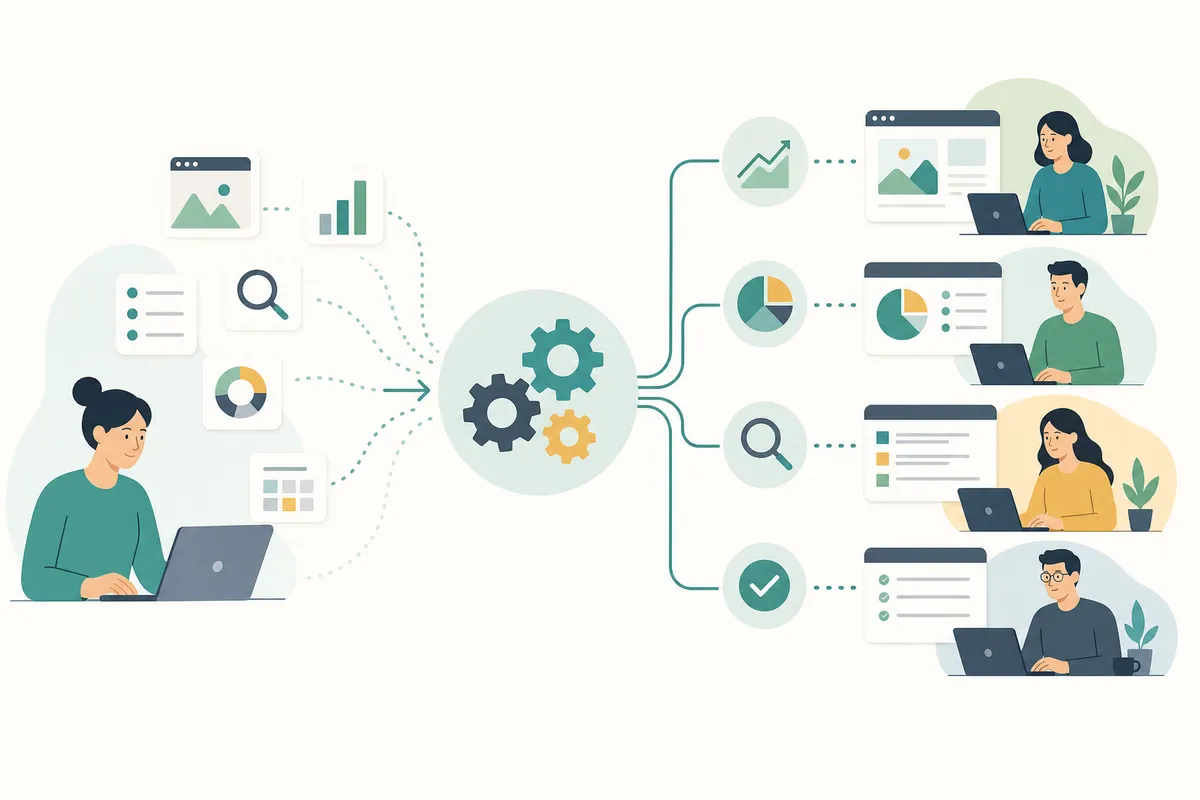
Automation on its own just means a task runs without a human doing it by hand. Scalable automation is a narrower, harder standard: the system keeps its speed, accuracy, and cost per unit flat as volume rises. A script that drafts one blog post a week and a system that drafts fifty a week without more editing hours per post are doing different jobs. That's true even if both are technically "automated."
The gap shows up fastest in content and internal linking. A single writer can hand-place internal links across ten articles and keep track of what points where. At 500 articles, that same manual process either stops happening or starts creating duplicate anchors and orphaned pages. This approach replaces that manual tracking with a system that draws links from your own site's crawl data. The linking then stays accurate as the site grows instead of decaying.
Scalable versus non-scalable: the practical difference
| Attribute | Scalable automation | Non-scalable automation |
|---|---|---|
| Architecture | Modular; each step (research, draft, review, publish) runs independently | Monolithic; one script or person does everything end to end |
| Data handling | Content briefs, keywords, and settings are separated from the writing logic | Instructions and data are mixed into one prompt or spreadsheet |
| Environment | Works the same on 10 pages or 10,000 | Breaks or slows sharply past a fixed volume |
| Oversight | A defined human checkpoint before publish | Either fully manual or fully unattended, with no middle step |
| Failure mode | One broken step is isolated and fixable | One failure can cascade through the whole batch |
Why scalable automation is now a growth priority

This shift isn't a niche IT trend anymore. Gartner reported that over 80% of organizations self-reported increased or continued investment in hyperautomation initiatives in 2021. 56% said they had an average of four or more concurrent hyperautomation initiatives running at once. That same research put combined venture capital and private equity investment in RPA, process mining, process discovery, NLP, and virtual assistants at roughly $500 million by mid-2021. The broader market opportunity was estimated at around $440 billion worldwide.
The pressure is coming from both directions inside companies. Gartner found that in 2021, 50% of CEOs and 69% of boards of directors were demanding accelerated growth and operational excellence. Those are goals that automation is well suited to deliver. On the execution side, 80% of executives expected to increase spending on digital business initiatives in 2022. 65% said they were increasing the pace of their digital business. And 72% planned to shorten timelines for implementing those initiatives. Gartner also projected that by 2024, organizations would cut operational costs by 30% through scaling automation and redesigning operational processes.
For SEO specifically, the same math applies at a smaller scale. Content and technical work that used to require linear headcount growth can now grow output without linear cost growth. That only holds if the automation is actually built to scale rather than just to run once. This guide to SEO automation breaks down that math in more detail for content specifically.
Key methodologies: from programmatic SEO to autonomous workflows
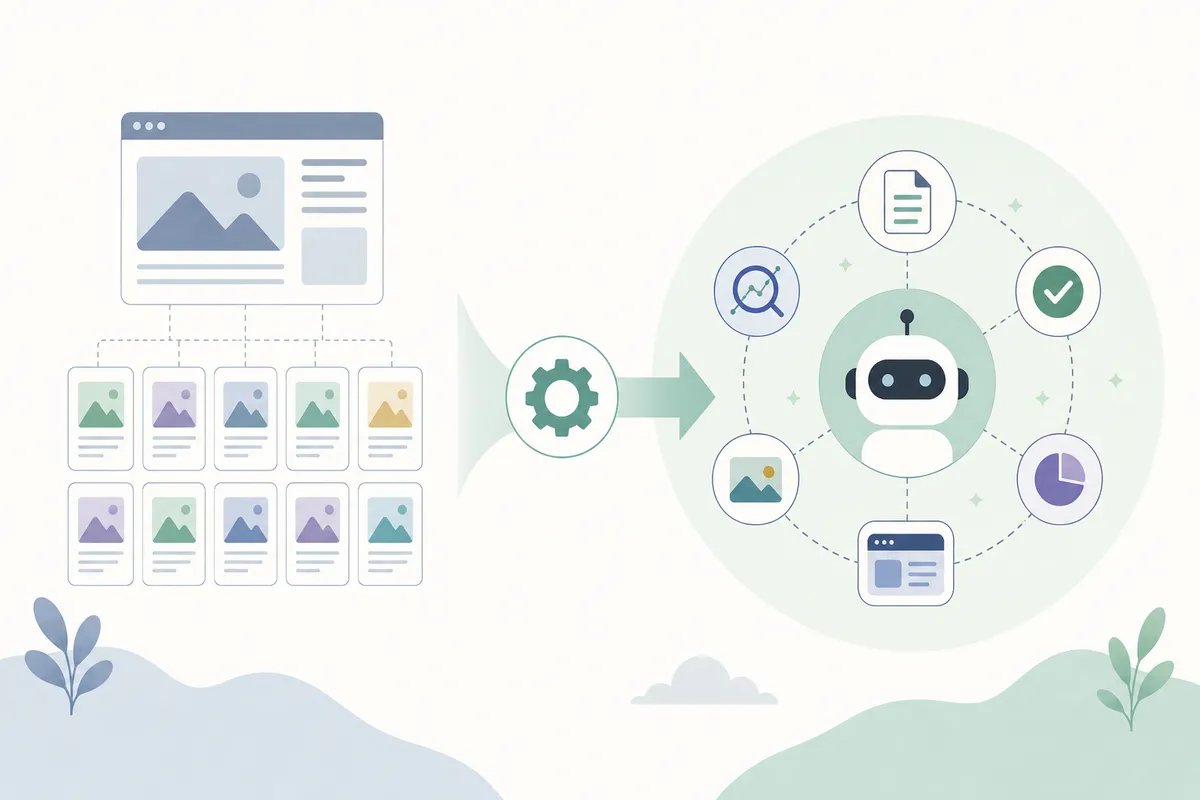
Not every automated approach scales the same way, and picking the wrong one for your situation is a common early mistake. Three methodologies dominate SEO and content automation today, each with different tradeoffs.
Programmatic SEO generates large sets of similar pages, like location pages or product variants, from a structured template and a data source. It scales extremely well for repetitive, well-defined page types. But it produces thin or duplicate-feeling pages fast if the template isn't built with real local or product-specific detail.
AI-assisted content pipelines use a model to draft full articles or pages from a brief. The draft then routes through automated quality checks before a human reviews it. This methodology scales well for blog content, guides, and evergreen pages where each piece needs its own research and structure, not just a swapped variable.
Autonomous workflows chain multiple automated steps together, research, drafting, image placement, internal linking, and publishing, with minimal manual intervention between them. This is the most scalable methodology on paper. But it's also the one most exposed to compounding errors if any single step in the chain is weak.
Comparing the three methodologies
| Methodology | Best for | Human oversight needed | Scales to |
|---|---|---|---|
| Programmatic SEO | Location pages, product variants, structured data pages | Template design and periodic data audits | Thousands of pages |
| AI-assisted content pipelines | Blog posts, guides, evergreen articles | Review before publish, every piece | Dozens to hundreds of pieces monthly |
| Autonomous workflows | Full content and linking cycles for established sites | Spot checks and exception handling | Full-site content operations |
Most teams that succeed at scale don't pick one methodology, they layer them. Programmatic templates handle structured pages, an AI-assisted pipeline handles original content, and autonomous steps cover the repetitive parts of both, like internal linking. This article on optimizing SEO automation for traffic gains walks through how to combine them without diluting quality.
Where scalable automation breaks: quality, penalties, and AI's limits
Automation that scales the wrong thing scales the problem. The most common failure isn't a technical bug, it's applying full automation to a task that genuinely needs human judgment.
The quality risk
Automated content at volume tends to drift toward generic phrasing, repeated structures, and claims that sound plausible but aren't grounded in real data about the business. A reader, and increasingly an AI search assistant summarizing the page, can tell the difference between a specific, sourced claim and a filled-in template sentence. Thin content at scale doesn't just underperform, it can drag down the credibility of the pages around it.
The penalty risk
Google's spam policies are explicit that content produced primarily to manipulate search rankings, regardless of whether a person or an automated system produced it, violates those policies. This isn't a ban on automation itself. It's a standard about intent and quality. Automated content that's genuinely useful, accurate, and specific to the reader's need is treated the same as any other content. Automated content built purely to fill a keyword list at volume is the pattern that draws scrutiny.
Where AI still needs a person
AI systems are strong at pattern matching across large amounts of text, which is exactly what drafting and structuring content requires. They're weaker at knowing what's actually true about a specific business, what changed since the source material was written, and when a claim needs a caveat. That gap is why every scalable system needs a defined point where a person checks the output before it goes live. That is not a formality. It is the step that catches the errors automation can't see in itself. This automation guide covers which tasks are safe to fully automate and which ones still need a person in the loop.
The hybrid approach: why full automation alone loses
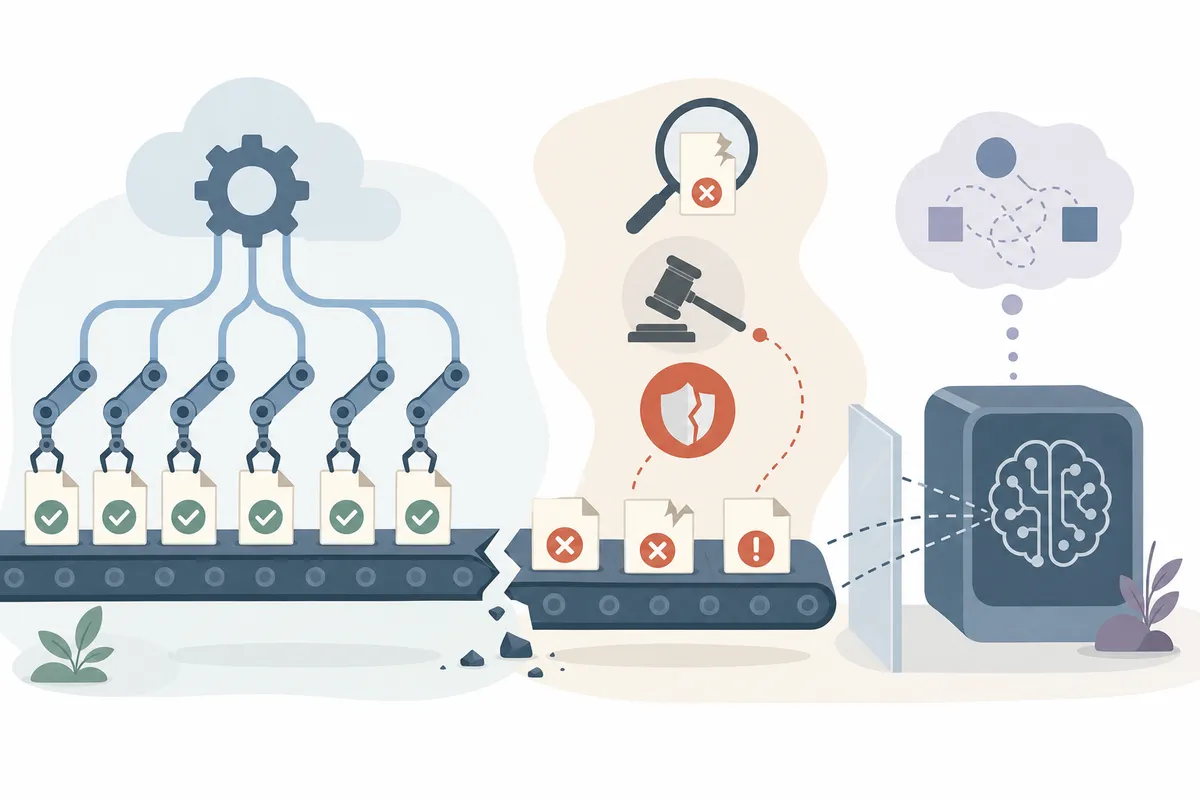
Fully manual SEO doesn't scale. Fully autonomous SEO, with no review step, scales the mistakes along with the output. The approach that actually works in practice sits between the two. Automation handles research, drafting, structure, and the repetitive mechanics, while a defined checkpoint keeps a person deciding what actually publishes.
This isn't a compromise position, it's what the data on scaling automation across other fields also shows. The same principles that keep automated test suites reliable at scale, modular steps, separated data and logic, and regular review, apply just as directly to content and SEO pipelines. A system built as one inseparable process breaks the moment volume increases. A system built as connected, checkable steps can grow without losing control.
SearchBlueprint's own AI article writer is built around that principle. It runs 36 checks per draft before a piece is considered ready, rather than treating "AI wrote it" as the finish line. That's the practical shape of hybrid automation, machine speed for the volume, a defined gate for the quality.
A practical roadmap for scalable automation
Building automation that survives real growth follows a fairly consistent pattern, whether the process is testing software or publishing content. Five steps cover most of what determines whether a system scales or stalls.
- Choose tools built for scale, not just for the first task. A tool that's simple, fits your budget, and genuinely supports growing volume beats one with more features but a hard ceiling. Weigh the learning curve and how well it integrates with what you already run.
- Design with scalability in mind from the start. Keep configurations, keyword lists, and content rules separate from the logic that runs them. Avoid hardcoding anything you'll need to change later, because retrofitting scale into a rigid system costs far more than building for it upfront.
- Test before you trust it with real volume. Run the workflow against a range of inputs, including the messy or unusual ones, before letting it run unattended. A system that only works on clean, ideal inputs will fail quietly the first time it meets a real one.
- Keep version control and backups. Track changes to your automation's configuration and content rules the same way you'd track code. If a change causes a problem, you need to revert it fast, not rebuild it from memory.
- Review and optimize on a schedule. Automation isn't a set-and-forget system. Revisit it regularly, check what's underperforming, and adjust as your site, your competitors, and search engines change around it.
Skipping any one of these five is usually where "we automated it and it broke" stories start. The teams that scale successfully treat automation as infrastructure that needs maintenance, not a script they run once and walk away from.
FAQs
What is scalable automation in SEO and marketing?
It's an automated workflow, for research, content, or linking, that keeps its speed, accuracy, and quality consistent as volume grows. That's different from one that only works reliably at small scale.
Is scalable automation the same as programmatic SEO?
No. Programmatic SEO is one methodology under the scalable automation umbrella, useful for structured, repetitive pages like location or product pages. It also covers AI-assisted content pipelines and autonomous workflows, which handle different kinds of content.
Can AI automation get a website penalized?
Yes, if it's used to produce content primarily to manipulate rankings rather than to genuinely help the reader. Google's spam policies apply to that intent regardless of whether the content was written by a person or an automated system. That's why a human review step before publish matters.
How much can scalable automation actually save?
There's no single figure that applies to every business. But Gartner projected that by 2024, organizations would cut operational costs by roughly 30% through scaling automation and redesigning their operational processes. The actual savings for any one team depend on how much manual, repetitive work the automation replaces.
Do I need developers to build scalable automation?
Not necessarily. Low-code and managed platforms can cover most content and SEO automation needs. Custom development matters more for highly specific workflows or deep integrations with existing internal systems.
Start with the audit, not the automation
Scalable automation works best when it starts from real data about your own site, not a generic template applied at volume. Before you commit a workflow to run unattended, see what a full audit actually finds. Talk to the team and look at a sample SEO report to see exactly which pages, keywords, and content gaps are worth automating first.
Sources
- Scalable Test Automation: Design, Optimize, and Scale
- What is Automation Scalability? Things You Should Know
- 10 Best Practices for Writing Scalable Test Automation ...
- Scaling automation: How to fast-track digital transformation
- What is Scalable Automation? And Why Most Systems Are ...
Disclaimer: This article is general information about rules and figures that applied when it was written, not personalised financial, tax or investment advice. It does not take account of your income, obligations, risk tolerance or goals, and rates and thresholds change. Verify the current position with the relevant authority, and speak to a licensed adviser or a qualified accountant before acting.
About the author
SearchBlueprint researched, wrote and scored this article with the content pipeline our customers run on their own sites. The score in the byline is what our content engine gave this page before it published. Nothing here is reviewed by hand, which is the point: it is the product's output, published where anyone can check it.