Why SEO Scalability Matters for Sustainable Growth (and How to Build It)
SearchBlueprint · · 11 min read · scored 92/100

Here is why SEO scalability matters for sustainable growth: organic traffic only compounds when output can rise without budget and headcount rising in step. That takes template-level technical controls, repeatable content systems, and reporting tied to revenue. A bigger team writing more pages by hand is not a strategy. It is a payroll problem waiting to happen.
Most teams discover this the hard way. Publishing doubles, quality slips, rankings wobble, and the person who held the process together resigns. This article covers what scalable SEO actually is, what it costs compared to the alternatives, the technical and editorial systems that hold at 50,000 pages, and the situations where chasing scale is the wrong call entirely.
What SEO scalability actually means
SEO scalability is the ability to grow organic search performance without a matching increase in people, hours, or spend. Ten times the pages should not require ten times the team.
The test is simple. If your organic output slows every time someone goes on leave, gets promoted, or quits, you do not have a scalable SEO program. You have a person wearing a process as a costume.
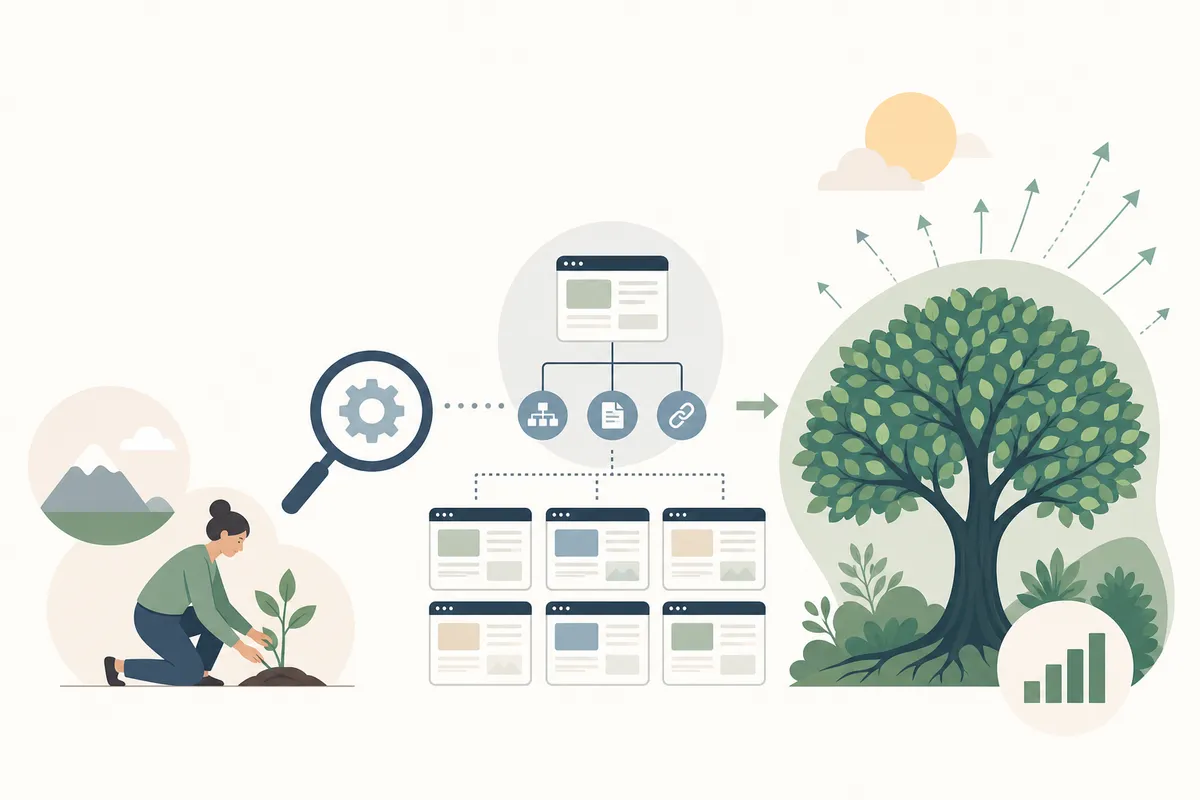
Small-site SEO is manual by nature, and that is fine. One person writes the content, fixes issues page by page, and tracks a short keyword list. A workflow built for a 500-URL site does not bend at 50,000 URLs, though. It snaps. Decisions that were made once per page have to become rules made once per template, and checks that were run by hand have to run on their own.
Scalable is not the same as sustainable
The two words get used interchangeably, and they should not be. Scalable means output can grow cheaply. Sustainable means the growth survives contact with reality: staff turnover, algorithm updates, a site migration, a budget cut. Business researchers writing on startups have made the same point about companies generally, arguing that scale pursued before capacity produces fragile growth. In SEO the pattern is identical. A content operation that quadruples output while quality controls lag is scaling, but it is not sustainable, and the rankings eventually say so.
You want both. Systems give you scale. Governance and honest measurement make the scale sustainable.
Why SEO scalability matters for sustainable growth: the economics of compounding
Organic search is the rare channel where cost per acquisition falls as the program matures, because pages published two years ago keep converting without new spend. Paid channels reset to zero every morning. That compounding is the entire commercial argument for SEO, and scalability is what protects it.

The talent math
The hiring route gets expensive fast. One analysis of the scaling problem puts the cost of hiring a single SEO specialist at $15,000 to $25,000, and reports that a system doing the same work at ten times the volume runs a fraction of that monthly. The same analysis cites talent scarcity affecting 85% of agencies. Even if you have the budget, the person you want may not exist in your market. That squeeze is not unique to SEO: an Equinix survey of the IT sector found 58% of employers feel a lack of skilled personnel is a threat to their business.
| Path to more output | Cost signal | What it scales | Where it breaks |
|---|---|---|---|
| Hire another specialist | Reported at $15,000 to $25,000 per hire in scaling analyses | Judgment, strategy, manual fixes | Output stops the day the person leaves, and 85% of agencies already report talent scarcity |
| Brief more freelancers | Per-article fees plus editing hours that grow with volume | Raw word count | Quality drifts without templates; thin pages under 300 words reportedly dropped 22% to 41% in rankings in 2026 |
| Build systems and automation | Software plus setup time, a fraction of a hire monthly per the analyses above | Audits, templates, and checks applied to every page at once | Needs clear ownership and governance, or the outputs go unread |
Why agencies feel it first
An agency multiplies the problem by its client count. Every manual process gets repeated across every account, so the margin erosion that a single in-house team feels slowly hits an agency all at once. That is why the case to invest in SEO automation is strongest for agencies, and why agency SEO compounds so visibly once the systems are in place: the same template, audit, or workflow improvement lands across twenty clients simultaneously.
Technical foundations that hold at 50,000 pages
Technical SEO at scale is pattern control, not page repair. One canonical rule applied to a template can fix thousands of URLs in a single change. Chasing those URLs individually is not slow. It is impossible.

Crawl budget becomes a hard ceiling
Practitioners commonly treat around 10,000 indexable URLs as the point where crawl budget starts to bind, the same range Google's crawl-budget guidance for large sites flags for active management, and sites past roughly 100,000 URLs that ignore it report new content sitting unindexed for weeks. Google's own search documentation ties crawl capacity to server health: sustained 5xx errors and slow responses tell Googlebot to back off, and the crawl rate recovers slowly after the errors stop. A site that publishes daily but gets crawled reluctantly is paying for content the index never sees.
Two details trip teams up here. Noindex tags do not save crawl budget in the short term, because Google has to crawl the page to read the tag. And a sitemap stuffed with redirects, noindexed pages, and soft 404s actively degrades crawl efficiency by teaching Google that your submitted URLs are unreliable.
Set the rule once, at the template
| Technical layer | What breaks as pages multiply | The scalable control | Early warning sign |
|---|---|---|---|
| Crawl budget | New pages sit unindexed for weeks on large, unmanaged sites | Log-file analysis plus robots.txt rules that keep crawlers on money pages | A widening gap between published and indexed counts |
| URL parameters and facets | Filters and sort orders mint thousands of near-duplicate URLs | Canonical and parameter rules set once per template, not per page | Indexed URL count growing faster than content count |
| XML sitemaps | Redirects and soft 404s pollute the file and erode crawl trust | Automated sitemaps listing only canonical, indexable, 200-status URLs | Search Console reporting submitted URLs it declines to index |
| Server health | Sustained 5xx errors suppress crawling, and recovery takes weeks | Uptime-grade monitoring with alert thresholds on error rates | Crawl-rate dips in crawl stats after each deploy |
Every row in that table shares one property: the fix is a rule, not a task. Rules survive staff changes. Task lists do not.
Scaling SEO content without shipping thin pages
The content trap is seductive because volume looks like progress. It is not, on its own. The reported 22% to 41% ranking drops on thin paginated content in 2026 are what volume without standards buys, and remediation reportedly took weeks. The answer is not writing less. It is making quality repeatable.
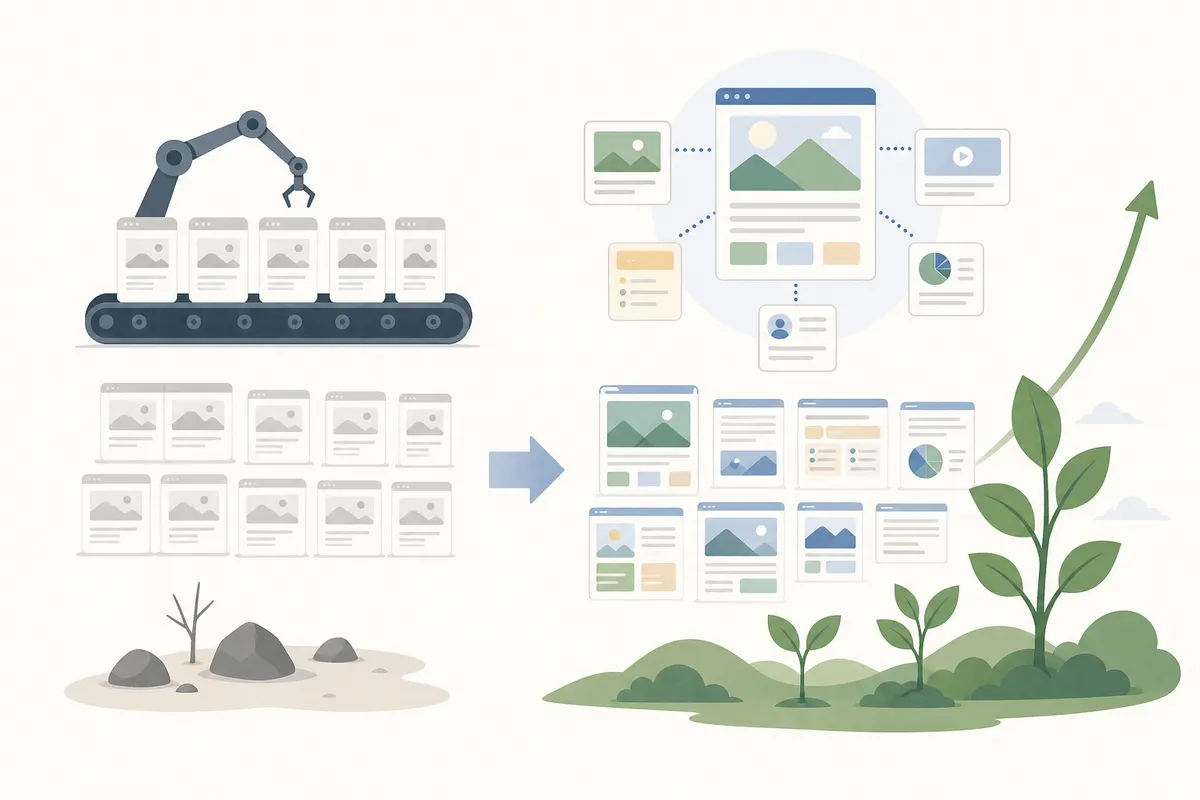
Templates carry the structure, writers carry the expertise
A content template defines the skeleton per topic type: required sections, target depth, internal linking pattern, tone. Writers then spend their effort on the part machines and juniors cannot fake, which is knowing the subject. Understanding what makes an SEO article worth publishing is the prerequisite for templating one; a template built from a weak article scales the weakness.
Your calendar should be built the same way, from data rather than mood. Topics chosen through keyword research that pays for itself get prioritized by traffic potential, buying intent, and difficulty, so the highest-return pieces ship first. One page targets one primary keyword. Two pages chasing the same term split your own authority, and Google ranks neither well.
The approval queue is the real bottleneck
When a 1,000-word article waits 14 days for sign-off, that is not quality control. That is a queue. Pre-approved templates, tiered review levels, and written brand-voice standards remove most of the judgment calls that reviews exist to catch. The review then covers what actually needs a human: claims, accuracy, positioning.
Write passages an answer engine can lift
Scale has a new audience reading it. AI Overviews, ChatGPT, and Perplexity quote self-contained passages that answer a question outright, which means scaled content needs structural discipline even more than hand-crafted content does: front-loaded answers, headings that match real questions, tables whose rows make sense out of context. The fundamentals of on-page SEO still decide how machines read a page, and a template is the cheapest way to enforce them on every page at once.
Measurement and governance: proving the compound
Rankings for a handful of head terms tell you almost nothing about a program serving tens of thousands of URLs. Measurement has to shift to aggregates: organic traffic by topic cluster, crawl coverage, indexation rate, and revenue contribution by landing page. Those are the numbers that connect SEO activity to the business, and they are the numbers that keep budgets funded.
Governance is the unglamorous half. Someone owns keyword strategy. Someone owns technical changes. Someone prioritizes the development backlog. When those names are missing, tickets rot. The framing of the ticket matters as much as the owner: "fix crawl errors" gets ignored, while an enterprise example cited in the space, a crawl-waste ticket quantified at an estimated $40,000 in missed organic revenue per quarter, moved straight up the backlog. Operational language plus a revenue number beats a vague instruction every time.
Honesty belongs in the framework too. A check you could not verify should be reported as unverified, not silently passed or failed. Scores with a consistent denominator, and findings that say what was actually measured, are what make a report trustworthy enough to act on. We tested this posture on ourselves: SearchBlueprint's own organic traffic grew 347% after we started running our own audits and systems on our own site, treating it as the first customer.
When scalability is the wrong goal for sustainable growth
An honest guide has to say this: not every site should scale, and not every quarter is the time to.
- Small sites win on depth, not breadth. Under a few hundred URLs, the highest-return work is usually making ten money pages excellent, not publishing a hundred mediocre ones. Systems thinking still helps; industrial volume does not.
- Scaling a broken foundation multiplies the damage. Automating publication onto a site with duplicate-content problems or an unmanaged crawl profile produces failure at scale. Fix the patterns first.
- Some models cannot scale, and that is fine. A local practice serving one city has a natural ceiling on useful pages. Manufacturing doorway pages past that ceiling invites the exact quality problems described above, and Google's spam policies name doorway pages as a violation outright.
- Capacity before volume. The researchers who studied scale-first startups found the same weakness everywhere: growth outrunning the skills and controls needed to sustain it. Build the measurement and governance before the tenfold output, not after.
The pattern across all four: sustainable growth is the goal, and scalability is a means to it. When the means starts damaging the end, pause the means.
FAQs
What is SEO scalability?
SEO scalability is the ability to grow organic search results without a proportional increase in people, hours, or budget. It relies on template-level technical rules, repeatable content systems, and automated checks, so that ten times the output does not require ten times the team.
Why does SEO scalability matter for sustainable growth?
Because organic traffic compounds only when output can keep rising after budgets and headcount stop rising. Without scalable systems, growth depends on specific people, and it stalls when they leave. One scaling analysis prices a single specialist hire at $15,000 to $25,000, which makes people-only growth expensive as well as fragile.
At what site size does scalability start to matter?
Practitioners commonly point to around 10,000 indexable URLs as the point where crawl budget and template-level controls start to bind, with sites past roughly 100,000 URLs reporting weeks-long indexation delays when crawl budget goes unmanaged. The systems mindset pays off earlier, though, because it is cheaper to install habits than to retrofit them.
Does scaling content production hurt rankings?
Only when volume outruns standards. Sites with thin content under 300 words on paginated pages reportedly saw ranking drops of 22% to 41% in 2026, and remediation took weeks. Teams that scale through templates, defined quality gates, and data-driven calendars raise output without that penalty.
Is scalable SEO only for enterprises and agencies?
No. Agencies feel the pressure first because every manual process repeats across every client, but any site that plans to grow benefits from rules over tasks. On very small sites the priority flips: deepen the pages that earn money before widening the site at all.
See what a scalable report looks like
Systems are copied faster than they are invented. Open the sample SEO report to see how a scalable audit reads when every check states what was verified and every score shares one denominator, then talk to the team about running it on your site. That, in the end, is why SEO scalability matters for sustainable growth: the compounding only starts once the systems are actually built, and the first brick is knowing exactly where your site stands today.
Resources / References
- Google's crawl-budget guidance for large sites
- Google's own search documentation
- Google's spam policies
Sources
About the author
SearchBlueprint researched, wrote and scored this article with the content pipeline our customers run on their own sites. The score in the byline is what our content engine gave this page before it published. Nothing here is reviewed by hand, which is the point: it is the product's output, published where anyone can check it.