The Importance of Landing Pages for E-commerce SEO Success
SearchBlueprint · · 10 min read · scored 95/100

The importance of landing pages for e-commerce SEO success is hard to overstate. They match a shopper's exact search with one focused page, instead of a generic homepage or a crowded category grid. A page built around a single offer, with proof and one clear action, converts more visitors. It also sends Google a clearer ranking signal than a diluted, multi-purpose page can.
What is a landing page in e-commerce?
A landing page is a standalone page built for one purpose: getting a specific visitor to take one action. It is not your homepage. It is not a product page. You build it on purpose, for one campaign, one search term, or one audience segment.
Most e-commerce sites confuse "the page someone lands on" with "a landing page." Any page can technically be one in web analytics. But a true landing page is deliberately narrow. It drops site navigation, product recommendations, and anything else that gives a visitor a reason to leave before converting.
A common myth says these pages hurt SEO because they are "thin" or built only for ads. That is not accurate. A landing page can rank in organic search if it answers a real query in depth. What actually limits its SEO is no unique content, no internal links, and no reason for Google to treat it as more than a duplicate of your catalog.

Landing page vs. product page vs. homepage
| Page type | Primary job | Navigation | SEO focus |
|---|---|---|---|
| Homepage | Introduce the brand and route visitors to categories | Full site navigation | Broad brand and category terms |
| Product page | Sell one SKU, with specs, reviews, and related items | Full navigation plus breadcrumbs | Specific product and long-tail terms |
| Landing page | Convert one segment of traffic on one offer | Minimal or none | Matched tightly to one search term or campaign |
Product pages still carry most of the organic traffic on a typical store, and they deserve their own optimization work; see 9 ways to optimize product pages for higher sales and SEO for the specifics. A landing page does not replace that work. It is a separate layer built for traffic that already knows what it wants.
Why landing pages are critical for e-commerce SEO
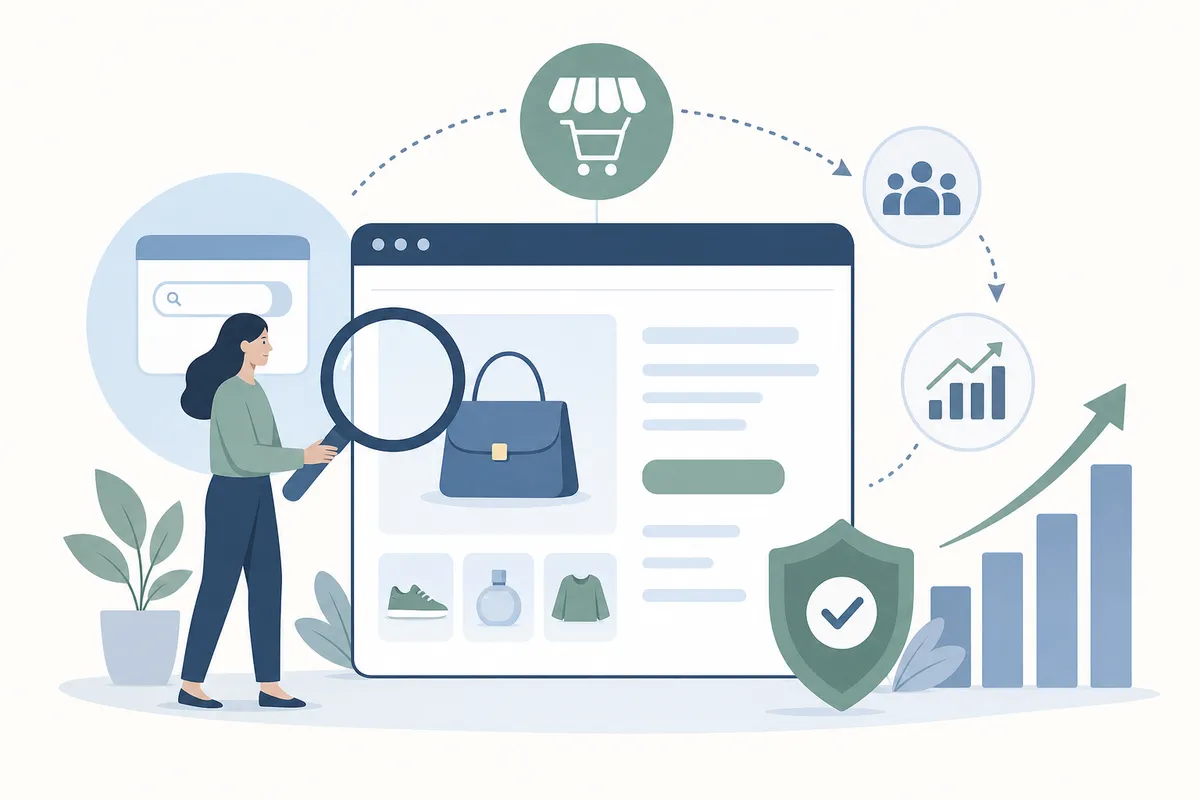
They support e-commerce SEO in three connected ways: precise intent match, stronger on-page relevance, and conversion behavior that reflects a genuinely useful page.
Intent match: answering the exact search, not a category
A shopper searching "waterproof hiking boots for wide feet" wants exactly that. A category page for "boots" answers a broader, weaker version of the same question. A dedicated page can answer the specific one, with the exact phrase in the title, the intro, and the product selection shown.
This is the same principle behind good on-page SEO generally: match the page to the query, not the other way around. The on-page SEO checklist covering 27 pre-publish checks walks through that match in detail, titles, headings, and internal links included.
Conversion signals search engines reward
Google has said plainly that useful, relevant content built for people, not for search engines, is what its ranking systems reward; its own Search Essentials guidance sets that standard. A page that genuinely serves one clear intent, with real product detail and a fast, usable layout, fits that standard better than a page trying to serve everyone at once.
Speed is part of the same standard. Core Web Vitals, the metrics Google uses to judge loading speed, interactivity, and visual stability, are documented on web.dev, and a slow page loses both rankings and sales before a visitor even reads the offer.
Speed alone can move revenue directly. Google's own research, often referenced as the "Milliseconds Make Millions" report, found that shaving just 0.1 seconds off mobile load time lifted conversion rates by as much as 8% on retail sites.
The data behind the conversion lift
Independent case studies point the same direction:
| Metric | Reported figure | Source |
|---|---|---|
| Conversion rate after moving campaign traffic to a dedicated page | Up 9.91% | Case study by Replo, reported via Instapage |
| Revenue per visitor after the same page rebuild | Up 10.25% | Same Replo case study |
| Bounce rate: product page vs. dedicated landing page | Product pages saw 72% more bounces | Instapage |
| Typical e-commerce conversion rate across industries | Roughly 2% to 4% | Industry benchmark cited by Instapage |
| Conversion lift from a 0.1-second faster mobile load | Up to 8% | Google's "Milliseconds Make Millions" research |
These are reported figures from published case studies, not guarantees. Your own numbers will depend on your product, your traffic source, and how closely the page matches what the visitor searched for. The direction, though, is consistent: a page built for one intent outperforms one built for everyone.
Common landing page mistakes that cost you rankings and sales
Most of the damage comes from a handful of repeated mistakes:
- Leaving site navigation in place. Every menu link is an exit ramp. A page with a full navigation bar competes against its own call to action.
- No single, clear call to action. Five competing buttons ("Buy now," "Learn more," "Sign up," "Compare") give visitors permission to do nothing.
- Duplicating product page content. Copying the same description word for word gives search engines no reason to treat this page as distinct or useful.
- Ignoring page speed. A slow mobile load loses visitors before the offer even renders, on the one page meant to convert them.
- Building it once and never testing it. These pages are some of the easiest to A/B test: one headline, one image, one CTA at a time.
- Skipping internal links entirely. A page with no path in from the rest of the site, or back out to it, sits isolated with weak authority signals.
For the broader set of on-page habits that move rankings beyond this page type, the practical on-page SEO tips that actually move rankings guide covers the fixes in more depth.
Essential elements of a high-converting e-commerce landing page
A page that converts almost always shares the same structure: what a shopper sees immediately, and what convinces them to stay.
Above the fold: what a shopper sees first
The first screen has to do most of the work. It needs:
- A headline that matches the search term or ad that brought the visitor there
- One clear call to action, visible without scrolling
- A supporting image or short video of the actual product
- A one-line value proposition: what the shopper gets, and why it matters
If someone has to scroll to understand the offer, you have already lost part of the audience.

Trust and proof signals
Below the fold, the job shifts from clarity to confidence:
- Real customer reviews or ratings, not generic testimonials
- Shipping, return, or guarantee terms stated plainly
- Security badges or payment logos, where they genuinely reassure buyers
- A second call to action, placed after the proof, for visitors who needed convincing first
None of this replaces solid on-page fundamentals. Title tags, heading structure, and image alt text still apply here the same way they apply everywhere else; the nine proven on-page SEO techniques that actually boost rankings breaks those fundamentals down.
Types of landing pages every e-commerce store needs
Not every page looks the same, because not every visitor arrives with the same intent.
| Type | Best for | Typical traffic source |
|---|---|---|
| Category-intent page | A specific need, like "running shoes for flat feet" | Organic search, Google Shopping |
| Seasonal or promotional page | A sale, holiday push, or limited-time drop | Email, paid social |
| Comparison page | Shoppers weighing your product against a named alternative | Organic search, branded and competitor terms |
| New-customer offer page | A first-purchase discount or a lead-capture offer | Paid social, influencer links |
| Ad-specific page | One exact PPC ad group, nothing more | Google Ads, Meta Ads |
A store selling across Shopify or BigCommerce usually needs a mix of these, not one template reused everywhere. The SearchBlueprint page on e-commerce SEO for Shopify and BigCommerce covers how this fits into a wider plan for a growing catalog.
Landing pages and paid traffic: why they depend on each other
Paid traffic makes these pages easier to justify, because the return shows up fast. If an ad promises "30% off waterproof boots" and the click lands on a general boots category page, the mismatch costs money on every click. A page that mirrors the ad's exact offer closes that gap.
The dependency runs both ways, though. A page built only for one ad campaign, with no lasting content or internal links, usually comes down once the campaign ends. That is fine for paid traffic, but it means the page never builds organic value.
The stronger approach treats evergreen pages, the ones tied to an ongoing product line or a real recurring search term, differently from short-lived campaign pages. Evergreen ones deserve full on-page SEO investment. Short campaign pages do not need it, and forcing that effort onto a two-week promotion is usually wasted work. For the fuller picture of what actually moves rankings across an e-commerce site in 2026, see e-commerce SEO in 2026: what actually moves rankings.
How to tell if your landing pages are working
A landing page is working if it converts meaningfully better than the page it replaced, not simply because it exists.
Track a small set of numbers, not everything available:
- Conversion rate, compared against your site's average
- Bounce rate, compared against your product or category pages
- Organic impressions and clicks, if the page is meant to rank
- Page load time on mobile specifically, since that is where most e-commerce traffic now happens
If a page is underperforming your product page on the same traffic, the fix is rarely more design polish. It is usually a mismatch between what the page promises and what the visitor actually searched for.
FAQs
What is the difference between a landing page and a product page in e-commerce?
A product page introduces one item to everyone, with full navigation, reviews, and links to related items. A landing page targets one segment of traffic with a single offer and one call to action, and it usually drops site navigation so nothing competes with that goal.
Do landing pages help SEO, or are they only useful for paid ads?
They can rank in organic search when they answer a specific query in real depth and follow standard on-page SEO practices. A page is not excluded from rankings just because it was built for a campaign, but a thin page with no unique content will not rank regardless of its purpose.
How many landing pages does an e-commerce site actually need?
There is no fixed number. Most stores are better served by one page per major campaign, product line, or high-intent search term, rather than a single page trying to serve every visitor at once.
What is a good conversion rate for an e-commerce landing page?
Typical e-commerce conversion rates fall roughly between 2% and 4%, though this varies by industry and traffic source. A well-built landing page usually converts meaningfully higher than a generic product or category page receiving the same traffic.
Should a landing page include the site's main navigation menu?
Most conversion-focused pages remove or minimize navigation on purpose. Every extra link is a chance for a visitor to leave before completing the one action the page was built for.
Give your product lines their own landing pages
Pick your three best-selling product lines this week. Build one dedicated landing page for each, with a single offer and one clear call to action, and give it the same on-page SEO attention your product pages already get. Talk to the SearchBlueprint team and see a sample SEO report that shows exactly where your current landing pages, and the e-commerce SEO results tied to them, are losing ground. That is the importance of landing pages for e-commerce SEO success: pages built with the same care as your product pages close the gap between traffic and revenue.
Resources / References
Sources
About the author
SearchBlueprint researched, wrote and scored this article with the content pipeline our customers run on their own sites. The score in the byline is what our content engine gave this page before it published. Nothing here is reviewed by hand, which is the point: it is the product's output, published where anyone can check it.