Understanding search intent: why pages rank or don't
SearchBlueprint · · 11 min read · scored 95/100

Understanding search intent means working out what a searcher wants when they type a query, then giving them exactly that. Google decides what each query means before it ranks anything, so a page that answers the wrong goal loses to a weaker page that answers the right one.
What search intent actually is
Search intent, also called user intent or keyword intent, is the reason behind a search. Every query stands in for a task. Someone typing "espresso machine descaling" wants instructions. Someone typing "breville barista express price" is close to a purchase. The words overlap; the goals do not.
Search engines read that difference before they rank anything. Google's ranking systems determine what a query means first, and its Search Quality Evaluator Guidelines give user intent a full section of its own (section 12.7). The helpful content system, first rolled out in 2022, pushes in the same direction: it rewards pages written to satisfy the person searching and demotes pages written mainly to rank. Google's guidance on creating helpful content asks, in effect, whether a visitor leaves feeling they got what they came for.
For you, that means keyword research is half the job. You can target the right term with the wrong page and stay invisible. Matching the intent behind the term is the other half.

Why understanding search intent matters for SEO

The clearest evidence is what happens when a page starts matching intent after missing it. Ahrefs reports that one of its landing pages was stuck because people searching "backlink checker" wanted a working tool, and the page offered none. After the team added a free checker, the page gained 516% more traffic in under six months, on the same keyword and the same domain.
You cannot out-write a mismatch, either. If the results page for your keyword is full of product grids, no article will crack it, however well researched. If it is full of guides, your category page has no business there. Google has already decided what format satisfies the query, and it grades your page against that decision.
Intent also settles the money question: which keywords deserve sales pages and which deserve articles. Send buyers to a blog post and they bounce before the pitch. Sell to someone who came to learn and they leave with a worse opinion of you than when they arrived.
The four types of search intent
SEOs sort queries into four buckets: informational, navigational, commercial, and transactional. Google's quality rater guidelines slice the same behavior a little differently, into know, do, website, and visit-in-person queries. The two models agree more than they differ, so use whichever helps you decide what to build.
| Intent type | What the searcher wants | Query signals | Page that matches | Example query |
|---|---|---|---|---|
| Informational | To learn something or get a question answered | how, what, why, guide, tutorial | An article that answers the question in its first paragraph | "how does a heat pump work" |
| Navigational | To reach a specific site or page they already know | brand names, product names, "login" | Your homepage or product page, clearly titled and fast | "gmail login" |
| Commercial | To compare options before choosing one | best, review, vs, top, alternatives | A comparison or review that weighs real trade-offs | "best crm for small business" |
| Transactional | To act now: buy, book, sign up, download | buy, price, order, coupon, near me | A product or service page with a short path to checkout | "buy standing desk frame" |

Informational: answer first, teach second
These searchers want the answer, then the reasoning. Put the direct answer in the opening lines, use headings that mirror the questions people ask, and keep the sales pitch out of the body. Informational queries belong to articles and guides, and their job is to earn trust and hand the reader a sensible next page. The selling happens later, on the page they click through to.
Navigational: be findable for your own name
Make sure your brand and product names return your pages, with the homepage, login, and main product pages clearly titled. Ranking for someone else's navigational query is usually worthless: Yoast tells the story of its old Google Analytics plugin ranking for the term "Google Analytics," where visitors wanted Google's site, so the clicks helped nobody.
Commercial: earn a place on the shortlist
These searchers are close to spending but still unsure, and they are reading to narrow the field. Give them the comparison they came for: who each option suits, what it costs, where it falls short. A review that reads like an ad gets skipped, because hiding the drawbacks is exactly what this reader is filtering for.
Transactional: get out of the way
The searcher has decided. Show the price, the terms, and one obvious action, and remove every step between arrival and checkout. Detours that feel harmless on an article, like a newsletter prompt or a long preamble, cost real money here.
Google's own four labels
In the rater guidelines, know maps to informational, website maps to navigational, and do covers the commercial and transactional end. The fourth, visit-in-person, is its own game: queries like "dentist near me" trigger the map pack, and a location page plus a well-kept business profile do the ranking work there, since an article cannot enter the map pack at all.
Mixed intent, and queries with layers
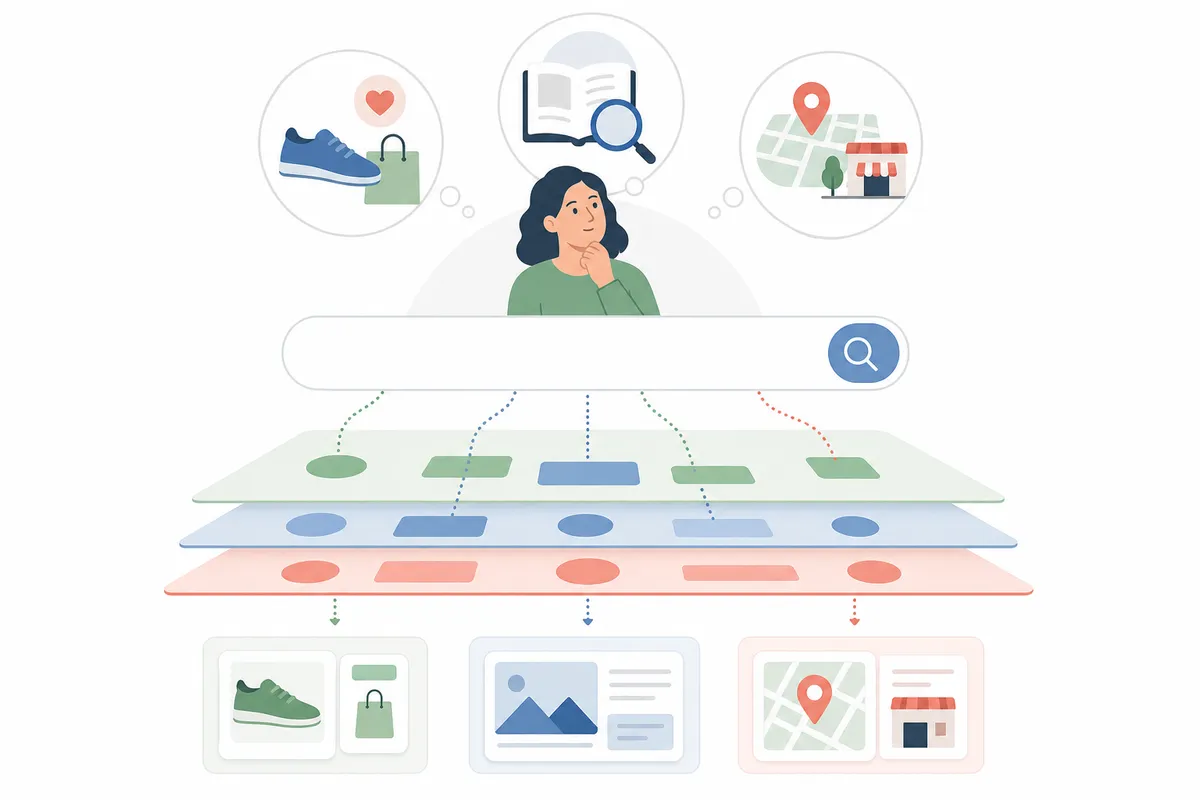
Not every query picks a lane. "Running shoes for beginners" pulls buying guides and product pages onto one results page, because searchers arrive at different stages of the same decision. Google hedges by mixing result types, so you can either cover both angles on one page or pick the stage you serve best and accept the split.
Word order alone can flip a query's meaning. Semrush gives a useful pair: "ingredients for dog food" returns homemade recipes, while "dog food ingredients" returns explanations of what commercial kibble contains. The same three words in a different order describe a different task.
Intent has layers, too. Someone searching "how to make sourdough bread" wants steps and measurements, but the top pages also cover starter care, troubleshooting, and storage, because that is what the task involves once you start it. Cover the layers the results page covers, and skip the ones it does not.
How to identify search intent for any keyword
Read the results page first
Google has already classified every query you care about, and the first page of results is its answer sheet. Search your keyword and note three things: what type of pages rank (articles, product pages, tools), what format they share (how-to, list, comparison), and which SERP features appear. Each feature is a signal you can act on.
| SERP feature | What it signals about intent | What to do about it |
|---|---|---|
| Featured snippet or AI Overview | Informational: searchers want a direct answer | Answer the question in one self-contained paragraph near the top of your page |
| Product grids and shopping ads | Transactional or commercial: searchers are ready to spend | Point a product or category page at the query and keep articles for other terms |
| People Also Ask box | The question has layers searchers expect covered | Answer those related questions as their own sections |
| Map pack | Visit-in-person: the searcher wants a nearby business | Compete with a location page and a complete business profile |
| Video carousel | The task is easier to watch than to read | Add a demonstration video, or accept a format disadvantage |
Study the query's wording
Modifiers do a lot of the classifying for you. "How" and "what" lean informational, "best" and "vs" lean commercial, and "buy," "price," and "near me" lean transactional. Longer queries usually carry clearer intent: "crm" could mean anything, while "crm for a two-person plumbing business" tells you the searcher, the situation, and the stage. That specificity is a large part of why long-tail keywords drive more leads than head terms.
Check it with a tool, then verify
Reading every SERP by hand stops scaling somewhere around your fiftieth keyword. Run your list through a free keyword intent checker to get a first-pass label on each query, or use a keyword checker that shows volume, difficulty, and intent together when you also need to judge whether a term is worth chasing. Treat every label as a hypothesis rather than a verdict, because tools misread mixed queries regularly and the live results page is the only classifier Google is bound by. Spot-check any keyword you plan to build a page around.
How to shape content around intent
Ahrefs frames the matching work as three Cs: content type, content format, and content angle. The type is the kind of page (article, product page, tool). The format is its shape (how-to, list, comparison, review). The angle is the hook the ranking pages share. For "best air fryer," Ahrefs notes the current year keeps appearing in top-ranking titles, which tells you searchers want this year's picks rather than a list from three years back. Match all three before you worry about word count.
Then cover the subtopics the results page expects. The People Also Ask box and the headings that repeat across top pages tell you what a complete answer includes; fold those into your outline rather than bolting them on at the end. If a topic needs several pages, plan the content as one connected cluster so each page owns one intent instead of overlapping with its neighbors.
Titles carry intent signals of their own. Echo the vocabulary the ranking titles use: if every result says "checker" and yours says "analyzer," you are describing the same thing in words nobody searched. For the full sequence from research through on-page work, follow a step-by-step keyword optimization process rather than treating intent as a one-off check.
When intent shifts under a ranking page
Queries do not hold still. Moz recounts what happened with its own domain tool: the page ranked well as a "domain analysis tool" until the titles in the results drifted toward "Domain Authority checker." The words people searched, and the words Google rewarded, had moved. Moz re-optimized the page for the new phrasing and, as the team tells it, reclaimed the top ranking.
You can also check how settled a query is before you invest in it. Ahrefs suggests reading a keyword's SERP position history with the filters set to "Top 50" and "last 6 months." Rankings that barely move point to a clear, stable intent. When they churn instead, Google is still re-testing what the query means, and a page built for today's interpretation may not fit next quarter's. For your existing pages, watch for clicks fading while positions hold. That gap usually means the intent, or the features stacked above you, changed.
Understanding search intent in AI search
AI answers raise the stakes on the same principle. Moz's senior search scientist Tom Capper observes that AI Overviews show up most prominently on informational results pages, which are the queries where a direct answer can replace a click. If your rankings live on informational terms, assume a machine-written summary now sits above some of them.
The response is structural. Answer engines quote passages rather than whole pages, so each section should answer one question completely enough to stand alone: the question as a heading, the direct answer in the first sentence or two, the detail after. A passage that needs surrounding context to make sense cannot be quoted on its own. For commercial queries, AI answers lean on comparisons with concrete criteria, so named trade-offs and specific numbers travel further than adjectives. Intent matching used to happen at the page level; it now happens at the passage level as well.
Where intent fits in keyword research
Classify intent while you are building the keyword list, before anything gets written. Group the terms by intent before you map them to pages: informational terms feed the blog, commercial and transactional terms feed money pages, and each page gets exactly one primary keyword, so your own pages never compete for the same slot. A beginner's guide to keyword research walks through building that list from scratch. And picking keywords you can actually win matters as much as reading their intent, because a perfectly matched page still fails against a results page full of sites you cannot outrank yet.
FAQs
What are the four types of search intent?
Informational (the searcher wants to learn something), navigational (they want a specific site), commercial (they are comparing options before a purchase), and transactional (they are ready to act). Google's Search Quality Evaluator Guidelines describe similar categories: know, do, website, and visit-in-person.
How do I figure out the search intent of a keyword?
Search it and read the first page of results. The page types, formats, and SERP features Google shows are its working definition of what the query means. Intent labels from keyword tools help you sort large lists quickly, but verify any keyword you plan to build a page around against the live results.
Can one page target more than one search intent?
Yes, when the results page itself is mixed. If Google shows both guides and product pages for a query, a page that answers the question and then presents options can serve both readers. When the results split cleanly into separate intents, build separate pages instead.
Does search intent change over time?
Yes. Moz watched searches drift from "domain analysis tool" to "Domain Authority checker" and re-optimized the page to keep its ranking. Recheck the results for your most important keywords every few months, especially for any page whose clicks decline while its position holds.
Why does my page rank but get few clicks?
Usually something above you answers the intent faster: a featured snippet, an AI Overview, ads, or a map pack. Search the keyword and look at what a searcher sees before your listing appears. Sometimes the fix is winning that feature. Sometimes it is retargeting the page to a query where the organic results still get the click.
Check your five biggest keywords today
Search each one and compare what ranks against what you built. Wherever the results page disagrees with your page's type, format, or angle, that page is the one to fix first, and understanding search intent is the check that finds it before a competitor does. Look through a sample SEO report to see how intent gaps surface in a real audit, then talk to the team about closing yours.
Resources / References
Sources
About the author
SearchBlueprint researched, wrote and scored this article with the content pipeline our customers run on their own sites. The score in the byline is what our content engine gave this page before it published. Nothing here is reviewed by hand, which is the point: it is the product's output, published where anyone can check it.