What Is Link Building? Which Links Help and Which Hurt
SearchBlueprint · · 13 min read · scored 92/100
What is link building? It's the practice of getting other websites to link to pages on your site. Search engines read each of those links as a vote of trust. A few relevant links from respected sites can lift your rankings more than hundreds of weak ones.
This guide is for business owners, marketers and anyone new to SEO who wants to understand links before spending money on them. You'll learn what a link is, why Google still counts them, which links carry weight, which ones get sites penalized, and whether you can do the work yourself.
What is link building, and where does it fit in SEO?
Link building is the part of SEO that happens on other people's websites. You can't write it into your own pages. Someone else has to decide your page is worth pointing their readers to.
That puts it in the off-page category. If you're still sorting out how the pieces relate, this breakdown of on-page, off-page and technical SEO shows where links sit next to your content and site health. On-page work makes a page worth ranking. Technical work makes it reachable. Links tell search engines that other people agree it deserves a spot.
What a link actually is
A link, or hyperlink, is a piece of HTML that sends a reader from one page to another. Two parts of it matter for SEO:
- The URL in the
hrefattribute, which says where the link goes. - The anchor text, the clickable words a reader sees.
A link reading "SEO copywriting guide" tells both people and search engines what they'll find. A link reading "click here" tells them nothing.
Internal links versus backlinks
Links come in two kinds. Internal links join pages on your own site. External links, usually called backlinks, point to your site from somewhere else.
Both matter. Internal links help search engines understand how your pages fit together. Backlinks carry more authority, because an independent site chose to vouch for you. When people talk about link building, they almost always mean earning backlinks.
How links work as a ranking signal
Search engines use links for two jobs. Moz's beginner guide to link building puts it plainly: links help search engines discover new pages, and they help decide how well those pages should rank.
Discovery: links are how crawlers find you
Crawlers move around the web by following links. A page with nothing pointing to it is hard for Google to find and harder to judge. Even a strong page can sit unnoticed if no link leads there.
Ranking: why a link counts as a vote
Google's early edge came from links. One of its founders, Larry Page, created PageRank, which scored a page partly on the number and quality of links pointing at it. According to Moz, that approach let Google pull ahead of other search engines in the late 1990s.
The logic still holds. You wouldn't send a friend to a bad restaurant, and site owners rarely link to pages they think are poor. So a link reads as a recommendation. Not every vote counts the same, though. A link from a respected site in your field carries far more weight than one from a blog nobody reads. For the fuller case on why backlinks still move rankings, including how they compare with other signals, that guide goes deeper.
What links do beyond rankings
Rankings are the main reason to build links, but they aren't the only payoff:
- Referral traffic. People click links. A mention in the right industry article sends readers who already care about your topic.
- Brand awareness. Wikipedia's entry on link building describes it as a proven marketing tactic for increasing brand awareness.
- Compounding trust. Each good link makes the next one easier to earn, because your site looks established. That's how you build organic search authority that keeps paying off long after the work is done.
How Google changed the rules on links
Because links were so valuable, people started faking them. Google has spent close to two decades closing those loopholes. The history explains why some old tactics now do nothing, or worse.
- Late 1990s: PageRank. Links became a core ranking signal. SEOs soon learned how to game it with sheer volume.
- 2005: Jagger 2. According to Wikipedia, Google stopped giving credit to reciprocal links, the "I'll link to you if you link to me" swaps that were everywhere at the time.
- 2012: Penguin. Moz describes the first Penguin update as the point where low-quality link building could actively damage rankings, not simply waste time.
- October 5, 2014: Penguin 3.0. This update targeted sites using black hat link tactics. Wikipedia reports it affected 0.3% of English-language queries worldwide.
Big names were caught along the way. Wikipedia lists J.C. Penney, BMW, Forbes and Overstock.com among the brands that received severe ranking penalties for spammy link tactics. Size didn't protect them.
Directories tell the same story. Moz notes that Google once recommended submitting your site to web directories. The tactic was abused, and Google stopped passing much value through those links.
What makes a backlink worth having
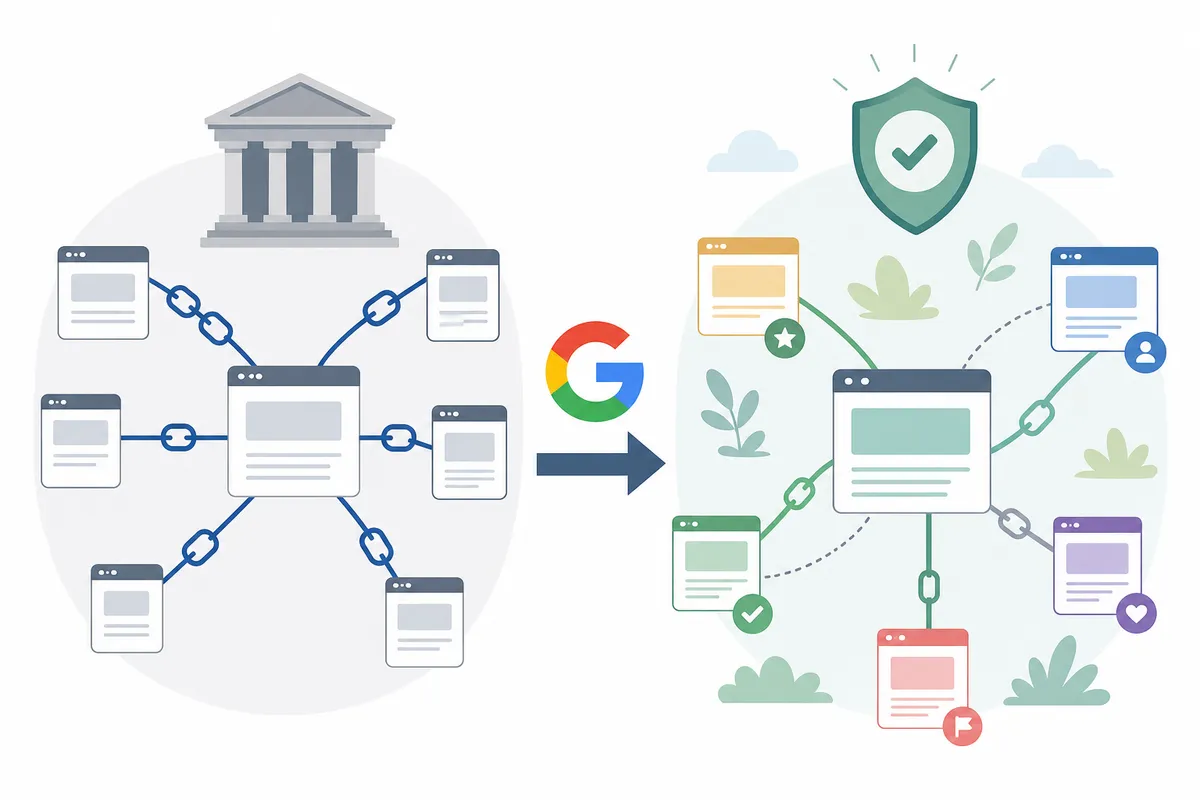
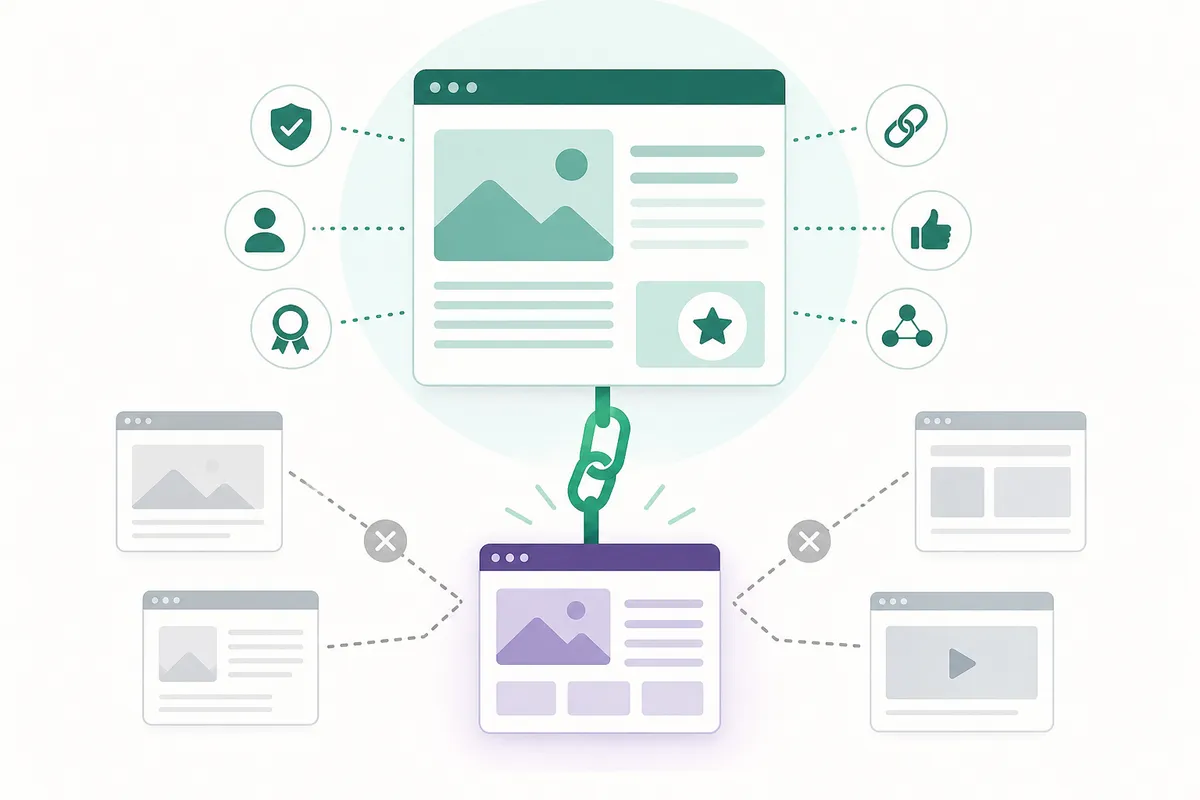
Some backlinks help, some do nothing and some can hurt. Before you chase any link, check it against these factors.
Relevance
A link from a site in your niche implies that people in your field respect your work. Relevance works at the page level too. Semrush offers a clear example: if you sell basketball shoes, a link from a gardening blog does little. A link from a basketball shoe buying guide, in a paragraph about your product, is worth a lot.
Authority
Links from established sites usually count for more. Google has never published an official authority score, so SEO tools estimate one. Semrush's Authority Score, for example, runs on a 100-point scale and blends link quality, organic traffic and how natural a site's backlink profile looks. Treat any third-party score as a rough guide, not a ranking factor.
Placement and anchor text
Where a link sits matters. A link inside the main body text usually carries more weight than one tucked into a footer or sidebar. Anchor text matters too. Descriptive anchors help, but anchors stuffed with exact keywords look engineered and can trigger a penalty.
Link attributes
Some links carry a rel attribute telling Google how to treat them. Google's own guidance on qualifying outbound links covers three:
rel="nofollow"for links the publisher doesn't want to endorse.rel="sponsored"for paid or sponsored links.rel="ugc"for user-generated content such as comments and forum posts.
Google treats these as hints rather than strict rules, so a nofollow link isn't worthless. It still sends visitors and builds awareness.
Diversity
A healthy profile has links from many different sites, page types and anchor phrases. Fifty links from one domain look less natural than ten links from ten different domains. There's a strong argument that a varied backlink profile beats raw volume, especially in crowded markets like SaaS.
| Factor | Strong signal | Weak signal | How to check it |
|---|---|---|---|
| Relevance | A site and page about your exact topic | A site in an unrelated industry | Read the linking page and the paragraph around the link |
| Authority | An established site with real traffic and its own backlinks | A new or abandoned site with no audience | Compare authority scores and traffic estimates in an SEO tool |
| Placement | Inside the main body, early in the article | Footer, sidebar or a long list of links | Open the page and find where the link sits |
| Anchor text | Natural, descriptive wording | Exact-match keywords repeated across many links | Review anchors in a backlink report |
| Attribute | Editorial link with no attribute, or a paid link marked sponsored |
An unmarked paid link | Inspect the link's HTML |
Types of links you'll come across
Links differ by how you get them. Some are earned, some are requested and some are bought. The bought ones carry the most risk.
| Link type | How you get it | Counts toward rankings? | Risk level |
|---|---|---|---|
| Editorial link | Another site cites your content without being asked | Yes, the most valuable kind | None |
| Resource link | Your page is added to a curated list of helpful resources | Yes, when the list is relevant | Low |
| Directory listing | You submit your business to a directory | Little ranking value today | Low if the directory is reputable |
| Guest post link | You write an article for another site | Limited; Google says most should carry nofollow | Medium at scale |
| Reciprocal link | Two sites agree to link to each other | Largely discounted since 2005 | Medium when excessive |
| Blog or forum comment | You post a comment containing a link | Rarely; most carry nofollow or ugc | Low value, spam risk |
| Paid link | You pay a site to place a link | Breaks Google's spam policies | High |
Editorial links are what every other type tries to imitate. Yoast's guide gives a good example: a restaurant that earns a mention in The Guardian's food section gains more than a dozen random directory links ever could.
Link building methods that still work
Semrush sorts link building into four methods: earn, ask, add and buy. Three are fine. One isn't.
| Method | What it involves | Effort | Should you do it? |
|---|---|---|---|
| Earn | Publish content that others cite without being asked | High up front, lasting results | Yes, the most sustainable approach |
| Ask | Contact sites that mention you or would benefit from your page | Medium, ongoing | Yes, when your page adds real value for their readers |
| Add | List your business in reputable directories and social profiles | Low | Yes, as a baseline for new sites |
| Buy | Pay a site directly to host a link | Low effort, high risk | No, it breaks Google's spam policies |
Earn links with something worth citing
Links follow content that gives other writers something to reference. Original data, surveys, free tools, calculators and detailed how-to guides all work. Journalists need sources. Bloggers need proof. If your page is the clearest source on a topic, it gets linked without you sending a single email.
Ask for the links you already deserve
Outreach is where most people struggle. Ahrefs' beginner SEO course, in its March 2021 lesson on the topic, says the hard part is the process, which comes down to emailing complete strangers and asking them to link to you. It works best when your request helps the person reading it. Good places to start:
- Unlinked mentions. Sites that name your brand but don't link to it. A short, polite note often fixes this.
- Broken links. Pages linking to a resource that no longer exists. Offer your page as a working replacement.
- Resource pages. Curated lists in your niche that your guide would genuinely improve.
- Competitor links. Sites linking to several of your competitors may be open to linking to you.
For step-by-step detail on each approach, see these nine tactics that earn real links.
Build association, not only links
Semrush draws a helpful line between "link producers" and "association producers." Link producers, such as email outreach and broken link building, are easy to scale but rarely land links on top sites. Association producers, such as digital PR, becoming a quoted source and partner links, take more time and budget. They tie your brand to a category in the eyes of search engines and AI tools, and they tend to win links from more authoritative sites.
Most new programs lean only on the first group. A balanced plan uses both.
Link building tactics that get sites penalized
Some shortcuts still produce quick wins, which is why they survive. They also put your whole site at risk. Google's spam policies treat links meant to manipulate rankings as link spam.
Avoid these:
- Buying links from site owners for ranking purposes. Paying an agency or freelancer to run outreach is fine. Paying the site that hosts the link is not.
- Private blog networks (PBNs), groups of sites built only to link to a main site.
- Link farms and link schemes that exist to trade links in bulk.
- Excessive link exchanges set up purely to swap links.
- Keyword-stuffed anchors repeated across many links.
When Google spots an unnatural link profile, it can lower your visibility or remove pages from results. Yoast notes that recovery can take months. If you run several sites, the risk grows, because links between them can look like a network. This guide to scaling links across multiple sites without penalties covers how to keep that clean.
Link building in the age of AI search
Search results aren't only ten blue links anymore. Google's AI Overviews, ChatGPT and Perplexity pull answers from across the web and name a handful of sources.
Links still play a part here. AI systems often draw on search engine indexes, so authority you build in Google tends to carry over. Semrush reports that its own research found link quality influences AI visibility, and that nofollow links had almost the same effect as followed ones. Treat that as one company's findings rather than settled fact.
Two other signals matter:
- Brand mentions. Being named in credible content, even without a link, tells AI tools what your business does.
- Co-citation. Appearing alongside trusted competitors in the same article signals which category you belong to.
The coverage that wins you links also wins you mentions, so one plan covers both.
Can you do link building yourself?
Yes, for the basics. Most small businesses can handle the foundations without outside help:
- Claim listings on reputable directories and industry sites.
- Find unlinked brand mentions and ask for the link.
- Publish a genuinely helpful resource on a regular schedule and tell the people who would care.
- Review your profile monthly. A good habit is to run your domain through a backlink checker to see who links to you, which links you've lost and which competitors are pulling ahead.
The work gets harder at scale. Digital PR campaigns, original research and steady outreach take time you may not have. Consider outside help when:
- Your competitors have far more referring domains and your rankings have stalled.
- Past agencies left you with links that look spammy and need cleaning up.
- You compete in a crowded market where content alone isn't moving you.
Whoever does the work, links should serve a plan. Decide which pages matter most, then point your effort there. If you don't have a plan yet, start with this walkthrough on how to build an SEO strategy from scratch so every link supports a page that earns money.
How to tell if your links are working
Links take time to show results. Track a few numbers each month instead of checking rankings daily:
- Referring domains. The count of unique sites linking to you matters more than total links.
- Rankings for target pages. Watch the pages you built links to, not the whole site.
- Referral traffic. See which linking pages send real visitors.
- Lost links. Links vanish when pages are edited or deleted. Reclaim the ones worth keeping.
If referring domains climb and your target pages move up, the work is paying off. If links grow but rankings don't, the links may be irrelevant, or the pages may need on-page fixes first.
FAQs
What's the difference between link building and backlinks?
Backlinks are the links themselves, pointing from another site to yours. Link building is the work of earning them through content, outreach, PR and relationships.
Is link building still important for SEO?
Yes. Google still uses links as a ranking signal, and AI search tools often rely on search indexes that weigh them. What changed is that quality and relevance now matter far more than volume.
How long does link building take to show results?
It varies with your site, your competition and the quality of the links. Expect weeks to months before new links show up in rankings. Earned links also compound, so results tend to grow over time.
Are nofollow links worth getting?
Often, yes. Google treats nofollow as a hint rather than a strict rule. Nofollow links from relevant sites still send visitors, build awareness and make your profile look natural.
Can you pay for backlinks?
You can pay an agency or freelancer to run outreach for you. Paying a site directly to host a link for ranking purposes breaks Google's spam policies and can cost you rankings. If a link is paid, it should be marked rel="sponsored".
Check your own link profile before you build a link
You searched "what is link building" and now have the answer: trust earned from other sites, which search engines and AI tools can read. How your links stack up against your competitors' is what you don't know yet. Open our sample SEO report to see how a full audit lays out links, rankings and fixes, then talk to the team about running one for your site.
Resources / References
Related reading: Ecommerce Link Building: How to Earn Links That Actually Sell.
Sources
About the author
SearchBlueprint researched, wrote and scored this article with the content pipeline our customers run on their own sites. The score in the byline is what our content engine gave this page before it published. Nothing here is reviewed by hand, which is the point: it is the product's output, published where anyone can check it.