AI SEO in 2026: What It Actually Does, and Where It Falls Short
SearchBlueprint · · 13 min read · scored 92/100

AI SEO is the use of machine learning and natural language processing to handle keyword research, content drafting, technical audits, and rank tracking faster than a person can do it manually, while a human still sets strategy and checks the output before anything goes live. It is not a replacement for SEO judgment. It is a way to compress the research and production time that judgment depends on.
That distinction matters more in 2026 than it did two years ago. Search results now blend classic blue links with AI Overviews, and a growing share of research happens inside ChatGPT, Perplexity, and Google's AI Mode instead of a search engine at all. An agency that has run more than 40 AI-powered platforms across live client accounts put it bluntly: some tools "genuinely changed how we work," while others were "pure budget drain." This guide separates the two, and shows you what to check before you commit budget to either.
What Is AI SEO, and How Does It Actually Work?
At its core, AI SEO is SEO work that runs through a machine learning model instead of a spreadsheet and a person's memory of best practice. The model reads a data set, search volumes, competitor pages, your own site's crawl data, and produces an output: a keyword list, a content brief, a list of broken links, a drafted paragraph.
What makes it different from a plain keyword tool is the reasoning layer sitting on top of the data. Older SEO software returned numbers. AI SEO software interprets them: it can read the top-ranking pages for a term, infer what search intent they're satisfying, and suggest a content angle based on that inference, a task that used to take a person hours of manual comparison.

The Building Blocks: NLP, Machine Learning, and Automation
Three technical pieces do most of the work in any AI SEO stack:
- Natural language processing (NLP) reads and scores text the way a search engine's language model does, which is why it now shapes which pages get seen as relevant. The role natural language processing plays in deciding modern rankings is worth understanding on its own, because it explains why keyword density stopped mattering and topical coverage started to.
- Machine learning models trained on ranking data predict which pages are likely to perform for a given query, before you publish anything.
- Automation connects those predictions to action, scheduling audits, flagging technical errors, or queuing content drafts without someone manually kicking off each step.
What Changed in 2026: AI Search Engines Enter the Picture
The bigger shift isn't in the tools. It's in where people search. What actually changed in SEO because of AI over the past two years is that a meaningful share of research queries now get answered inside an AI Overview, a ChatGPT thread, or Perplexity's answer box, before the searcher ever clicks a traditional result. AI SEO tools built for 2026 have to optimize for both surfaces at once: classic rankings and AI citation.
AI SEO vs. Traditional SEO: What's Actually Different

The underlying goal hasn't changed, earn visibility for the terms your customers search. What changed is how much of the research and production work a machine now handles before a person reviews it.
| Task | Traditional Approach | AI SEO Approach | Typical Difference |
|---|---|---|---|
| Competitor keyword analysis | Manual review of competitor pages and spreadsheets | Automated scan and comparison across dozens of competitor URLs | Hours of manual work condensed to minutes |
| Content brief creation | Writer or strategist researches intent and structure by hand | Model generates a brief from top-ranking pages and intent signals | Faster first draft, still needs a strategist's edit |
| Technical audit | Analyst manually checks crawl errors, redirects, and schema | Crawler flags errors automatically and prioritizes by impact | Continuous monitoring instead of periodic checks |
| Rank tracking | Manual rank checks or basic tracking spreadsheets | Automated daily or weekly tracking with trend alerts | Real-time visibility instead of stale snapshots |
| AI-search visibility | Not previously tracked at all | Tools now monitor citations in ChatGPT, Perplexity, and AI Overviews | A genuinely new category of measurement |
That last row is the one traditional SEO software simply didn't have a column for. AI search engines are a 2026 problem, and what AI search engines mean for your SEO strategy is that ranking well in Google no longer guarantees you show up when someone asks an AI assistant the same question.
What AI SEO Tools Actually Do (Core Use Cases)
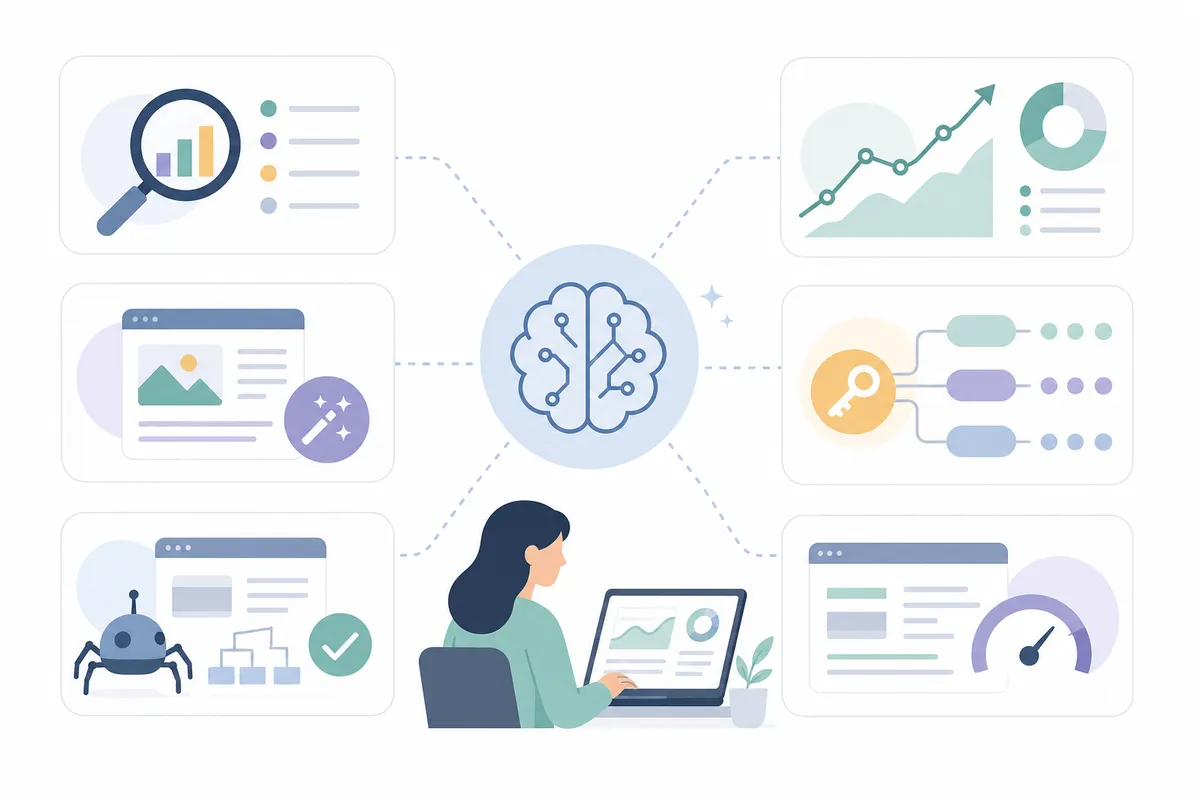
Most platforms marketed as "AI SEO" fall into five overlapping jobs. Few tools do all five equally well, which is why picking one usually means picking a priority first.
Keyword Research and Discovery
This is the most mature use case. Instead of pulling a list of exact-match terms, AI-powered keyword discovery clusters related searches by intent, so you get groups of terms a single page can realistically target, rather than a flat list you'd have to sort by hand.
Content Creation and On-Page Optimization
AI drafting tools can produce a structured article in minutes from a brief. The catch is quality control. Using AI content writers without tanking your rankings means treating the draft as a starting point, not a finished page, adding specifics, checking facts, and editing for the voice a real expert would use.
Deciding what a model should write versus what a person should write is its own skill. When to use AI versus a human writer usually comes down to how much the page depends on first-hand experience or a claim only your business can verify.
Once a draft exists, on-page structure still decides whether it gets cited. On-page techniques that earn AI Overview citations, direct answers up front, clear headings, self-contained paragraphs, apply whether a human or a model wrote the first draft.
Technical SEO Audits
AI-assisted crawlers scan a site and flag broken links, missing meta tags, slow pages, and structured-data errors, then rank them by likely impact instead of listing every issue with equal weight. But automated audits have a ceiling. What an AI SEO audit finds, and what it still misses is a fair question to ask before you trust a tool's severity ratings without a second look.
Internal Linking and Site Architecture
Some platforms scan your existing content and suggest internal links based on topical relevance, rather than requiring someone to remember every page on the site. This matters more as a site grows past a few hundred pages, where manual link mapping stops being realistic.
Rank Tracking and Reporting
Automated tracking checks positions daily or weekly across markets and devices, then surfaces the changes worth acting on instead of a wall of numbers. For agencies reporting to clients, this is often the single most time-saving use case, because it replaces a manual weekly pull with a standing report.
Types of AI SEO Solutions: Which Category Do You Need?

"AI SEO tool" covers a wide range of products, from a single-purpose keyword clusterer to a fully autonomous publishing agent. Knowing which category you actually need avoids paying for capability you won't use.
| Category | What It Does | Example Use Case | Best For |
|---|---|---|---|
| Keyword and content research platforms | Combines keyword data with AI-generated briefs and intent clustering | Building a content calendar around real search demand | Content teams and agencies managing multiple sites |
| Content generation tools | Drafts articles, meta descriptions, and outlines from a brief | Producing a first draft in minutes instead of hours | Teams that edit heavily before publishing |
| Technical audit and crawling tools | Scans a site for errors and prioritizes fixes automatically | Catching broken links and schema errors between manual audits | Sites with large page counts or frequent changes |
| AI-visibility (GEO) trackers | Monitors whether a brand is cited in ChatGPT, Perplexity, or AI Overviews | Measuring citation share against named competitors | Brands competing on answer-engine visibility, not just rankings |
| Autonomous "done-for-you" agents | Plans, writes, publishes, and reports with minimal manual input | Running SEO for a business with no in-house SEO staff | Small businesses that want SEO running without daily oversight |
Well-known names sit across these categories rather than in just one, platforms like Semrush and Ahrefs lean toward research and tracking, Surfer SEO and Frase toward content optimization, and newer entrants position themselves as fully autonomous agents that publish without a person in the loop. The autonomous category is the newest and the least proven; vendors in it commonly advertise installation in about ten minutes and support for 50-plus languages, which speaks to how automated the setup has become, not to how much editorial oversight you should skip.
The Real Benefits of AI SEO for Brands and Agencies
The honest case for AI SEO is speed, not magic. Work that used to take a specialist most of a day now takes minutes, which changes what a small team can realistically keep up with.
- Research time drops sharply. One agency that has tested more than 40 platforms on live client accounts notes that manually analyzing competitor keywords or auditing hundreds of pages used to take about 10 hours; AI tools now handle the same analysis in minutes.
- Smaller teams can maintain a bigger site. Automated audits and rank tracking mean a one-person SEO function can monitor a site that would previously have needed a small team.
- Reporting becomes continuous instead of periodic. Agencies serving multiple clients get standing dashboards instead of manually compiled monthly reports.
- Content velocity increases. Sites can realistically publish weekly instead of monthly, because drafting no longer starts from a blank page.
- Traffic gains are typically gradual, not instant. Vendor guidance generally puts the first visible traffic movement at one to two months after adoption, useful for setting expectations with a client or a boss.
Risks, Limitations, and What to Avoid With AI SEO
None of this works if you treat the tool's output as final. The failure mode isn't that AI SEO doesn't work, it's that it gets deployed without the review step that made SEO work in the first place.
Hallucinated Data and Inflated Recommendations
AI models can present a wrong number with the same confidence as a right one. The agency testing standard worth borrowing here: cross-check keyword volumes and rankings against Google Search Console for at least three months across multiple accounts, and drop any tool whose numbers are consistently off by more than 15-20%. If a platform recommends optimizations that contradict what your own Search Console data shows, that's a signal to investigate, not to follow blindly.
Generic Content That Fails E-E-A-T
Unedited AI drafts tend to read as generic, because a model has no first-hand experience to draw on. Google's own Search Essentials guidance judges content on whether it's helpful, reliable, and demonstrates real expertise, regardless of how it was produced. Thin AI content that never gets a human review pass is exactly the pattern that fails those criteria. The signs your content isn't AI search ready is a useful checklist to run before you publish a batch of AI-assisted pages.
Over-Automation Without Human Review
Fully autonomous "publish while you sleep" tools are the fastest way to ship errors at scale. A wrong fact or an outdated claim published automatically to fifty pages is a much bigger cleanup job than the same mistake on one manually reviewed page. Most reputable platforms now offer an approve-before-publish setting for exactly this reason, use it, at least until you trust the output on your own site.
How to Evaluate an AI SEO Tool Before You Buy
Free trials make every platform look capable in a fifteen-minute demo. The differences show up over weeks, on your own data.
| Evaluation Criterion | What Good Looks Like | Red Flag | Why It Matters |
|---|---|---|---|
| Data accuracy | Keyword volumes and rankings track within 15-20% of Google Search Console | Numbers consistently diverge from GSC with no explanation | Bad data leads to bad content and audit priorities |
| Integration | Connects cleanly to Search Console, Analytics, and your CMS | Requires manual export/import for basic reporting | Manual workarounds erase the time savings the tool promised |
| Editorial control | Lets you review and approve before anything publishes | Publishes automatically with no approval step | Protects you from shipping errors at scale |
| Pricing structure | Clear per-seat or per-project pricing, with a real free trial | Vague tiers or bills scale silently with usage | Annual plans typically save 20-30% over monthly, but only if the tier fits your actual usage |
| Transparency on AI limits | Vendor states what the tool can't do (e.g., no AI-visibility tracking) | Vendor claims the tool "does everything" with no caveats | A tool that can't state its limits usually hasn't tested them |
Run any shortlisted tool against a real project for at least a month before committing to an annual plan. A full AI SEO audit of your own site, run manually or with a tool you already trust, gives you a baseline to check any new platform's claims against.
Building an AI SEO Workflow That Actually Moves Rankings
A workflow beats a tool. The platforms that deliver results tend to follow the same sequence, whichever vendor sits behind it:
- Cluster keywords by intent, not just by volume, so each page targets a group of related searches instead of one narrow term.
- Draft with AI, edit with a person who adds specifics, checks facts, and writes the parts that need real experience.
- Structure for extraction, answer the question in the first sentences, use clear headings, and keep paragraphs self-contained so both search engines and AI assistants can quote them.
- Audit continuously, not quarterly, so technical errors get caught within days instead of accumulating for months.
- Track both classic rankings and AI citations, since the two now diverge more than they used to.
A real AI-driven content workflow walks through this sequence end to end, including where most teams skip a step and pay for it later with thin, unedited pages.
AI SEO and AI Search Engines: Why the Two Now Overlap
Ranking on page one of Google used to be the finish line. In 2026, it's one of two finish lines. How to stay visible as AI search engines grow requires the same technical foundation as classic SEO, clean structured data, fast pages, crawlable content, plus a content style built for citation: direct answers, clearly labeled facts, and passages that make sense pulled out of context on their own.
Structured data is part of that foundation. Schema.org's vocabulary is what lets a page mark up its facts, an FAQ, a product's price, a business's hours, in a form both traditional search engines and AI systems can parse reliably. Getting this right doesn't guarantee an AI citation, but skipping it makes one much less likely.
FAQs
Is AI SEO actually worth the investment for a small business?
Usually yes for research and audit speed, with a caveat: budget for editing time on any AI-generated content. The tool saves you research hours; it doesn't remove the need for a person to check the output before it publishes.
How long does it take to see results from AI SEO?
Vendor guidance generally puts the first visible traffic movement at one to two months, similar to traditional SEO timelines. AI speeds up the work, not how long search engines take to re-crawl and re-rank a site.
Can AI SEO tools replace an SEO specialist entirely?
No. They replace the manual, repetitive parts of the job, data pulls, first drafts, routine audits, but strategy decisions, fact-checking, and editorial judgment still need a person who understands the business.
How accurate is the data from AI SEO tools?
It varies significantly by vendor. A reasonable standard, borrowed from agencies that test tools professionally, is to cross-check against Google Search Console for at least three months and flag anything more than 15-20% off.
Do AI SEO tools help with visibility in ChatGPT and AI Overviews, not just Google?
Some do, and it's a genuinely separate feature to check for, not every "AI SEO" platform tracks AI-search citations. If that's a priority, confirm the tool measures it before you buy, rather than assuming it's included.
See Where Your Site Actually Stands
AI SEO can compress weeks of research and drafting into hours, but only when the output gets checked against your own site's real data, not a vendor's demo. Before you commit budget to a platform, get a clear picture of what your site needs fixed first, see a sample SEO report to know what that kind of audit actually surfaces, then talk to the team about applying it to your own domain.
Resources / References
Sources
About the author
SearchBlueprint researched, wrote and scored this article with the content pipeline our customers run on their own sites. The score in the byline is what our content engine gave this page before it published. Nothing here is reviewed by hand, which is the point: it is the product's output, published where anyone can check it.