Is Your SEO Workflow Killing Your Growth? 7 Warning Signs
SearchBlueprint · · 11 min read · scored 92/100

Is your SEO workflow killing your growth? It is if your team produces research, audits, and reports faster than it ships fixes and pages. A workflow that generates activity instead of published changes holds rankings flat no matter how good the strategy behind it is, and the fix starts with counting what actually goes live each week.
This article answers the question rather than selling you a fix: it is written for business owners, in-house marketers, and agencies who do real SEO work every week but cannot point to the growth it bought. You will learn the seven signs of a broken loop, how to tell a workflow problem from a strategy problem, and how to rebuild the process one stage at a time.
Key Takeaways
- A broken SEO workflow looks like motion without movement: full spreadsheets, finished audits, flat traffic.
- The loop usually breaks at handoffs, not tasks. Research that never becomes a brief costs more than slow research.
- Measure outcomes such as rankings and revenue, not activity such as tasks closed and reports sent.
- Automate the repeatable stages, keep people on judgment calls, and verify that what you shipped is actually live.
What an SEO workflow is, and where it quietly breaks
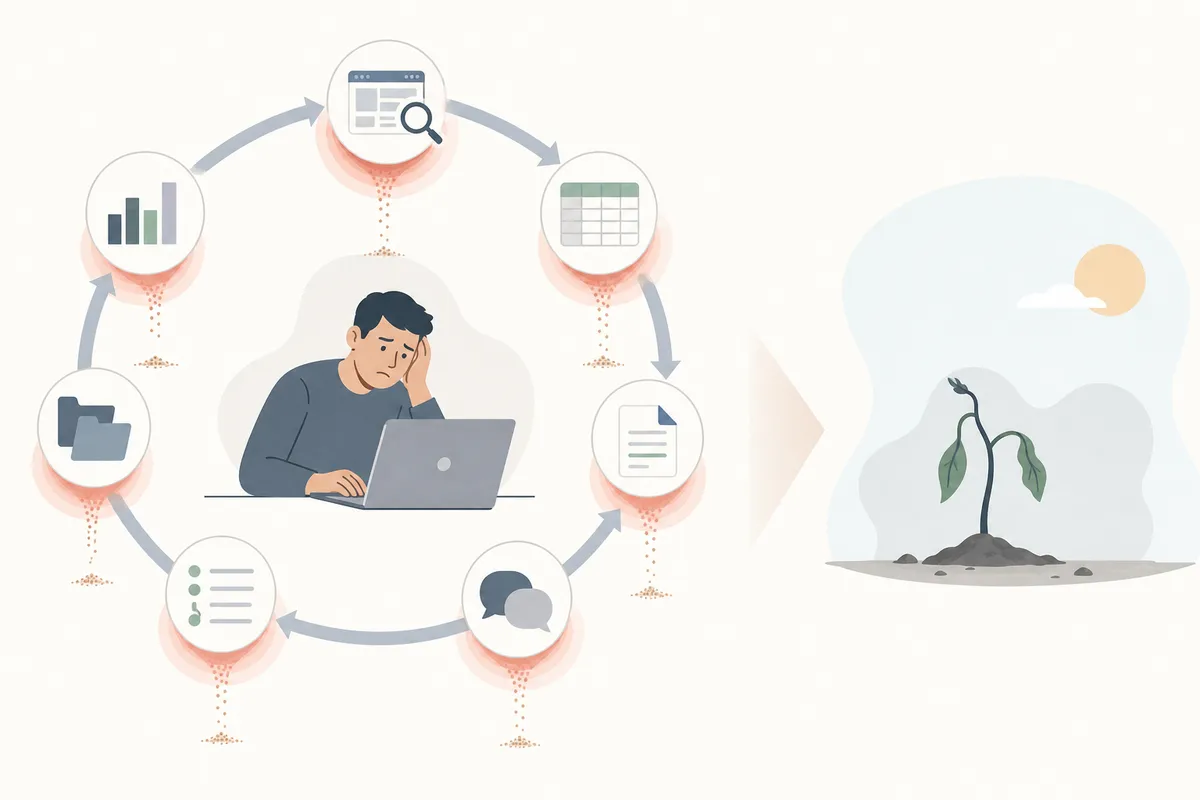
An SEO workflow is the repeating loop that turns research into published, measurable changes on your website: find opportunities, plan pages, produce content, fix technical issues, earn authority, measure results, and start again. That is the whole definition. Everything else is detail.
The loop rarely breaks inside a stage. Your researcher is good at research. Your writer writes well. It breaks between stages, at the handoffs. A keyword list waits three weeks for a content plan. A finished draft waits on an approval that never comes. An audit names forty issues and assigns none of them. Each handoff leaks a little momentum, and the leaks compound.
That is why teams can work hard on SEO for a year and see nothing move. The individual tasks were done. The loop never closed.

7 signs your SEO workflow is killing your growth
Read these against your last quarter. Two or three matches means friction. Five or more means the workflow itself is the growth problem.
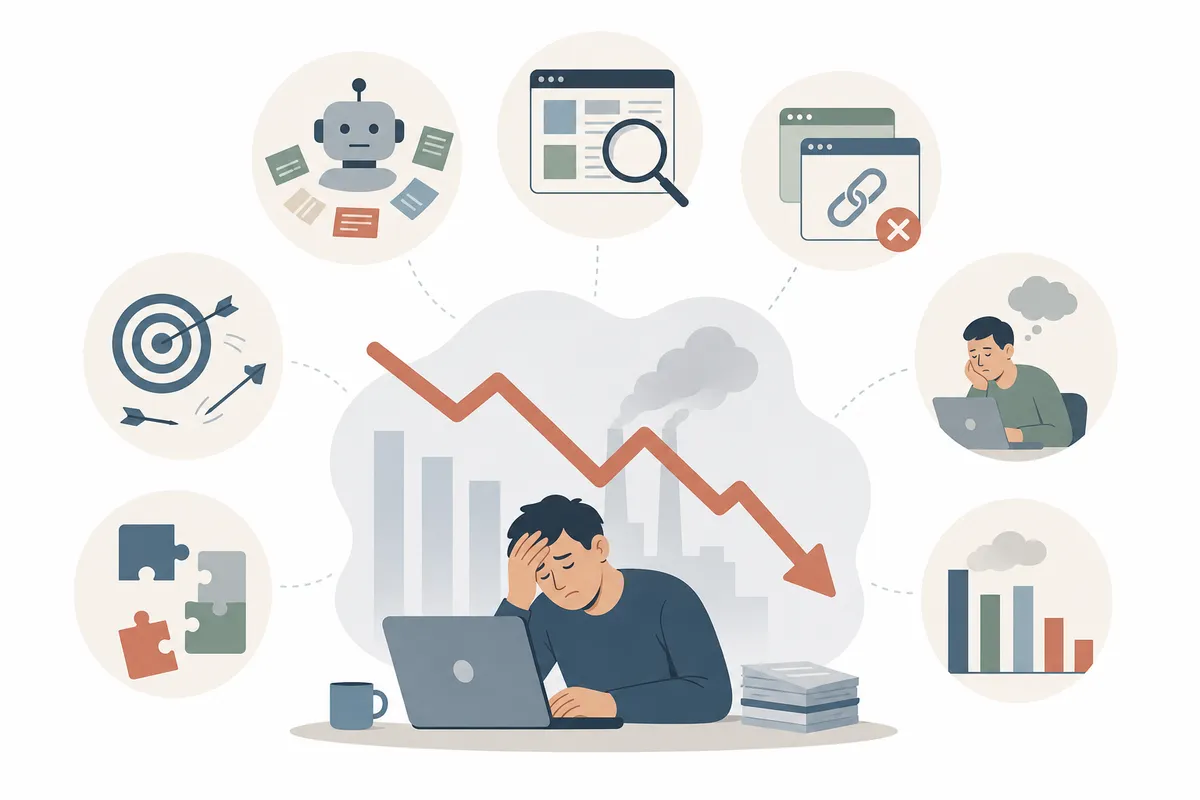
1. Keyword research that never becomes a page
The clearest symptom is a spreadsheet graveyard. Someone ran the research, scored the keywords, and mapped the intent. Then the tab was closed. If your keyword lists outnumber your published pages by ten to one, the research stage is a hobby, not a workflow stage. Research only counts when it exits as a brief with a deadline.
2. Every decision waits on one person
One founder approves every title. One partner reviews every post. The bottleneck is usually senior, busy, and well meaning, which makes it hard to name. Law firms feel this hardest, because partners bill by the hour and review queues stretch for weeks; the playbook that fills a law firm's caseload works partly because it moves approval to a checklist instead of a person. If your pipeline stops every time one calendar fills up, you have a single point of failure, not a workflow.
3. You report activity, not outcomes
"Published 4 posts, fixed 12 meta tags, sent the monthly report" describes effort. It says nothing about growth. Outcome metrics are rankings gained, pages entering the top ten, organic sessions, and leads or revenue from organic. If your reports would read the same in a month where traffic doubled and a month where it halved, they are measuring the wrong thing.
4. Audits keep finding the same issues
Run an audit twice, six months apart, and compare. If the second one repeats the first, your workflow produces findings but not fixes. An audit is an input to a queue, not a deliverable. A finding without an owner and a date is a finding you will pay to rediscover next quarter.
5. Content sits in review for weeks
A draft loses value while it waits. The SERP moves, a competitor publishes, the seasonal window closes. When the gap between "written" and "live" is measured in weeks, you are funding content your audience meets late or never. Review should be a gate a draft passes through in days, with clear pass criteria, not an open-ended queue.
6. Reporting eats the days meant for fixing
If assembling the monthly report takes longer than acting on it, the ratio is inverted. Reporting exists to direct next month's work. When it becomes the work, you get a beautifully documented plateau. The report should be generated, and the human hours should go to the fixes it points at.
7. Recommendations have no owner and no deadline
"We should improve internal linking" is not a task. "Add links from these five pages to the pricing page by Friday, owner: Dana" is. Workflows die in the gap between those two sentences. Every recommendation that leaves a meeting without a name and a date attached has already been declined; nobody said so out loud.
Where the manual loop loses the most time
Manual SEO work fails in predictable places. The table below maps each stage of the loop to its usual failure point, so you can find yours instead of guessing.
| Stage | What the manual version looks like | Where growth stalls | What a working loop does |
|---|---|---|---|
| Keyword research | Hours exporting and deduplicating lists in spreadsheets | Lists go stale before anyone acts on them | Research flows straight into a page-mapped plan with owners |
| Planning and mapping | Keywords assigned to pages by memory and guesswork | Two pages chase one term and neither ranks | Each keyword maps to exactly one page, checked against the crawl |
| Content production | Drafts pass through email threads and versioned documents | Weeks between brief and published URL | Drafting and quality checks run on a schedule, review is a fast gate |
| Technical fixes | Audit findings live in a PDF nobody reopens | The same issues resurface in every audit | Findings become tickets with owners, and re-audits verify the fix shipped |
| Authority and links | Ad hoc outreach when someone remembers | Long quiet stretches, then bursts with no compounding | A steady, small weekly quota that compounds |
| Reporting | Screenshots pasted into slides every month | Reporting consumes the time meant for fixing | Reports generate themselves and point at next week's queue |
Two patterns run through every row. First, information gets trapped in a format nobody works from, such as a PDF or a slide deck. Second, no stage hands its output to the next stage automatically, so a person has to remember to carry it across. Fix those two patterns and most of the table fixes itself.
Is it your strategy or your workflow?
These two problems look identical from a traffic chart, and they have opposite cures. Diagnose before you rebuild.
The difference in one sentence each
A strategy problem means you are shipping the wrong things: chasing keywords you cannot win, building pages for searches with no buyers behind them, or spreading effort across tactics that do not fit your business model. A workflow problem means the plan is sound and almost none of it ships. Reviewing the main types of SEO strategy that scale is the fastest way to check the first half; if your plan holds up against those and traffic is still flat, the workflow is your suspect.
The weekly shipping test
Count the SEO changes that actually went live on your site in the last four weeks. Published pages, updated pages, fixed redirects, corrected titles, new internal links. Anything a crawler could see. If the count is near zero while your backlog is full, you have your answer, and it is not the strategy. A healthy loop ships something every single week, even in a quiet month.

How to fix an SEO workflow that holds growth back
Rebuild in stages, in this order. Each step makes the next one easier, and none of them requires pausing the work you already do.
Put the whole loop in one place
Pick a single system of record where research, the content plan, audit findings, and results all live together. The format matters less than the singularity. When the keyword plan lives in one tool, the audit in a PDF, and the calendar in someone's head, every handoff requires a human courier, and couriers forget. One place, visible to everyone, with a status on every item.
Automate the repeatable stages
Rank tracking, crawling, technical audits, report assembly, and first-draft research are the same procedure every time. Machines should run them on a schedule so people never have to remember to. One caution here: automation means automating the loop, not mass-producing pages. Google's spam policies explicitly cover scaled content abuse, meaning large volumes of pages created primarily to manipulate rankings rather than help users, and the policy applies however the pages were made (Google Search Essentials). Automate the plumbing. Keep the publishing bar high.
Decide what stays human
The split is not "automate everything" or "trust nothing." It is a job-by-job call, and getting it backwards is expensive in both directions.
| Task | Best owner | Why | Risk if you flip it |
|---|---|---|---|
| Rank tracking and crawls | Machine, on a schedule | Same procedure every run, humans forget or skip weeks | People burn hours on checks a script does in minutes |
| Audit finding detection | Machine first, human triage | Detection is mechanical, prioritization needs business context | Untriaged findings pile up and the queue loses credibility |
| Keyword-to-page mapping | Machine draft, human confirms | Mapping follows rules, but only you know your margins and priorities | Pages get built for terms that cannot pay for themselves |
| Content drafting | Machine draft, human edit | Drafting is fast to automate, judgment and voice are not | Unedited output risks the scaled-content line and reads generic |
| Strategy and prioritization | Human | Requires knowledge of your customers, margins, and capacity | Automation optimizes for volume instead of revenue |
| Report assembly | Machine | Assembly is copying numbers, insight is reading them | Analysts spend the month formatting instead of deciding |
Verify that what shipped is actually live
A successful save is not a successful publish. Pages get committed to a CMS and never render, redirects get configured and never fire, fixes get marked done against a page that still fails. Close every task by checking the live URL, not the tool that claims to have changed it, and confirm Google can fetch the page with the URL Inspection tool in Search Console. This one habit removes the most demoralizing failure in SEO: months of "completed" work that Google never saw.
Work in fixed cycles and hold the cadence
Open-ended SEO work expands to fill whatever time it is given. Fixed cycles force output. Set a 90-day horizon for the big rocks and a weekly rhythm for shipping; ecommerce teams can lift the structure directly from a 90-day technical SEO plan built for stores and adapt the contents to their own stack. Weekly rank checks close the loop, because a cadence you measure is a cadence you keep. We ran this exact loop on our own site and grew organic traffic 347 percent, and the honest version of that story is that the loop mattered more than any single tactic inside it.
AI search punishes a slow workflow twice
Traditional search was forgiving of slowness. A page could climb for months and hold a position while you moved on. AI-driven search is not built that way. Google's AI Overviews, ChatGPT, and Perplexity assemble answers from pages that respond directly, carry clear structure, and stay current (Google Search Central), so a workflow that takes six weeks to ship an update now costs you twice: the ranking and the citation.
The mechanics favor teams that ship continuously. Answer engines quote self-contained passages, which means updated pages get re-read and re-cited while stale ones fall out of answers. Product and category pages feel this fastest, and getting your products cited by AI search instead of skipped is largely a workflow problem dressed up as a technology problem: structured data kept accurate, availability and pricing kept current, questions answered on the page the moment they start appearing in search. None of that is hard. All of it depends on a loop that ships weekly.
FAQs
What is an SEO workflow?
An SEO workflow is the repeating process that turns research into live changes on your website: find keyword opportunities, plan pages, produce content, fix technical issues, build authority, measure results, and repeat. The defining feature of a good one is that each stage hands its output to the next stage without a person having to remember.
How do I know if the problem is my workflow and not my strategy?
Count the SEO changes that went live on your site in the last four weeks. If the count is near zero while your research and plans are solid, the workflow is the problem. If you are shipping steadily and traffic still does not move, question the strategy: the keywords you chose, the pages you built, and the intent behind them.
Should I automate my entire SEO workflow?
No. Automate the repeatable stages: rank tracking, crawls, audits, report assembly, and first drafts. Keep humans on strategy, prioritization, and editing. Google's spam policies target scaled content abuse, so pages mass-produced without human judgment carry real risk, while automating the plumbing around human decisions carries almost none.
How often should an SEO workflow produce published changes?
Weekly. The changes can be small: an updated page, a fixed redirect, new internal links, a corrected title. The cadence matters more than the size, because weekly shipping keeps every stage of the loop moving and gives you a fresh signal to measure against.
Can a small team run a real SEO workflow?
Yes. A small team runs the same loop with fewer items in it: one page shipped a week, one audit a quarter, rank checks on a schedule. Tools carry the mechanical stages, so the human hours go to the judgment calls. A two-person loop that closes every week beats a ten-person process that never ships.
Count what you shipped this week
Open your site's change history and count the SEO changes that went live in the last seven days. If the answer is close to zero, your SEO workflow is killing your growth, and it can be rebuilt one stage at a time starting with that number. Talk to the team and walk through a sample SEO report to see exactly what a working loop should hand you every week.
Resources / References
About the author
SearchBlueprint researched, wrote and scored this article with the content pipeline our customers run on their own sites. The score in the byline is what our content engine gave this page before it published. Nothing here is reviewed by hand, which is the point: it is the product's output, published where anyone can check it.